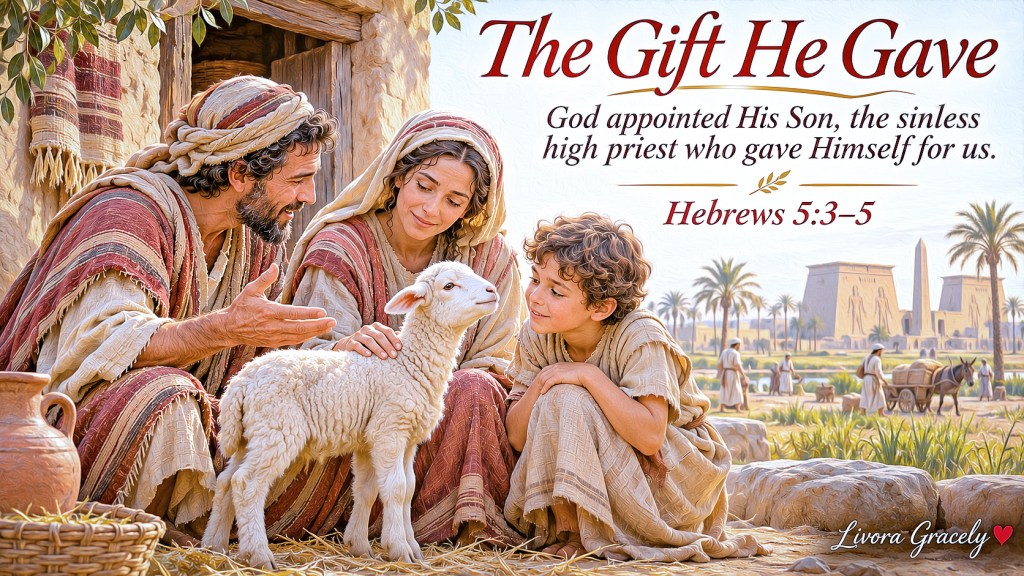
Hebrews 5:3–5
God appointed His Son, the sinless high priest who gave Himself for us.
The lamb was kept until the appointed day.
In Egypt, Israelite households prepared for a night they would remember for generations. They were to choose an animal without defect and keep it until the fourteenth day of the month. The Lord would lead His people out of slavery, and the Passover would become a lasting remembrance of His deliverance.¹
The story was not to end with those who saw that night. When their children asked about the observance, the people were to tell them what the Lord had done.¹
Centuries later, Paul wrote that Christ, our Passover lamb, had been sacrificed.² The memory of deliverance helps us hear the good news of Christ, even as the New Testament unfolds the meaning of His death in its own words.
Hebrews now leads us to another part of Israel’s worship: the service of the high priest. It asks us to consider both the priest who brought a sacrifice and the Son whom God appointed.
A Priest Who Needed Mercy
The high priest served on behalf of the people in matters related to God. He offered gifts and sacrifices for sins, and he could deal gently with those who went astray because he himself was subject to weakness.³
That weakness had a consequence: he had to offer sacrifices for his own sins as well as for the sins of the people.³
On the Day of Atonement, Aaron brought a sacrifice for himself and his household before making atonement for the people.⁴ He stood among those who needed mercy, even as he carried out his appointed service.
His calling was an honour, but it was not something he could take for himself. God called Aaron to serve. In the same way, Hebrews says, Christ did not take the glory of becoming high priest upon Himself. God appointed the Son.³
The Son Appointed by God
Hebrews reminds its readers of the words God spoke about His Son. It then reaches to another psalm: the Son is a priest forever in the order of Melchizedek.⁵
Jesus did not belong to the line of Levi from which Israel’s priests came. The letter will explain more about His priesthood in the chapters ahead. For now, we are given its foundation: His calling came from God.
The Son appointed by God also shared our humanity. He knew suffering and temptation, yet He did not sin.⁶
Here lies a difference. Aaron needed to bring a sacrifice for his own sins. Jesus, our holy and blameless high priest, had no sin of His own for which to offer one. Hebrews says that He offered Himself once for all.⁷
The Priest and the Offering
How can Jesus be both the priest and the offering?
Hebrews will return to this as it continues its story. As high priest, Jesus acts on behalf of His people before God. As the offering, He gave Himself. The letter says that Christ offered Himself without blemish to God, so that our consciences may be cleansed to serve the living God.⁸
His sacrifice was not a gift He needed to bring for His own forgiveness. It was His self-giving for others.
Peter also speaks of the cost of redemption: the precious blood of Christ, like that of a lamb without blemish or defect.⁹ His words echo the image of a spotless lamb. Paul calls Christ our Passover lamb.² These images lead us to remember Jesus and what He has done.
Passover and the Day of Atonement each have their own place in Israel’s story. The Passover recalls God’s deliverance from Egypt. The Day of Atonement included sacrifices for the sins of the priest and the people.¹ ⁴ The New Testament uses these different pictures to help us understand Christ; we do not need to make them identical.
Remembering What He Has Done
The children of Israel were to hear again why their families kept the Passover.¹ Remembering carried the story of God’s deliverance from one generation to the next.
Paul also passed on what he had received about the Lord’s Supper. Jesus gave bread and the cup to His disciples and told them to remember Him. Whenever the community eats the bread and drinks the cup, Paul says, it proclaims the Lord’s death until He comes.¹⁰
At the table, believers remember the gift Christ gave. Their hope does not rest on bringing a sacrifice of their own to complete His work. They receive what He has done and are called to live as people who belong to Him.
Israel’s journey did not end on the night they left Egypt. God led His people through the wilderness, where He provided food and water, even as they faced hardship along the way.¹¹ Hebrews also speaks to people on a journey, urging them to hold firmly to their hope and continue toward God’s promised rest.¹²
We, too, remember as we travel. The road may be uncertain, and our strength may fail. But the One who gave Himself is not a priest who needs another to take His place. He lives, and He is able to save those who come to God through Him.⁷
The high priest once brought a sacrifice for himself and for the people. Jesus, the sinless Son appointed by God, gave Himself for others.
So we remember His gift, come to God through Him, and continue the journey as His people.
Scripture References
- Exodus 12:3–6, 24–27.
- 1 Corinthians 5:7.
- Hebrews 5:1–5 — verses 3–5 are the main passage.
- Leviticus 16:6, 15–17.
- Hebrews 5:5–6; Psalm 2:7; 110:4.
- Hebrews 2:14–18; 4:15.
- Hebrews 7:23–27.
- Hebrews 9:11–14.
- 1 Peter 1:18–19.
- 1 Corinthians 11:23–26.
- Exodus 16:11–18; 17:1–7.
- Hebrews 3:12–14; 4:1–11.


Leave a Reply