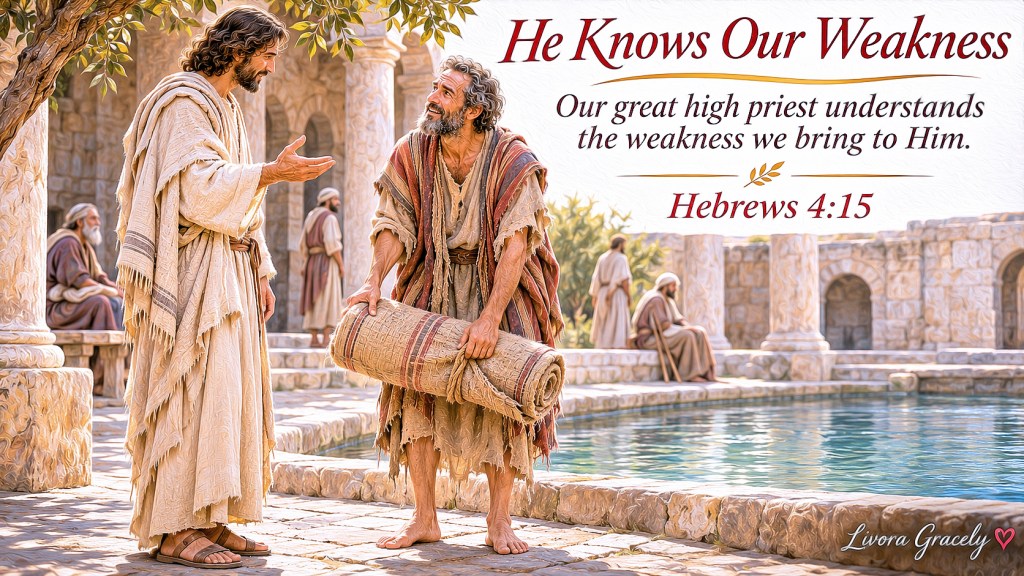
Hebrews 4:15
Our great high priest understands the weakness we bring to Him.
Beside a pool in Jerusalem stood five covered colonnades. Beneath them lay people who were sick, blind, or unable to walk.¹
Among them was a man who had been ill for thirty-eight years.
Jesus saw him lying there and learned that he had been in this condition for a long time. Then He asked a question: “Do you want to get well?”
The man spoke of the water and of his difficulty reaching it. He had no one to help him into the pool, he said, and while he was trying to get in, someone else went down ahead of him.¹
Jesus told him to get up, take his mat, and walk. At once, the man was made well.
John tells us that the man had been ill for thirty-eight years; he does not say how long he had waited beside the pool.¹ But his answer lets us hear something of his helplessness. And in that place, Jesus saw him and spoke to him.
The story at Bethesda does not tell us how every illness will end. It does, however, invite us to look at the One who approached a person in need.
Hebrews asks us to look at Him too.
The High Priest Who Understands
In the previous verse, Hebrews called Jesus our great high priest and urged us to hold firmly to the faith we profess. Then it gives us a reason to trust Him: He is able to sympathise with our weaknesses.²
This high priest is Jesus, the Son of God, who has passed through the heavens. Yet His place in heaven does not mean He is unfamiliar with life on earth.
Earlier, Hebrews said that He shared in flesh and blood. He became like His brothers and sisters and suffered when He was tempted. Because of this, He is able to help those who are being tempted.³
He knows what it is to live a human life in a world marked by hunger, sorrow, opposition, and death.
At Bethesda, Jesus saw a man whose body had failed him for a long time. In Hebrews, we meet the same Jesus as the high priest who understands human weakness. The letter does not ask us to believe that our need is too small, too complicated, or too old to bring before Him.
Tested in the Wilderness
After His baptism, Jesus was led by the Spirit into the wilderness. He fasted for forty days and forty nights, and afterward He was hungry.⁴
The Gospel does not ask us to imagine hunger as an idea. It tells us that Jesus experienced it.
Then the tempter came. The first challenge concerned bread: if Jesus was the Son of God, why not turn stones into food? Jesus answered with the words of Scripture, declaring that people live by every word that comes from God.⁴
Other temptations followed. Jesus faced them and refused to turn from the Father’s will.
Hebrews says that He was tempted in every way, just as we are, yet He did not sin.² This does not require us to imagine that He encountered every situation exactly as we do. It asks us to take seriously both His testing and His faithfulness.
The pressure was real. His obedience was real too.
Long before, Job had known the weight of devastating loss and illness. In his story, the accuser questioned whether Job would remain faithful when what he possessed was taken away.⁵ Job’s suffering reminds us that testing can reach into the deepest places of a human life.
His story is not a measure by which we must rank anyone’s pain. Nor does it mean that every illness has the same cause as his. It helps us recognise that suffering can bring difficult questions—and that those questions are not strange to Scripture.
Yet Without Sin
There is a difference between being tempted and giving in to temptation.
Hebrews holds both truths together: Jesus was tested as we are, and He remained without sin.² We do not honour His faithfulness by pretending that the testing meant nothing. Neither do we need to suggest that He sinned in order to say that He understands us.
But someone may ask: “What if I have already given in? Jesus never sinned. Can He understand a person who carries guilt and shame?”
Jesus did not commit a sin of His own. Scripture does not ask us to imagine otherwise. It tells us that He shared our humanity, suffered under testing, and is a merciful and faithful high priest.³
Peter writes that Christ committed no sin, yet suffered and bore our sins in His body on the cross.⁶ His words recall Isaiah’s picture of the suffering servant, who was regarded as afflicted but was wounded for the transgressions of others.⁷
The sinless One did not turn away from a world of sinners. He gave Himself for them.
And when a person has sinned, the New Testament directs that person toward Jesus Christ, the righteous One, who speaks to the Father in our defence.⁸ His sinlessness is not a reason for the ashamed to stay away. He is the One to whom they may turn.
Help for the Weak
The man beside the pool spoke of what he could not do. Jesus listened and answered him.
Our own needs may be different. Some are visible; others are carried quietly. We may be resisting a temptation, living with an illness, grieving a loss, or trying to find words after a failure.
The healing at Bethesda is not a promise that every person will be healed immediately. Hebrews does give us an assurance for every moment of need: we do not have a high priest who is unable to understand our weaknesses.
He knows human testing. He remained without sin. And He is able to help those who are tempted.² ³
In the next verse, the letter will invite us to approach God’s throne of grace for mercy and help.⁹ Before we reach that invitation, Hebrews lets us see the heart of the One who makes it possible.
Jesus, our great high priest, knows our weakness.
We can come to Him.
Scripture References
- John 5:1–9.
- Hebrews 4:14–15 — verse 15 is the main verse.
- Hebrews 2:14–18.
- Matthew 4:1–11.
- Job 1:6–22; 2:1–10.
- 1 Peter 2:22–24.
- Isaiah 53:4–6.
- 1 John 2:1–2.
- Hebrews 4:16.


Leave a Reply