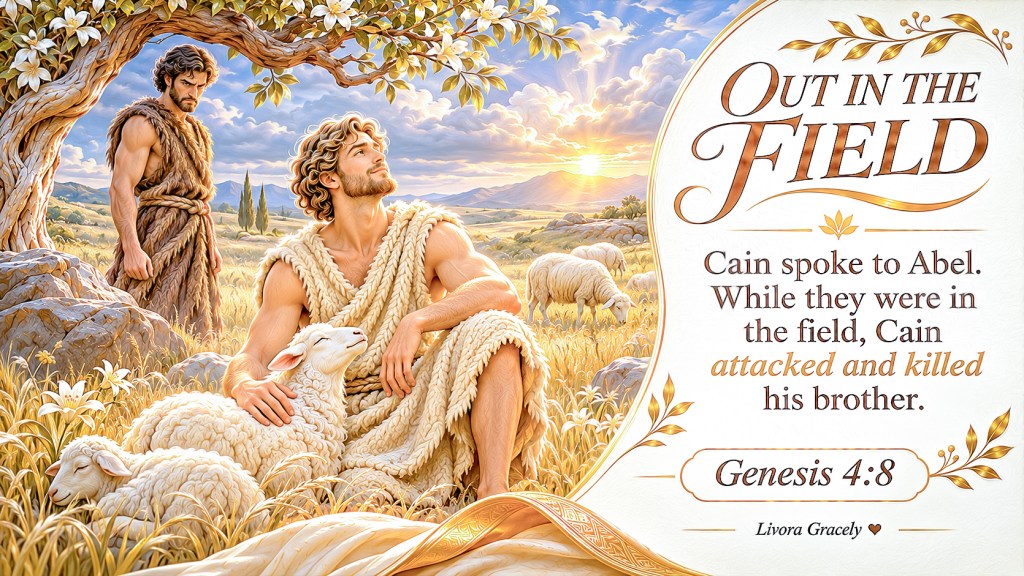
Cain spoke to Abel. While they were in the field, Cain attacked and killed his brother.
Together in the Field
The brothers who knew the ground and the flock are together in a field. By the end of the verse, Abel is dead.
Genesis has introduced them through their family and their work. Cain worked the soil; Abel kept flocks. Both brought offerings to the Lord. When the Lord did not look with favour on Cain and his offering, Cain became very angry, and his face was downcast.
Before the brothers meet in the field, God speaks to Cain. He asks about his anger and warns him that sin is crouching at his door. Cain must rule over it.
Then the story moves forward. Cain speaks to his brother Abel. While they are in the field, Cain attacks him and kills him.
Words on the Way
The account is brief. Some English translations include Cain’s invitation to go out to the field. Their notes explain that these words appear in several ancient versions but are absent from the Masoretic Hebrew text. The poster says simply that Cain spoke to Abel; either way, the brothers are in the field when the attack takes place.
Genesis does not tell us what Abel thought as the two came together. It does not describe the weapon Cain used or give us the details of the attack. We can stay with what the verse says, allowing its few words to carry their weight.
The man who acts is the same Cain to whom God had spoken. The man who dies is Abel, his brother. Their names have stood beside each other since the beginning of the chapter. Now the story tells us of a loss that cannot be undone.
His Brother Abel
It would be easy to follow only Cain: his offering, his anger, the warning he received. But Abel is more than a figure in Cain’s story.
Genesis tells us that he was Eve’s son and Cain’s brother, a keeper of flocks who brought an offering to the Lord. Later, the letter to the Hebrews remembers Abel’s faith. These details give us a glimpse of the person whose life is taken in the field. The account does not give him a spoken line, but it names him and remembers his offering. His death leaves an absence in the family introduced at the beginning of the chapter.
We may wish the brothers had spoken differently, or that Cain had sought help with his anger. Those are questions we bring to the story; Genesis does not record such a conversation. Its warning before the field reminds us that anger did not have to become an attack. Cain’s action has ended Abel’s life.
After the Field
In the next verse, the Lord asks Cain where his brother Abel is. The question will lead the story towards Cain’s answer and the words God speaks about Abel’s blood crying out from the ground.
For now, we can pause at the field. A place that might have held ordinary work has become the setting of a brother’s death. The passage gives no long description of the moment, but it names the loss plainly.
Cain attacked his brother. Abel would not walk home.
Livora Gracely ♥
Sources


Leave a Reply