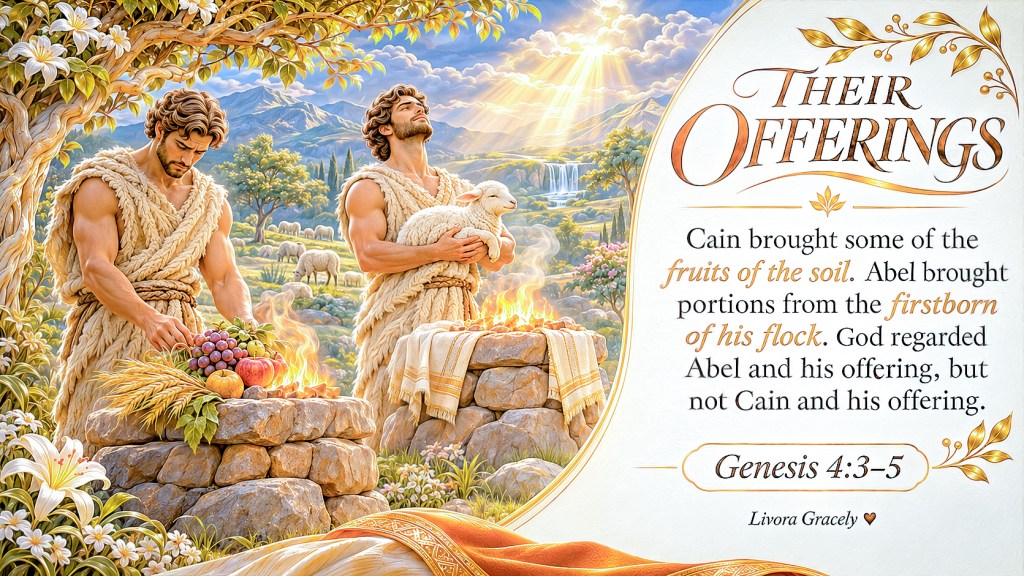
Cain brought some of the fruits of the soil. Abel brought portions from the firstborn of his flock. God regarded Abel and his offering, but not Cain and his offering.
Something to Bring
A gift may begin long before it is placed in someone’s hands. There can be thought in the choosing, anticipation in the carrying, and hope as it is offered.
In Genesis, two brothers bring offerings to the Lord. Cain works the ground; Abel keeps flocks. Each brings something connected with his work, and the account invites us to pay attention to what follows.
We are not told what the brothers said to each other as they prepared their offerings, or exactly what each was feeling. The story gives us a few carefully chosen details. Before we try to fill the silence, it is worth listening to them.
From Soil and Flock
In the course of time, Cain brings some of the fruits of the soil as an offering to the Lord. Abel also brings an offering: fat portions from some of the firstborn of his flock.
The account describes Abel’s offering as coming from the firstborn and mentions the fat portions. It describes Cain’s as fruits of the soil. It does not say that Cain’s produce was spoiled, nor does it tell us which plants he brought.
The poster shows fruit and grain beside a lamb. The colours and arrangement help us picture the brothers’ different work; they are an artist’s illustration. Genesis does not describe the altars or tell us how either offering was presented.
Then comes the response that changes the direction of the story. The Lord regards Abel and his offering, but does not regard Cain and his offering.
Two Offerings, Different Responses
Why the difference? Genesis does not give a complete explanation in these verses. It tells us that the Lord looked with favour on Abel and his offering, while Cain and his offering did not receive the same regard.
The letter to the Hebrews later remembers Abel as someone who offered by faith. That gives Christian readers another part of the biblical witness to consider, while the account in Genesis leaves some questions unanswered.
We should also be careful not to decide that produce from the ground is unacceptable simply because it is not an animal. Elsewhere, in a later setting, the book of Leviticus describes grain offerings. Those instructions do not explain everything about Cain’s offering, but they remind us that the Bible includes gifts from the soil as well.
What we offer can invite us to consider the faith and care with which we give. Yet we cannot see into Cain’s thoughts beyond what the story tells us. It is the Lord’s response, and Cain’s reaction to it, that the passage now places before us.
A Face Fallen
Cain becomes very angry, and his face is downcast.
The two brothers have brought their offerings. Genesis has named both the givers and their gifts; now it lets us see Cain’s distress. The story does not end at the moment of disappointment. In the verses that follow, the Lord will speak to Cain about his anger and the choice before him.
For now, there is a pause between the offering and the next words. The gift has been brought. The giver has not gone unnoticed.
Livora Gracely ♥
Sources


Leave a Reply