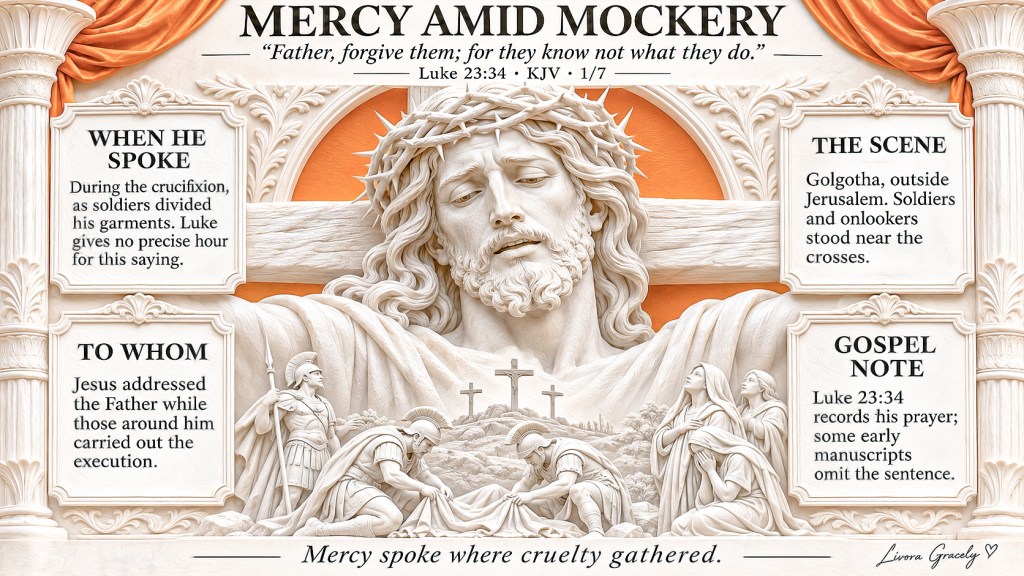
Mercy spoke where cruelty gathered.
A Prayer at the Cross
In Luke’s account, Jesus is crucified between two others at the place called Calvary. The scene is marked by suffering, public humiliation, and people watching what is done.
There, the King James Version records a prayer: “Father, forgive them; for they know not what they do.”
The words are addressed to the Father. They ask for forgiveness for others while the one who prays is being put to death. Luke then describes the dividing of Jesus’ garments by lot, followed by the mockery of rulers and soldiers.
The prayer does not make the cruelty disappear from the page. It stands within it, asking the reader to notice a response that does not echo the voices of contempt around the cross.
Words Addressed to the Father
Luke does not give a list of everyone included in the word “them.” The prayer appears amid the account of the crucifixion, and readers have understood it in relation to those involved in what was happening. Its wording leaves us with a petition rather than a catalogue of names.
Nor does the prayer say that the act of crucifixion was harmless. Forgiveness is asked in the presence of a terrible wrong. In Christian reflection, this moment has often been read alongside Jesus’ teaching to love enemies and pray for those who mistreat them.
That connection does not require us to imagine that forgiveness is easy, or to ask a person who has been harmed to pretend otherwise. The words in Luke are a prayer for mercy, spoken in a scene where harm is plainly visible.
Amid the Mockery
The people stand watching. The rulers deride Jesus, and the soldiers mock him. Their words, as Luke reports them, challenge him to save himself.
Set beside that challenge, the prayer directs attention elsewhere: towards the Father, and towards the people for whom forgiveness is requested. The account does not supply their private thoughts or tell us how each listener responded to the prayer.
There is also a detail about the text itself. The sentence containing this prayer is absent from some early manuscripts of Luke and present in others. Scholars discuss its textual history; the King James Version includes it, as do many Christian readings and traditions.
That note helps us read carefully. It does not change the fact that these words have shaped centuries of prayer and reflection for Christians who have received them as part of Luke’s account.
Mercy in the Telling
The seven sayings traditionally gathered from the cross come from different Gospel accounts; Luke’s prayer is often placed first among them. No single Gospel gives all seven as one numbered list.
Here, the prayer’s direction remains clear. Jesus speaks to the Father, asking forgiveness for others. Around that request, Luke’s narrative continues to show mockery and suffering.
For Christian readers, mercy is not presented as an excuse for cruelty. It is a prayer offered where cruelty has gathered, leaving the wrong visible and placing the request for forgiveness before God.
The voices of mockery fill the scene. The prayer asks us to listen for another voice, too.
Livora Gracely ♥
Sources: Luke 23:33–38, King James Version; Luke 6:27–28, King James Version; Tyndale House: The Variant in Luke 23:34a; Bible Gateway: Seven Words from the Cross.


Leave a Reply