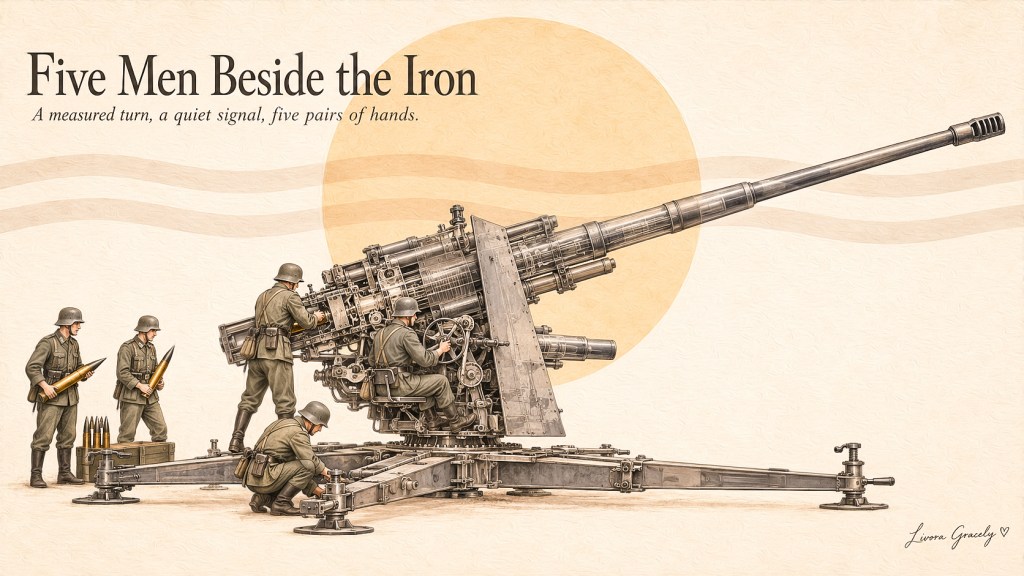
A measured turn, a quiet signal, five pairs of hands.
The first man said he had seen no train.
The second remembered fog.
In a letter written before either account, the third described a clear morning and complained that his socks were still wet.
Mara laid the three pages beside Ruth Rowan’s photograph. Five men stood around the gun. The museum archivist had found their papers through the unit reference on the back.
There was no room beneath the picture for all the versions of that morning.
Five Positions
Two men waited beside the ammunition boxes. One sat at a wheel. Another stood behind the shield. The fifth crouched near the base, below the others’ shoulders.
Mara marked their places on a sheet of tracing paper laid over a copy of the photograph.
The seated man’s view of the railway was blocked by iron. The man beside the boxes had been facing the other way. Only the crouching soldier described the bend beyond the embankment.
Mara moved his letter beside that corner of the picture.
Then she crossed out the sentence she had begun: The crew watched the train approach.
The Morning They Shared
There was wet earth under their boots and cold metal beneath their fingers.
The order was clear: the approaching train was not to be allowed through.
The younger of the two men beside the boxes kept looking at his watch. When a shouted order reached the position, he lifted what he was carrying and looked toward the man behind the shield.
The seated man made a measured turn of the wheel.
Below him, the crouching soldier looked through the gap beside the base. From there, he could see movement beyond the embankment.
He raised one hand.
The man behind the shield looked down at him.
Then he held up his own palm.
Wait.
The younger soldier shifted the weight in his arms.
“Shall I put this down?”
No answer came at first. He asked again.
This time, the standing man nodded.
The younger soldier lowered it beside the boxes. His companion stepped back with him.
The train reached the bend.
In his later account, the seated man said he waited because he could not see what the others were seeing.
The crouching soldier wrote that he kept his hand raised until the last carriage had passed.
What Each Man Knew
Mara read the account from the man behind the shield last.
He acknowledged delaying the order. He gave no reason in his official statement.
A private letter among his papers described a visitor the previous afternoon: a woman who had asked to speak to him alone.
One of the men beside the boxes remembered her too. He had shown her where to wait.
The younger soldier’s first letter home mentioned neither woman nor passengers.
I thought something had gone wrong. I was frightened to ask.
Years later, he claimed he had known exactly who was aboard.
Mara placed the two accounts together.
The man who said he had seen no train had heard it. He wrote that he had kept his eyes on the others, waiting for someone to tell him what to do.
The crouching soldier’s letter was shorter.
I could see the carriages. He could not. I put my hand up.
Mara returned to the photograph. The shield that had blocked one man’s view was barely noticeable beneath the gun’s long barrel.
She left the weather unresolved.
Beside the delay, she wrote down who had described it, and when.
The Small Bag
In the last testimony, the woman’s visit occupied three sentences.
She had worn gloves. She had placed a small handbag on the table. The witness had been sent outside before the conversation began.
Mara brought out the photograph from the blue car.
Gloves again.
She held the pictures beside each other, then put them down. The testimony supplied no name.
In a later statement, the same witness had identified the handbag in the museum’s collection. His signed identification was filed with its accession record.
Mara asked for the inventory.
A small handbag appeared under accession number 47.6. Its contents were listed on a separate sheet.
She followed the number across.
Handkerchief. Tickets. Papers.
Then a silver pocket pistol.
Mara checked the number against the museum’s exhibition list.
The pistol was the final object waiting for her catalogue entry.


Leave a Reply