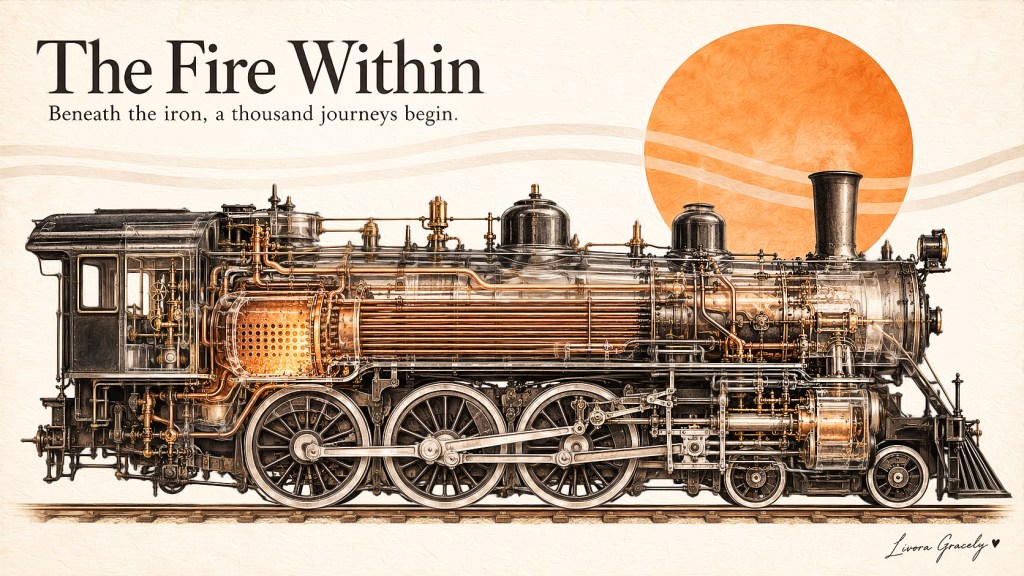
Beneath the iron, a thousand journeys begin.
The journey book had a line for every departure that morning.
None matched the night Ruth Rowan remembered.
She ran a finger down the dates without touching the faded ink. Beside her elbow, a spoon tapped the rim of an enamel cup.
“He came home before daylight,” she said. “I was awake.”
Mara looked beyond the records table at the locomotive under restoration. Its iron body stood above the rails, with a section removed to expose the long tubes within.
She had come prepared to write about those.
Before Morning
Ruth had recognised Elias’s handwriting on the envelope. She had set it beside her cup while fetching her father’s journey book.
Now the wartime volume lay open between them. A dry smell of soot rose as Ruth turned a page.
“Thomas Rowan was your father?”
Ruth nodded.
“I heard him at the back door. He couldn’t manage the latch. My mother had to let him in.”
“Was he hurt?”
“His hands were burned.”
Ruth moved the spoon out of her cup and laid it on the saucer. It did not quite fit.
“He had no coat. Mother asked where he’d left it.”
“What did he say?”
“That some passengers had to arrive before noon.”
Outside the records office, a restorer carried a length of copper pipe past the window. Ruth watched him cross the yard before looking down again.
“He wouldn’t tell her how many.”
What Came Home
Mara checked the departures once more. The official entries accounted for ordinary work: freight, an empty engine, a delayed arrival. Nothing recorded the journey Ruth described.
“Could he have been carrying something valuable?”
Ruth looked toward a cupboard behind the table.
“He brought something home.”
She took out a shallow box and placed it between them. Inside was a cloth bundle, small enough to fit beside the enamel cup.
Mara moved her notebook to make room.
Ruth unfolded the cloth.
One child’s shoe lay on it.
The leather had drawn inward around the empty opening. A short lace remained threaded through the eyelets, its ends uneven.
“Where’s the other one?” Mara asked.
“He didn’t bring it.”
Mara had reached for her ruler. She put it beside the notebook instead.
“How small was the child?”
Ruth placed her palm beside the shoe without touching it.
“Smaller than I was.”
For a while, neither turned the page.
A Name in Pencil
Ruth opened Elias’s envelope with a paper knife from her drawer.
A folded sheet lay inside, its edges darkened where it had rested against the paper. She spread it on a clear part of the table.
Names filled two narrow columns.
Beside some, someone had made a small pencil mark. Others had none.
Mara moved her chair closer.
“Do you recognise them?”
Ruth read down the first column. At the second, she stopped.
“Lucy Dale.”
She drew the cloth bundle nearer and folded back one corner. A little label had been sewn to its inside.
The same name.
“My mother put that there,” Ruth said. “Father gave her the name when she wrapped it.”
Mara looked from the marked line to the single shoe.
She opened her notebook, but left the space for the locomotive’s dimensions untouched.
“Did Lucy reach the place he was taking her?”
“I don’t know.”
“May I copy the names?”
Ruth nodded, then drew a second chair squarely beside Mara’s.
“Let me read them to you.”
Beside the Line
They checked each name against the sheet before moving to the next. Ruth left the shoe resting on its cloth.
When Mara finished, Ruth brought over a folder of photographs from the same period. Some showed the depot. Others followed the railway beyond the town.
She placed one beside the journey book.
“This is the line he would have used.”
The rails curved past an embankment. Above them stood a long artillery barrel, its shadow falling across the pale ground.
Mara leaned closer.
There were men beside it.
One sat at a wheel. Another stood behind the shield. Two waited farther back, and a fifth crouched near the base.
Mara counted them again.
Then she placed the passenger list beside the photograph.
Five men stood between those names and the road beyond.


Leave a Reply