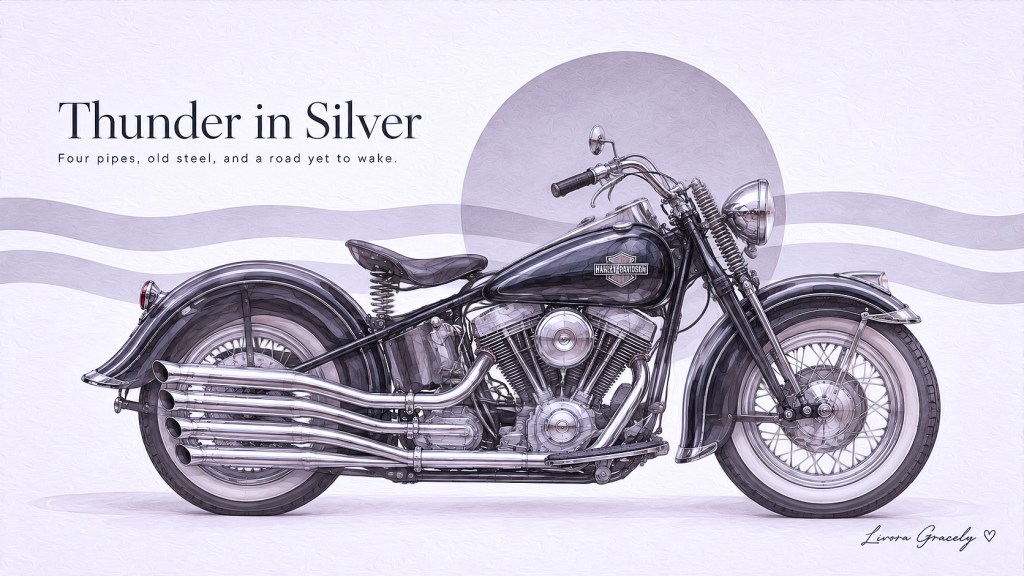
Four pipes, old steel, and a road yet to wake.
Elias had polished three of the Harley’s four silver pipes when Mara showed him the photograph.
His cloth stopped at the fourth.
She waited beside the black fuel tank while he looked at the woman in driving gloves. Then he folded the cloth and began again, rubbing a patch that was already bright.
“You know her,” Mara said.
“Yes.”
“What was her name?”
“That isn’t something I can give you.”
Before Opening Time
The address on the railway ticket had brought her to Bell Lane. Now the ticket lay in its paper sleeve on Elias’s bench, beside the photograph and Mara’s unopened notebook.
He worked the cloth beneath the last pipe.
“She used to come before we opened.”
“For repairs?”
“Sometimes. Sometimes she sat on the step until my father arrived.”
Elias glanced toward the doorway. Morning light fell across the worn stone outside.
“She brought bread. Still warm in the bag. My father would say she needn’t keep feeding us.”
“Did she stop?”
“He kept eating it.”
Mara smiled.
“She paid in cash,” Elias continued. “Counted it out before we asked. If anyone brought a camera, she found something to do around the corner.”
Mara looked at the pale face in the photograph.
“This one survived.”
“So it did.”
“The car belonged to Julian Mercer?”
The cloth stopped again.
For a while, the only sound came from someone sweeping the pavement outside.
Elias laid the cloth across the bench.
Clean Hands
Mara kept her notebook closed.
“I’m writing the exhibition catalogue,” she said. “I don’t want to put something in it that I can’t support.”
Elias looked at the crossed-out name.
Then he took a thick service book from the shelf. He set it on a clear patch of the bench and reached toward its cover.
A dark trace of polish remained on his thumb.
“Would you open that?”
Mara moved the photograph clear and opened the book at the cloth marker. The binding was stiff; when she lifted her hand, the pages began closing again.
“Don’t press it flat,” Elias said.
She drew a small wooden block beneath the raised cover and held the page at its outer edge.
He pulled a stool beside her.
For the first time, they were looking at the same thing.
“Three pages forward,” he said.
Between the Repairs
There were familiar workshop entries: cables, lamps, a repaired saddle. Between them, a smaller sum appeared beside the name Rowan.
Mara turned another page.
The same name. The same amount.
“Another customer?”
“A railwayman. Thomas Rowan.”
“What were you repairing?”
“Nothing.”
She looked from the payment column to Elias.
“That went to his family.”
The entries continued, month after month. A narrow note beside one said that Rowan had died. On the following page, the payments began again. Mara followed them into the next year, then the next.
Mara’s pencil hovered above her notebook.
Elias watched it.
She set it down.
“May I record these?”
He nodded.
“Who paid?” she asked.
“The woman in your photograph brought the money at first.”
“And afterwards?”
Elias looked toward the bright pipes.
“I kept the entries.”
Mara copied the amounts and dates. She left space beneath them instead of writing a reason.
The Letter That Stayed
When she finished, Elias asked her to close the book. She lifted the wooden block away and lowered the cover gently.
He washed his hands at the little sink behind the counter.
Then he unlocked a drawer.
The envelope he brought back had yellowed at its edges. There was an address on the front, but no stamp. Its flap was still sealed.
“I meant to send this.”
Mara waited.
“Rowan’s daughter looks after the records at the old locomotive depot now. She should have it.”
He placed the envelope beside the photograph.
“Will you take it?”
Mara slipped it into a clean document folder, keeping the address visible.
On her exhibition list, the next machine was a locomotive.
She had been going to ask about its engine.
Now she copied the daughter’s name.


Leave a Reply