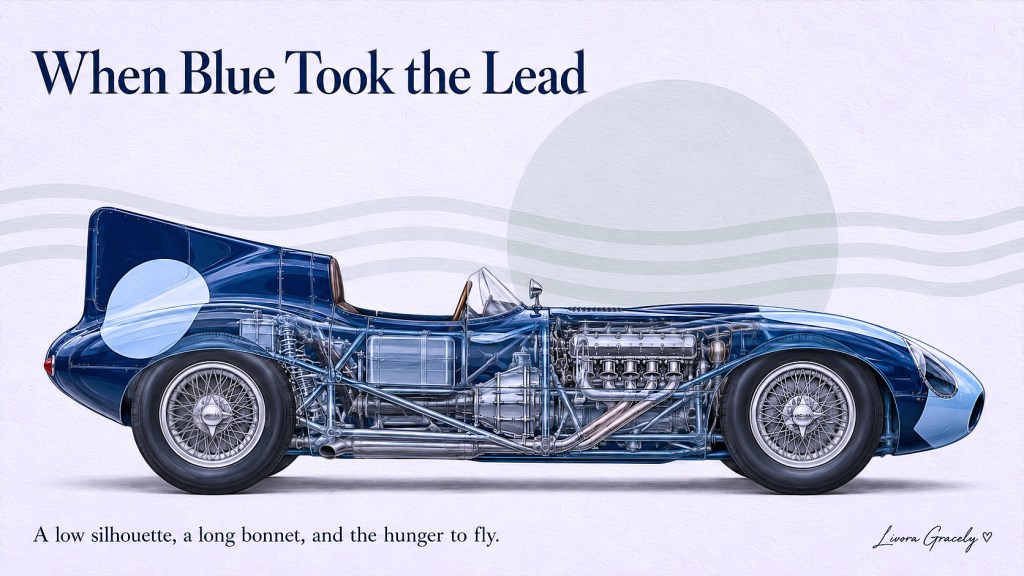
A low silhouette, a long bonnet, and the hunger to fly.
“This car has been photographed more often than it’s been cleaned,” the old mechanic said.
Mara looked up from the museum’s draft catalogue.
“Would you like that included?”
“I’d like someone to bring a cloth.”
She found one beside the service records and passed it to him. Beyond the workshop doors, staff were measuring the space for the exhibition. Here, the blue racing car occupied most of the floor and all of the available admiration.
The Name Everyone Knew
Mara’s first page was nearly finished.
Julian Mercer. A celebrated victory. A photograph of a smiling man beside the car’s long bonnet.
The exhibition artist had drawn the blue body almost transparent, showing the engine and framework beneath it. The actual car kept its workings behind polished metal. Mara walked around its low silhouette while the mechanic wiped a narrow line of dust beside the cockpit.
Among the service records lay another photograph.
A woman in driving gloves stood beside the car. Sunlight had washed much of her face pale, but her hands remained clear against the dark blue body.
Mara turned it over.
Someone had crossed out the name on the back. The ink had been pressed into the paper more than once.
She placed it beside Mercer’s photograph.
“Was she with him?”
The mechanic glanced over.
“With the car, certainly.”
Lower Down
He bent toward the leather seat, then straightened and rubbed one knee.
“There’s something caught behind the pocket flap. I can feel an edge.”
Mara leaned over the side. From where she stood, the steering wheel blocked her view. She moved closer, but the narrow cockpit left nowhere for her elbow.
“Could we photograph it?”
“Once we can see it.”
She set down her notebook.
The mechanic showed her where to place her feet, keeping clear of the polished edge. She lowered herself into the seat. Old leather creaked beneath her, releasing a warm, dry smell that mingled with the oil on his cloth.
From this low position, the long bonnet seemed to stretch almost to the workshop doors.
For a moment, her hands rested above her knees.
Then she turned toward the little seat pocket.
A folded corner of paper had caught beneath its leather flap. With the mechanic holding the flap clear, she eased the paper out and laid it on the clean tray he brought.
A railway ticket.
The Hands in the Picture
When Mara climbed out, the mechanic moved her notebook nearer the tray. She wrote down where the ticket had been found before returning to the photographs.
“His girlfriend, perhaps,” she said.
The mechanic put down the cloth.
“Look at her hand.”
Mara looked at the woman’s gloved fingers. Something small hung beneath them.
She brought the photograph closer.
A ring. Two keys.
“The car keys?”
The mechanic nodded toward a similar pair hanging beside the workshop door.
Mara looked again at the woman’s stance. One hand rested against the cockpit; the other held the keys loosely, as though she had just taken them out.
“That doesn’t tell us who drove,” she said.
“No.”
“But I was about to give her a caption.”
“What did it say?”
Mara glanced at the line she had pencilled beneath the photograph.
She rubbed it out.
The Other Side
The railway ticket had been folded twice. Its printed destination remained legible, though the date had faded along one crease.
Mara noted it down.
The mechanic returned to the blue paint, wiping around a rivet rather than across it. She turned the ticket over.
There was writing on the back.
She moved the crossed-out photograph beside it. The woman’s keys pointed toward the little rectangle of paper.
Mara drew a fresh page toward her.
On the ticket, beneath the address of a workshop on Bell Lane, were two words:
Ask him.


Leave a Reply