Genesis 9:5–6
God declared the worth of human life and required an accounting for its shedding, for humanity was made in His image.
Around the Table
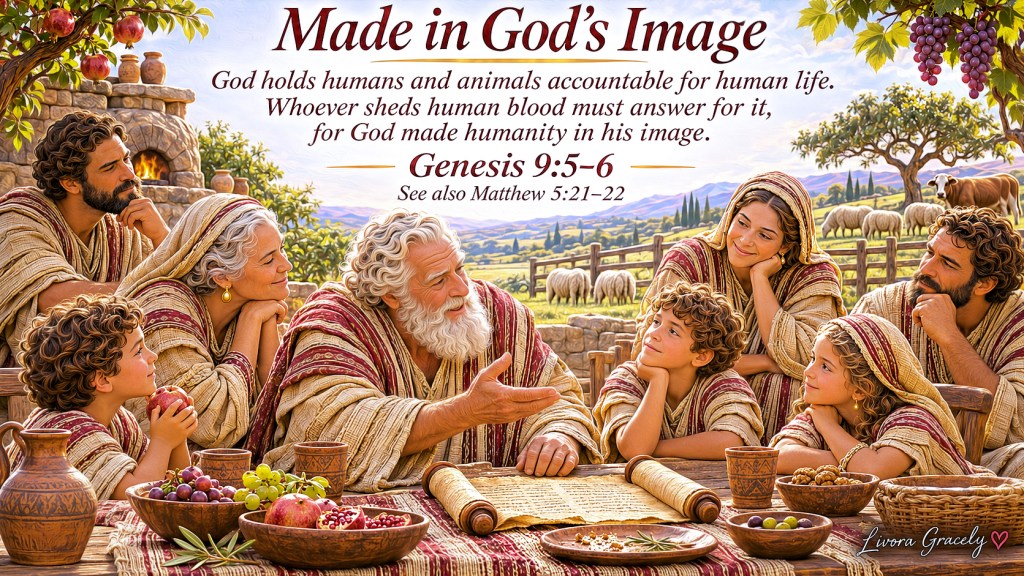
The meal has been served, and a scroll lies across the table. Noah extends one hand as he speaks, while a child rests his chin on his hand and listens.
Around them, the others lean closer. A cup stands beside the fruit, and crumbs remain on a plate. Beyond the family, sheep graze near the fence.
The poster imagines a conversation in Noah’s household. Genesis does not say that Noah wrote God’s words on a scroll or gathered his descendants to repeat them. The picture gives a place to listen to the words recorded in the passage: God speaks of human life and the responsibility for its shedding.
An Accounting for Life
God tells Noah that He will require an accounting for human lifeblood, whether taken by an animal or by another person.
The words follow the instruction concerning animal blood in the preceding verse. Now the passage turns to human life. God says He will require an accounting from each person for the life of another.
Verse 6 states the consequence for shedding human blood: the blood of the one who sheds it will be shed by a human. The language is solemn and concerns a life taken. The verse gives a reason for the gravity of that act: God made humanity in His own image.
These words come after the flood, in a story that has already described a world filled with violence. The family before God is receiving a blessing to multiply and fill the earth. At the same time, God speaks of the worth of the lives that will inhabit it.
Made in His Image
The reason reaches back to the creation account. Genesis 1 says that God created humanity in His image, male and female.
After the flood, the same truth is named again. A human life is not made significant by age, strength, achievement, or place at the table. Genesis grounds its worth in God’s act of creation.
In the poster, the faces around Noah belong to different generations. The children listen beside the adults; each has a place in the family gathering. The passage itself speaks more broadly than the imagined scene: humanity was made in God’s image.
The child with an apple, the woman leaning toward the table, and the man listening across from Noah are details of the picture. Together, they offer a way to pause over the lives the passage takes so seriously.
Words Spoken Later
Much later, Jesus spoke to those gathered on a mountainside about the commandment against murder. He also addressed anger toward a brother or sister and words of contempt directed at another person.
The two passages arise in different settings. Genesis speaks of an accounting for the shedding of human blood; Jesus calls attention to anger and contempt as He speaks about relationships among His hearers.
The connection invites attention to more than the final act of violence. Long before a hand is raised, a person may be reduced by the words spoken about them. Jesus’ words bring the treatment of another person close enough to be heard in the language of daily life.
The Family Listening
The scroll in the poster remains an artist’s addition. The account does not tell us that Noah wrote down the words or describe the conversation around his table.
It does preserve the reason God gave: humanity was made in His image.
Around the imagined table, the family listens. A child holds a piece of fruit; an older hand rests near the scroll. Each face belongs to a life God has made.
The meal is over, but the people remain together. And among the words carried forward after the flood is this reminder of the worth of human life.
Livora Gracely ♥
Sources
- Genesis 9:5–6 — God requires an accounting for human life and speaks of humanity made in His image.
- Genesis 1:26–27 — God creates humanity in His image.
- Genesis 6:11–13 — The earth is filled with violence before the flood.
- Matthew 5:21–22 — Jesus speaks about murder, anger, and contempt.


Leave a Reply