Genesis 9:2–4
God gave living creatures for food, as He had given green plants, but told Noah not to eat meat with its lifeblood still in it.
Preparing the Meal
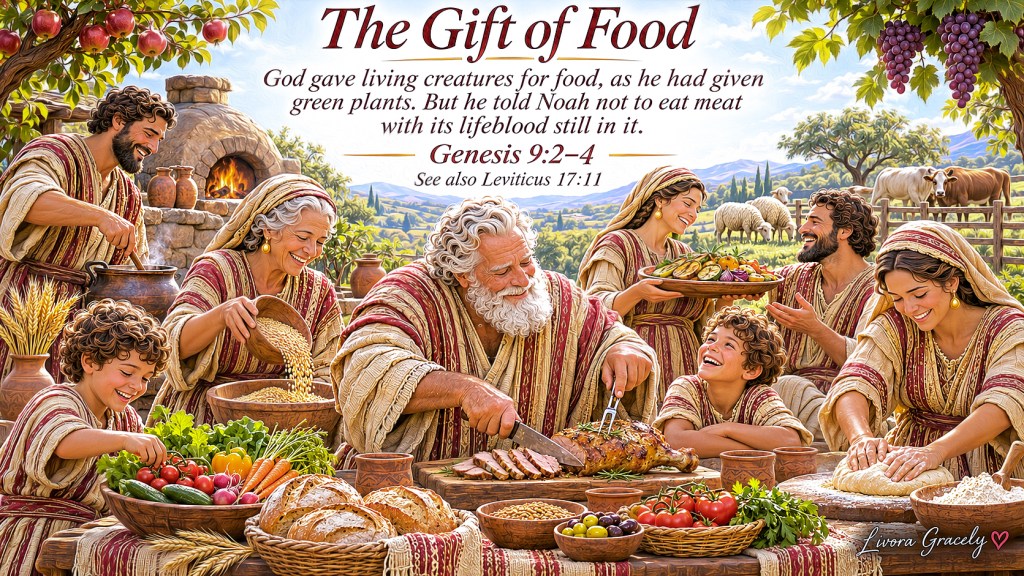
Noah holds the roasted meat steady while he cuts a slice. Beside him, a child watches with a smile. At the other end of the table, hands press into a mound of dough, leaving a dusting of flour on the cloth.
Grain falls into a bowl. Vegetables are gathered onto a platter. Near the oven, a pot is stirred while bread and fruit wait to be shared.
The poster imagines Noah’s family preparing a meal after the flood. Genesis does not describe this kitchen or tell us what the family served that day. The scene brings together foods that invite attention to God’s words in Genesis 9: living creatures were given for food, as green plants had been given before.
A Gift after the Flood
After blessing Noah and his sons, God spoke about the living creatures of the earth, the birds, and the fish of the sea. They would fear and dread humanity; they were given into human hands.
Then God said that every moving thing that lives would be food for them. Just as He had given green plants, He now gave these creatures as well.
The words recall the beginning of Genesis, when God gave seed-bearing plants and fruit to humanity for food. Now, after the flood, the account speaks of another provision.
The picture places bread, vegetables, grain, and meat on the same table. Each has passed through hands preparing it: kneading, sorting, stirring, and cutting. The meal has not yet begun, but the work around the table already points toward the people who will eat it together.
Life and Blood
God’s permission came with a boundary. Noah and his sons were not to eat meat with its lifeblood still in it.
The passage places this instruction beside the gift of food. The animal could be eaten, but its blood was not to be treated as ordinary food.
Later, in instructions given to Israel, Leviticus speaks of the life of a creature being in the blood. That passage belongs to a later setting; it helps illuminate the connection between blood and life without suggesting that the whole instruction in Leviticus was spoken to Noah.
Genesis 9 is brief. It gives both the provision and the restriction, allowing the family’s food to be seen alongside the life from which it came.
Beyond the Table
In the distance, sheep and cattle stand near the fence. They are part of the world into which Noah’s family has come after leaving the ark.
The earlier chapters followed animals entering the vessel, being kept through the flood, and coming out according to their kinds. Now God speaks of a changed relationship: the creatures will fear humanity, and living creatures are given for food.
The verse does not describe how Noah’s family felt about those words. It records the provision and its limit.
At the imagined table, a woman continues kneading, grain gathers in its bowl, and Noah finishes another slice. Soon the food will be carried to those waiting nearby.
The meal brings the family together beneath the trees. Within the passage behind the picture are God’s gift, His boundary, and the life that makes the meal possible.
Livora Gracely ♥
Sources
- Genesis 9:2–4 — God’s words to Noah and his sons concerning animals and food.
- Genesis 1:29 — God gives seed-bearing plants and fruit for food.
- Genesis 8:19 — The living creatures come out of the ark.
- Leviticus 17:11 — The connection between blood and life in instructions later given to Israel.


Leave a Reply