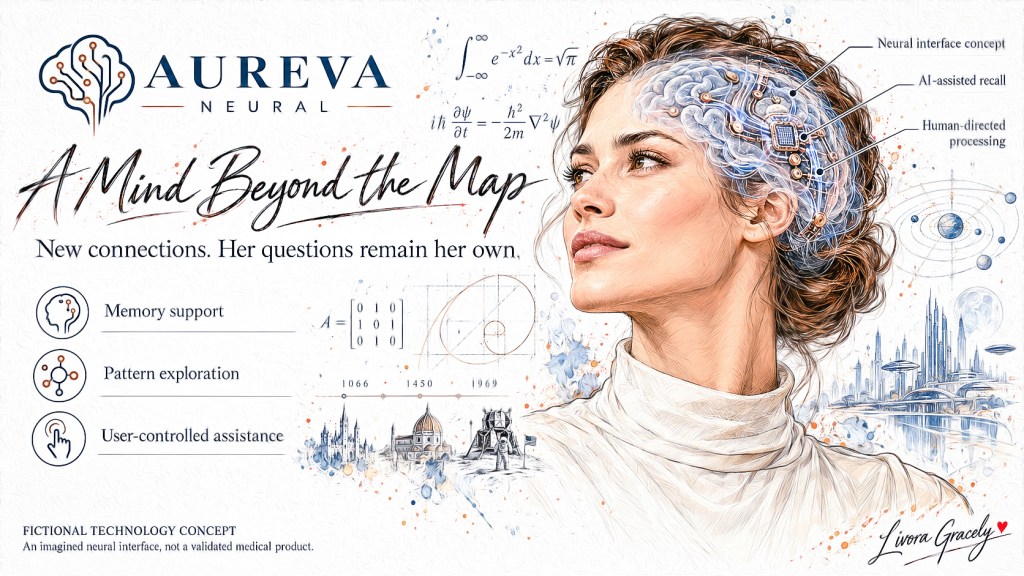
New connections. Her questions remain her own.
A Suggested Connection
The route was ready before she had finished her coffee.
Across the map on her desk, a blue line joined the new housing district to the school. Distances, crossings, and alternative paths appeared beside it. She followed the line with her finger, stopping where it passed through a narrow gate behind the market.
She could not remember that gate being open.
The proposal had taken seconds. In the future imagined here, the Aureva neural implant connected her thinking with an AI system that could search permitted records, compare possibilities, and help her retrieve information at extraordinary speed. Work that once occupied several afternoons could unfold while the coffee was still warm.
She asked the system to show its basis for including the gate. A municipal access plan appeared. The line was there, neatly drawn and labelled.
She requested the date of the last inspection.
Beyond the Recall
The implant brought forward a cluster of records: an old survey, a newer planning document, photographs, and a note she had written during an earlier visit. She recognised her own words before she remembered the morning that had produced them.
Ask about rear entrance.
She had been interrupted before following that question. The note contained no answer.
With assistance, she could hold several possible routes in view, compare their distances, and trace how a change to one crossing affected the others. The connections came with a breadth and speed she had never managed unaided. She selected two alternatives for closer examination, then returned to the gate.
Its status remained uncertain. The records described intended access; none established what a child would find there that morning.
She marked the gap in the proposal and saved it. Before leaving her desk, she suspended the stream of suggestions and took a printed map with her.
Her Own Question
At the market, crates stood beside the gate. A chain ran through its bars, and a delivery driver was looking for someone with the key.
She spoke to a stallholder, who explained when it was usually unlocked. The hours served deliveries. They did not match the children’s arrival at school.
A boy in school uniform stood nearby with his father. When she asked which way they walked, he pointed around the outside of the market. His father described the crossing where they sometimes waited through more than one change of lights.
The boy interrupted to mention a dog behind a fence. His father began to apologise, but she asked where the fence was. The boy showed her on the paper.
Back at her desk, she changed the question. She wanted routes that children could actually use at the relevant hour, with uncertain access clearly identified. Distance would still matter. So would the waiting she had heard about.
She resumed the assistance with those instructions.
Leaving It Open
New comparisons arrived quickly. She could explore more alternatives than the original proposal had contained, check their supporting records, and follow the consequences of moving a crossing. Where evidence was missing, she left a question for the next visit.
She chose two routes to discuss with families rather than presenting the first blue line as the finished answer. On the printed map, she added the gate’s delivery hours beside the chain she had sketched there.
At their next meeting, the boy recognised the paper. She moved her calculations aside and gave him a pencil, asking him to show her the walk from his front door.
He drew past the market, paused at the fence, and added a small square for the dog. She kept it on the map while he continued towards the school.
Aureva Neural is a fictional implanted AI interface. The extraordinary recall, processing, and information access in this story are speculative capabilities, not established outcomes of a validated medical product. The illustration does not depict a replacement brain or promise universal superintelligence.


Leave a Reply