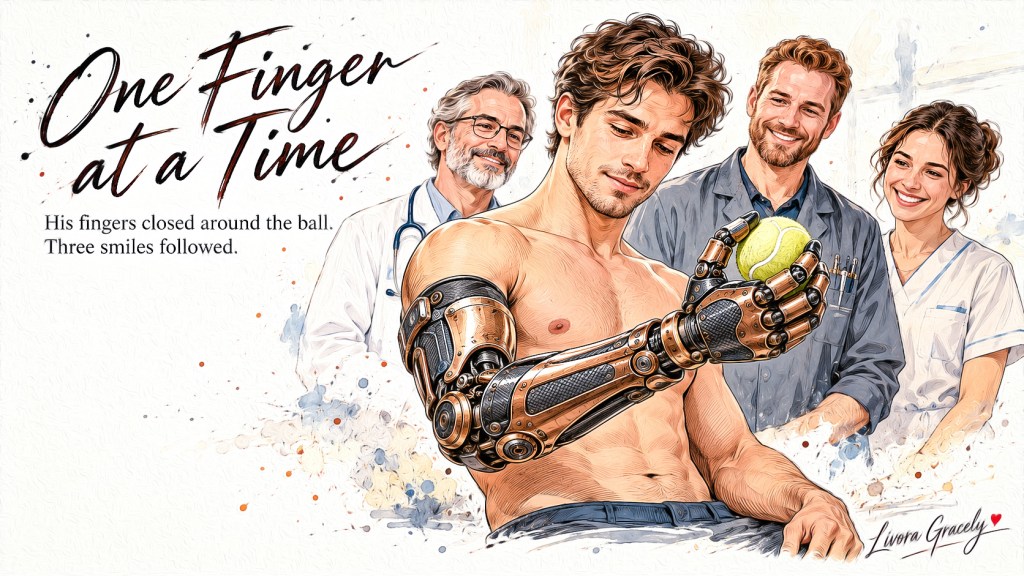
His fingers closed around the ball. Three smiles followed.
The Rolling Ball
The ball escaped before anyone could congratulate him.
It struck the table, bounced once, and rolled beneath the engineer’s chair. The engineer bent to retrieve it while the young man looked at the open fingers of his prosthetic hand. Beside him, the therapist lowered the shallow tray she had been holding ready.
“It prefers your side,” he told the engineer.
“So far.”
The ball came back with a strand of lint caught in its yellow covering. He picked it off with his other hand, then set the ball on the mat in front of him. The clinician drew a chair closer without crowding his elbow.
Outside the room, someone was calling a name. A trolley passed the doorway. Inside, he watched the fingers approach the ball again, paying attention to the moment when contact became a grip.
Learning the Grip
During earlier visits, he had spent long stretches learning how his movements and the device’s response fitted together. Some attempts ended with the hand closing before it reached the object. Others left him concentrating so hard that he needed a break before trying again.
The engineer had made adjustments with him, then watched what changed. The therapist asked what felt manageable. When he wanted to stop, they stopped; the notes carried unfinished tasks into another appointment.
Today, he brought the hand towards the ball more slowly. The fingers met its curved surface and closed. He lifted it just above the mat, lowered it, and tried once more. On the next lift, the ball remained in his grasp.
The clinician smiled first. The engineer followed, then the therapist, whose tray was still waiting nearby. He noticed all three and allowed himself a smile before looking back at the ball.
“Can we work on putting it down?”
A Smaller Adjustment
The therapist placed the tray on the table. He brought the ball over it, but when the fingers opened, it fell farther than he intended. It landed against the rim and rolled into the corner.
He studied the distance between the hand and the tray. The engineer asked whether he wanted to change a setting. He considered it, then asked to try from a lower position first.
This time, he brought the ball close to the tray before opening the hand. It settled against the base with a small tap. He looked towards the clinician, then reached to pick it up again.
They tried several times. One release came too soon; another took longer than he expected. Between attempts, he rested his arm and described what he had been trying to do. The engineer listened before making another note.
The therapist offered a different object. He glanced at it, then back at the ball.
“This one still owes me a quiet landing.”
Letting It Go
By the end of the session, the tray had moved aside. He wanted to place the ball on the mat where the first attempt had begun.
He lifted it, brought his hand over the chosen spot, and lowered it until the yellow covering touched the surface. Then he opened the fingers and drew the hand away. The ball shifted slightly against the mat but stayed within reach.
He rested his arm. There were still appointments ahead, and the engineer had a question about an earlier hesitation. He answered it while the therapist wrote down what they had practised.
When she reached to clear the table, he asked her to leave the ball for a moment. He leaned back and looked at the space between it and his open hand, with nothing now needing to be caught.
This is a fictional rehabilitation scene. The poster’s prosthetic arm is an artistic design; the story does not describe a tested product or imply that every prosthetic hand provides the same movements or control.


Leave a Reply