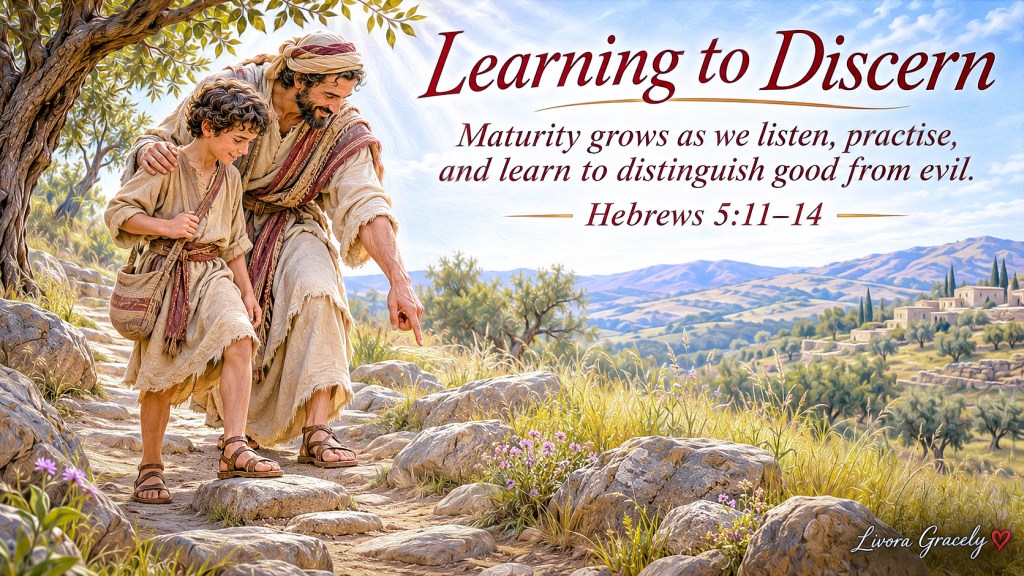
Hebrews 5:11–14
Maturity grows as we listen, practise, and learn to distinguish good from evil.
A father and his child came to a narrow path scattered with stones.
The child hurried ahead, then stopped where the ground became uneven. His father came alongside and showed him where to place his feet. They continued together, slowly at first. As they walked, the child began to notice the loose stones for himself.
He did not learn the path in a single step. He listened, tried, stumbled, and learned to pay attention.
Hebrews uses another picture of growth: a child learning to receive solid food. The writer wants his hearers to grow—not simply in the number of things they know, but in their ability to recognise good and evil through practice.¹
There Is More to Say
The letter has just introduced Jesus as the high priest appointed by God in the order of Melchizedek.² Then the writer pauses. There is much more to say, he tells the community, but it is hard to explain because they have become slow to listen.¹
Hebrews does not abandon the subject. The letter continues to teach, warn, and encourage; later, it returns to Melchizedek and to the priesthood of Jesus.³
The concern is not that every difficult question proves a person is unwilling to learn. Some truths take time to understand, and a weary person may need patient help. The writer is addressing a community that, after time has passed, needs to become attentive again.
Earlier, Hebrews had repeated the call from the Psalms: when you hear God’s voice today, do not harden your hearts.⁴ Listening is more than hearing words. It is being willing to receive what God says and respond.
Time and Growth
The writer tells his hearers that by this time they ought to be able to teach others. Instead, they need someone to teach them the basic truths of God’s word again.¹
Time alone does not guarantee growth. A person may have heard familiar words for years and still need help understanding how those words shape a life.
That does not make every question a failure. When Jesus began to wash His disciples’ feet, Peter did not understand what He was doing. Jesus told him that he would understand later. Then He explained His act of service and called the disciples to serve one another.⁵
Understanding can take time. A question honestly brought to a teacher can be part of learning; what matters is the willingness to keep listening and to respond.
The invitation to grow is also shared. Hebrews has already urged its readers to encourage one another daily.⁴ We can help another person learn without making them ashamed of what they do not yet know.
Milk and Solid Food
Hebrews describes its hearers as needing milk rather than solid food.¹ Milk is good and fitting for an infant. Peter even uses the picture of a baby longing for milk to encourage believers to desire spiritual nourishment and grow.⁶
The concern in Hebrews is that these hearers still need to return to the beginning when they should have grown further. The foundation matters, but a foundation is laid so that something can be built upon it.
Paul used a similar image when he wrote to the Corinthians. He pointed to jealousy and quarrelling among them as signs that they were not living with the maturity they needed.⁷ The problem was not merely that they had more facts to learn. What they believed was also meant to shape the way they treated one another.
Maturity does not require leaving the good news behind. It means receiving its truth more deeply and learning to live by it.
Trained by Practice
Hebrews says that solid food is for the mature, whose powers of discernment have been trained by constant practice to distinguish good from evil.¹
Like the child on the stony path, we learn to notice where we are placing our feet. We listen to Scripture, consider what is before us, seek wise counsel, and practise what we have learned. When we make a mistake, we can receive correction and begin again.
James urges his readers not only to hear the word but to do what it says.⁸ A lesson about love, for example, meets us in an actual disagreement. We may need to speak truthfully, listen carefully, seek help, or protect someone who is being harmed. Discernment asks what love and truth require in that particular moment.
Paul connects maturity with becoming less easily tossed about by misleading teaching and with speaking the truth in love.⁹ Knowing more should not make us proud of those who know less. It should help us care for one another with greater wisdom.
Keep Listening
Some who read this warning may wonder: “I have followed Jesus for years, yet I still have basic questions. Have I failed to grow?”
Hebrews gives its original hearers a serious warning. It does not tell us to label every person who needs help as unwilling to learn. A question can open the way to deeper understanding, and asking for guidance can itself be an act of humility.
Jesus welcomed children and told His disciples to receive the kingdom of God like a child.¹⁰ Hebrews calls its hearers to grow beyond spiritual infancy. The pictures serve different purposes. A mature believer can remain humble, ready to receive, and willing to ask for help.
The father on the path did not expect the child to see every loose stone at once. He walked beside him as he learned.
God’s people are invited to keep listening, to practise what they receive, and to encourage one another along the way. As we follow Jesus, the great high priest, we can continue to grow in wisdom, discernment, and love.
Scripture References


Leave a Reply