Genesis 9:11–13
God promised that never again would a flood destroy all living creatures. He set His bow in the clouds as the sign of His covenant.
Looking toward the Sky
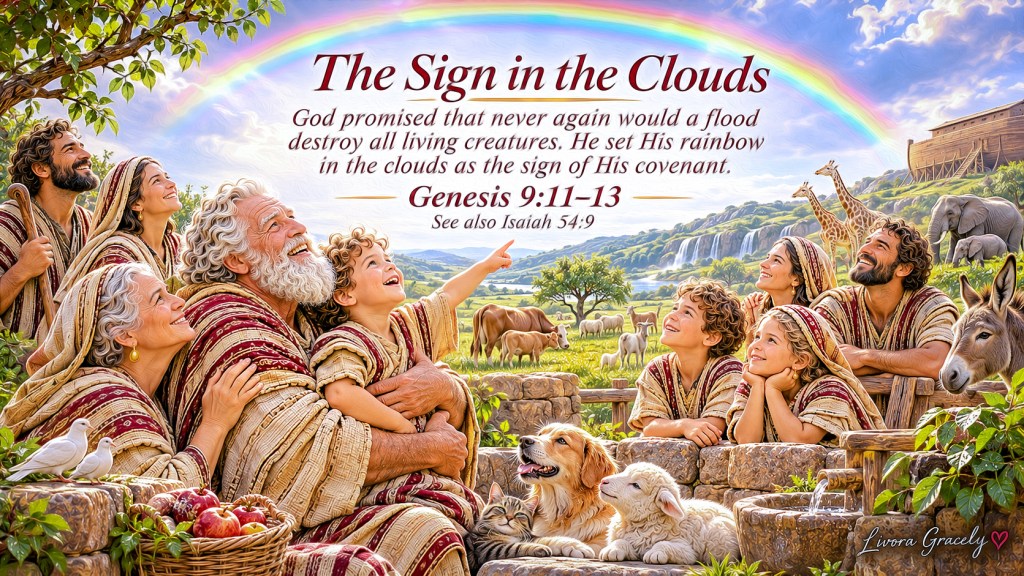
A child points toward the horizon. Beside the child, Noah looks up, an arm resting around the small shoulders. Across the yard, members of the family pause in their work, and the animals remain nearby.
The scene was planned for the second poster in this series. Genesis does not describe Noah and his descendants standing together to watch a rainbow. The image gives a visible setting to the sign God named when He spoke of His covenant after the flood.
The family had known a sky filled with rain and an earth covered by water. Now God spoke to Noah and his sons about a future in which clouds would appear again.
A Promise after the Waters
God established His covenant with Noah, his descendants, and every living creature. Then He declared its promise: never again would all life be destroyed by the waters of a flood; never again would a flood destroy the earth.
The words belong after a journey through judgment and preservation. Noah’s family and the creatures had entered the ark, lived through the flood, and come out onto the earth. The promise speaks of what God would not do again by a flood.
Its wording deserves care. Genesis does not say that rain will cease or that there will never be a local flood. The promise concerns a flood destroying all life and the earth as described in the account.
The waters had withdrawn, but the life ahead would still include clouds and rain. God gave a sign connected to His promise.
A Bow in the Clouds
God said that He had set His bow in the clouds as the sign of the covenant between Him and the earth.
The sign could be seen above fields and hills, beyond the roof of a home or the fence of a yard. In the planned picture, the family turns toward it together, while the creatures included in the covenant remain around them.
Genesis does not say that Noah’s family watched the first rainbow, or that a rainbow had never appeared before this moment. Its attention rests on what God declares: the bow in the clouds is the sign of His covenant.
The colors invite the eye upward. The words spoken by God give the sight its place in the story.
Words Remembered Later
Much later, the book of Isaiah recalls the days of Noah and God’s oath concerning the floodwaters. In a different setting, the LORD speaks to Jerusalem of His enduring kindness and covenant of peace.
Isaiah’s words are addressed to people living long after Noah. They look back to the flood promise as they speak of God’s commitment in their own circumstances.
Genesis introduces the promise and its sign; Isaiah recalls it while speaking assurance to Jerusalem.
The Sign and the Promise
In the planned poster, a child points, and Noah looks in the same direction. Their gestures are imagined, yet the sign itself belongs to the biblical account.
The covenant reaches Noah’s descendants and the living creatures for generations to come. Above the earth they inhabit, the bow is named as its sign.
The clouds will return. In the story, God has placed a sign among them, joined to a promise that reaches beyond the family who first heard His words.
Livora Gracely ♥
Sources
- Genesis 9:8–13 — God’s covenant, His promise concerning the flood, and the sign in the clouds.
- Genesis 8:18–19 — Noah’s family and the living creatures come out of the ark.
- Isaiah 54:9–10 — The LORD recalls the waters of Noah when speaking of His enduring kindness.


Leave a Reply