Livora Gracely is a pen name.
This little corner gathers whimsical stories, gentle reflections, and Scripture-inspired writing for readers who still enjoy noticing small things.
Some stories begin with questions.
Others begin with a quiet morning, a cup of tea, an old bench, or a verse that refuses to be forgotten.
The person behind the name simply prefers the words to arrive before the writer.
Writing to remember.
Sharing to inspire.
When every day looks alike, people must invent a reason to gather.
Sunday appeared on the calendar at 06:00.
No one saw it enter.
There was no change in the light. No softer wind. No official announcement from the ice. The generator continued its low, dependable argument with the cold, and the outside cameras showed the same pale horizon they had shown yesterday.
Mira found the date on the kitchen screen while waiting for the kettle.
“Sunday,” she said.
The kettle did not respond.
It had a practical nature.
A Small Exception
By noon, the crew had decided to make Sunday visible.
The cook found a jar of something sweet, three oranges that had travelled farther than most people in the room, and a packet of biscuits reserved for a future event no one could define. The biscuits were opened after a short discussion in which Rafi used the phrase “strategic morale” and Tomas used the phrase “they are only biscuits.”
The oranges were divided into equal pieces.
This took longer than expected.
At the outpost, food was not merely food. It was weight, fuel, storage, transport, and arithmetic. A careless handful thrown away could become a problem several weeks later. The special meal therefore contained a small amount of luxury and a large amount of counting.
Someone put the good cups on the table.
One of them had a crack.
Everyone agreed it looked intentional.
Rules of Chance
After lunch, Tomas proposed cards.
He dealt with the solemnity of a person signing a treaty, then lost the first round to Mira, the second to Rafi, and the third to a mechanic who had claimed not to know the rules.
“I allowed the others to become confident,” Tomas said.
“Very generous,” Mira replied.
The game continued until the cards softened at the corners from being handled by gloved or recently ungloved hands. Outside, the wind moved snow against the wall in long dry strokes. Inside, someone laughed so suddenly that the sound startled everyone into looking up.
It was an unfamiliar noise.
Not because they had forgotten laughter, but because it had arrived without a task attached to it.
A Moving Target
In the afternoon, the table was pushed aside for ping-pong.
The ball travelled badly in the warm room. It bounced too high, then too low, then once against Rafi’s shoulder and disappeared beneath a rack of drying socks.
Tomas insisted the room was uneven.
The floor had been checked.
The room was not uneven.
The world outside was.
This made the argument difficult to win.
They played in teams. Mira kept score on the back of an old maintenance sheet. The numbers beside the points were mixed with notes about fuel levels, a loose hinge, and the next radio check. Sunday had entered the outpost, but it had not been allowed to interrupt the paperwork.
This was the part nobody mentioned when they talked about rest.
A polar station did not stop being a machine because its people wanted a day off. Weather did not respect weekends. Frost did not wait for Monday. An instrument alarm could arrive during lunch with the confidence of a guest who had never been taught to knock.
The crew knew this.
They also knew that a day could be different without becoming easy.
Unscheduled Proof
By evening, the outpost felt almost festive.
There were crumbs on the table. The cards had been returned to their box. Tomas had lost at ping-pong and described the result as “a temporary statistical misunderstanding.”
Mira wrote the day into the log.
She recorded the wind, the temperature, the equipment checks, and the fact that the crew had gathered for a meal and played games.
Then she paused.
The official record contained no field for Sunday.
So she wrote it in the margin.
Not as a holiday.
As evidence.
Beyond the walls, the ice remained perfectly indifferent to the calendar. It offered no bells, no church, no change of colour. But when Mira returned to the common room, someone had left one orange segment on a plate for her.
It was not much.
That was the point.
In a place where every day looked alike, the smallest difference had to be protected.
And if Sunday had not arrived, the crew had done the next sensible thing.
Belonging sounds like a word. Then it begins rearranging the house.
Philemon 1:15–16
The Blue Cup
The second toothbrush appeared on a Tuesday morning.
It stood beside Nora’s in a pale blue cup, its bristles still perfectly straight.
The day before, her parents had returned from court with Theo, the nine-year-old boy who was now legally their son.
There had been photographs.
A small cake.
Documents carrying signatures and official seals.
Someone had asked everyone to stand close together, and for a moment the whole family fit neatly inside one frame.
This morning felt less ceremonial.
Theo had left one sock in the hallway. He did not know which kitchen cupboard held the bowls. Nora’s father had packed the wrong lunch in the wrong school bag.
And now the bathroom shelf had changed.
Nora stared at the two toothbrushes.
Her parents had spent months preparing for adoption. They had answered questions, opened their home to inspection, attended meetings, moved furniture, rearranged work, and learned how much they still did not know.
The cost had not purchased a child.
Children are not bought.
The cost had been paid to cross a distance—to remove obstacles, prepare a home, and make room for a life that could not be reduced to a new surname.
Theo brought joy with him.
He also brought a history that had begun before this family entered it. Adoption did not erase whatever losses had made adoption necessary.
The court could establish a relationship in a day.
The household would spend years learning how to live inside it.
At breakfast, Nora’s mother said, “Your brother needs help finding his classroom.”
The word landed quietly.
Brother.
It sounded smaller than everything it would require.
Paul has just imagined Onesimus returning to Philemon forever.
Now he tells Philemon what kind of future must receive him.
No longer as a slave.
More than a slave.
A beloved brother.
More Than Less
Paul’s sentence does not merely soften the old category.
He does not ask Philemon to consider Onesimus a more useful slave, a better-behaved slave, or a slave treated with unusual kindness.
He writes no longer.
Then more than.
The movement matters.
Kindness can improve the experience of an unequal relationship without questioning the category that controls it. A person may receive better food, gentler words, or increased responsibility and still remain seen primarily through the function they perform for someone else.
Paul reaches beyond improvement.
He places another word where the old description had stood.
Brother.
We should remain careful about what the verse does and does not settle. Paul does not write a direct legal command to emancipate Onesimus. Readers continue to debate what social or legal change he expected Philemon to make.
But uncertainty about the legal outcome must not make Paul’s language harmless.
One cannot call a man beloved brother and then imagine that nothing about the relationship needs to change.
Brother is not an ornament placed over the word slave.
It introduces a competing claim.
The old relationship says that one person stands above and the other beneath.
The new word says that both stand within a family neither of them created.
The old category asks what Onesimus owes Philemon.
The new one asks what Philemon owes a brother.
This does not erase history, responsibility, or whatever wrong may have occurred. Family language is not permission to hide harm or demand immediate trust.
It does, however, refuse to let history have the only name.
Onesimus is not merely the person who returns.
He returns carrying a relationship Philemon did not assign to him.
Paul already calls it true.
After the Garden
The word brother had already traveled an astonishing road before Paul placed it beside Onesimus.
On the morning of the resurrection, Mary Magdalene stood outside an empty tomb and mistook Jesus for the gardener.
When He spoke her name, recognition broke through her grief.
Then the risen Jesus gave her a message:
Go to My brothers.
The timing is difficult to miss.
These were the disciples who had failed during His suffering.
One denied knowing Him.
Others fled.
Doors were locked, courage had collapsed, and their promises had proved smaller than their fear.
Jesus rose from death with every right to name their failure.
The first family word He sent toward them was brothers.
That word was not sentimental forgetfulness.
The wounds were still visible on His body.
Brotherhood came from the other side of the cross.
Jesus continued, “My Father and your Father, My God and your God.”
He did not say our Father as though His sonship and theirs were identical. He remained the unique Son. Yet through His death and resurrection, those who belonged to Him were brought into a relationship they had not achieved.
His Father was now named as their Father.
His disciples were called His brothers.
Hebrews makes the cost even clearer.
The Son shared in flesh and blood. He was made like His brothers and sisters in every way, becoming a merciful and faithful High Priest who made atonement for their sins.
He did not stand far away and distribute family titles.
He entered our condition.
Carried suffering.
Faced death.
Opened the way to the Father.
Jesus did not call us brothers because the word was cheap. He made the word possible at the cost of Himself.
When Paul calls Onesimus a brother in the Lord, he spends a word purchased by Christ.
That is why it must not be spent carelessly.
Enemy at Door
Ananias understood something of that cost.
He lived in Damascus when Saul’s reputation arrived before him.
Saul had authority to arrest those who called on the name of Jesus. Ananias knew why he had come. When the Lord told him to visit Saul, Ananias answered with the danger everyone could see.
Then he went.
He entered the house.
Placed his hands on the man whose mission had been to bind believers.
And said, “Brother Saul.”
The word came before Saul had spent years proving the sincerity of his change to the church.
Ananias did not call him brother because the past had become imaginary.
He called him brother because the Lord Jesus had laid claim to the man he feared.
That is one of the most unsettling powers of Christian family language.
It can arrive before our emotions have caught up with grace.
It does not ask us to call evil good. Ananias named Saul’s danger honestly when he spoke with the Lord.
But once Christ placed Saul within His purpose, Ananias could no longer see him only through the letters he carried or the harm he intended.
The Lord had spoken another name over him.
Brother.
Paul now asks Philemon to receive that same disruption.
Philemon may possess his own memories of Onesimus. The letter does not tell us every reason those memories might be difficult.
But Christ has placed another truth beside them.
The man at the door belongs to the Lord.
Therefore, he also stands inside the family of everyone who belongs to the Lord.
Flesh and Lord
Paul could have stopped after calling Onesimus a brother in the Lord.
He does not.
He says Onesimus is especially dear to him, but even dearer to Philemon—both in the flesh and in the Lord.
The phrase will not allow brotherhood to remain safely invisible.
In the Lord reaches their shared life in Christ.
In the flesh reaches the embodied, social, daily relationship in which Philemon and Onesimus must now meet.
The gospel is not permitted to change the vocabulary of worship while leaving the household untouched.
It would be possible for Philemon to call Onesimus brother when the church gathered, then return him to the old category when the gathering ended.
Paul’s phrase closes that escape.
Brother in the Lord.
Brother in the ordinary world of bodies, rooms, meals, labor, status, and decisions.
The word must travel through the front door.
It must enter the way Onesimus is addressed.
Where he stands.
How his work is understood.
Whether his voice is heard.
What kind of future is imagined for him.
We are not told precisely how Philemon translated Paul’s appeal into action.
But we should not shrink in the flesh into a warm feeling.
Embodied brotherhood has consequences.
A church can sing about one family while preserving its social ladders with remarkable care.
People may be called brothers and sisters while wealth still determines whose opinion matters, status decides who is protected, and usefulness governs who is welcomed.
The sacred word remains on everyone’s lips.
The old categories remain in the room.
Paul does not offer Philemon that kind of brotherhood.
The word must become visible.
The Daily Price
That is where family language becomes expensive for us.
Christ alone pays the price that brings sinners into God’s family. Our patience, hospitality, or sacrifice cannot add to His atoning work.
But grace received creates a life to be lived.
The family name is His gift.
Making room for one another becomes our response.
Brotherhood may cost the surrender of superiority.
It may require listening to someone we once knew only by their role.
It may disturb a convenient arrangement.
It may ask a community to change who receives honor, who sits near the center, and whose pain is believed.
It may ask us to protect another person’s dignity when their usefulness to us has ended.
None of these actions purchases the relationship.
They reveal whether we have understood it.
There is a difference between paying for belonging and bearing the cost of belonging.
Jesus paid for our belonging.
We bear with one another because He did.
That distinction protects grace from becoming another transaction.
Onesimus does not have to purchase the word brother by becoming useful enough. Paul called him his child and his heart before Philemon had responded to the appeal.
Nor can Philemon buy moral admiration by performing one generous act.
Both men stand beneath a family name given in the Lord.
And that name asks to become real in the flesh.
Two Toothbrushes
Several weeks after Theo’s adoption, Nora stood with him outside the school office.
He had forgotten the paper required for a class trip. Their mother was at work, their father was unreachable, and Theo looked ready to disappear into the floor.
The administrator glanced at Nora.
“Are you his cousin?”
Nora hesitated.
Not because she did not know the legal answer.
Because some words become real gradually, through ordinary mornings no camera records.
The shared bathroom.
The missing cereal.
The night Theo woke from a dream and did not know which door to knock on.
The afternoon he saved her a seat without being asked.
“I’m his sister,” she said.
Then she helped him call home.
That evening, two toothbrushes stood again in the pale blue cup.
The second one no longer looked like a guest’s.
It had not become less noticeable.
The house had learned what it meant.
Paul places one sacred word into Philemon’s home.
Not slave.
Brother.
Not merely in the protected language of faith.
In the flesh and in the Lord.
The word had traveled through Christ’s incarnation, His suffering, the cross, and the opened tomb before it reached Onesimus.
Now it waited to rearrange a house.
Paul will soon make the test unmistakably personal: receive him as you would receive me.
Because once Christ has called someone brother, the word cannot remain only in our mouth.
Her mother knew this before a single word was spoken.
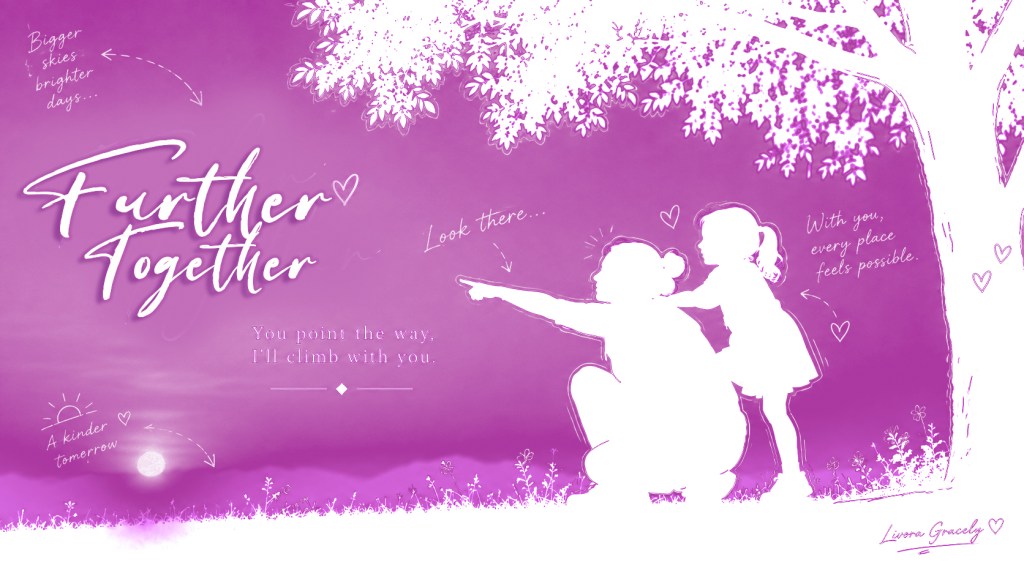
Five-year-olds have many ways of making announcements. Some use sentences. Some use tears. This one simply stood behind her mother and placed both hands on her shoulders.
The message was clear.
Your back. My transportation.
Her mother crouched.
But before the small passenger could climb aboard, something in the distance caught her attention.
She pointed.
“Look.”
The girl followed the direction of her finger.
For a moment, the ride could wait.
The Higher View
Children spend much of their early life looking at the world from below.
Tables are high. Shelves are unreachable. Adults somehow know what lies beyond the wall, around the corner, and farther down the road.
Then comes the wonderful invention called a mother’s back.
Suddenly the ground becomes smaller.
The view becomes wider.
Things hidden behind bushes appear. The road ahead can be seen. Even an ordinary tree looks different when your eyes are a little higher.
The child thinks she is simply being carried.
But something else is happening.
She is borrowing a view she cannot yet reach on her own.
Before the Climb
The mother could have lifted her immediately.
Instead, she pointed first.
There is something quietly beautiful in that order.
First, look.
Then, climb.
We often imagine that helping someone means carrying them as quickly as possible. Yet some of the deepest help begins before the weight reaches our shoulders.
It begins by showing them where to look.
A parent cannot walk every road for a child. A teacher cannot learn on behalf of a student. A mentor cannot live another person’s life.
But they can point.
There is the road.
There is the danger.
There is something beautiful beyond that hill.
There is a direction worth remembering.
The Weight We Welcome
Soon the girl will climb onto her mother’s back.
Two small arms will circle her neck. Two legs will swing beside her waist. The mother will stand a little more slowly than she did before.
The journey will become heavier.
And somehow, richer.
Love has always had this strange relationship with weight.
The people we love add things to our lives that cannot be measured only in kilograms: interruptions, responsibilities, questions, worries, muddy shoes, unfinished conversations.
They also give weight to things that might otherwise feel strangely light.
A road becomes a memory because someone traveled it with us.
A tree becomes that tree.
An ordinary afternoon becomes a story told years later.
Further Together
One day, the girl will no longer need her mother’s back.
Her legs will become longer. Her steps will become faster. She may eventually walk roads her mother has never seen.
That is not the failure of being carried.
It is its purpose.
Perhaps somewhere inside the grown woman she becomes, there will remain a faint memory of standing behind someone who lowered herself so she could climb.
And another memory may remain with it.
A hand pointing toward the distance.
Not controlling where she would go.
Simply helping her see that there was more ahead.
For now, though, she is five.
The horizon can wait another few seconds.
She has a mother to climb.
And her mother, already crouching beneath the tree, seems to understand one of love’s oldest arrangements:
Sometimes we show them the way. Sometimes we carry them toward it. For a little while, we get to do both.
Before the lights return, everyone learns what the silence was holding.
The generator stopped at 03:14.
Not dramatically.
There was no explosion.
No heroic shower of sparks.
The room simply lost its low, familiar hum.
For three seconds, the new outpost became a collection of walls standing in the dark.
Then the backup system caught.
A different engine began to turn beneath the floor.
The lights blinked once.
Twice.
And returned with the slightly offended brightness of something interrupted during important work.
In the nearest bunk, Tomas opened his eyes.
Across the corridor, someone said, “Is that normal?”
No one answered immediately.
That was how Mira knew it was not entirely normal.
The Sound Nobody Notices
During the day, the generator room was easy to ignore.
It lived behind an insulated door near the boot room, where snow softened into water, wet gloves waited on racks, and every surface seemed to have acquired a thin opinion about rust.
Inside, the engine ran with a steady mechanical breath.
Fuel became heat.
Heat became light.
Light became charged radios, warm soup, dry socks, weather readings, emails waiting to leave through the satellite link, and the small blue screen on which Mira checked the next day’s work.
The generator was not glamorous.
It had no orange bow.
It did not cross a field of ice.
It did not appear in photographs unless someone was specifically trying to make their parents appreciate electrical engineers.
Yet the entire camp leaned quietly on its rhythm.
Outside, the wind moved across the snow with all the warmth of a locked door.
Inside, the hum continued.
Most people did not hear it.
Until it stopped.
Three Seconds
Mira reached the power module first.
She had slept in thermal layers, as everyone did now, because crossing a corridor at night was not an activity that rewarded optimism.
The emergency lights painted the room red.
Rafi, the station mechanic, was already beside the control panel in white gloves and a wool hat that made him look less like a technician than a person preparing to negotiate with a very stubborn vegetable.
“Backup is stable,” he said.
His voice was calm.
His eyebrows were not.
The main generator had sensed a pressure irregularity and shut itself down before the problem grew teeth.
That was the sensible version.
The less sensible version was that the camp had briefly forgotten how to breathe.
Rafi listened to the backup engine.
He checked the fuel line.
He checked the temperature gauge.
Then he checked them again, because machines in the cold often behave like people at difficult meetings: they may say nothing at first, but they are rarely fine.
Mira stood beside him with the logbook.
At 03:17, she wrote:
Main generator paused. Backup engaged. No loss of heat.
The final sentence looked reassuring on paper.
Her hand had still been shaking when she wrote it.
The Water Behind the Wall
In the morning, Tomas filled a kettle.
The water came from snow gathered outside, melted, treated, and pumped through the station’s narrow system.
He watched the clear stream enter the metal pot and felt unexpectedly grateful.
It would become coffee.
Coffee would become conversation.
Conversation would become a day in which people could pretend they had slept better than they had.
The strange thing about remote life was that nearly everything ordinary had a machinery behind it.
A hot drink.
A charged tablet.
A shower that lasted only as long as it needed to.
A room warm enough to remove one glove.
Back home, these things arrived without introduction.
Here, each one had a sound.
A pump beginning.
A relay clicking.
A generator taking another breath.
No one announced this gratitude at breakfast.
They discussed weather readings, the snowmobile route, and whether Rafi’s hat had made the repair more difficult.
Rafi said the hat had been essential.
The hat, he explained, contained years of engineering experience.
Nobody asked for evidence.
The Quiet Work of Staying
By evening, the main generator was running again.
Not perfectly.
Rafi did not use that word.
He used within range, which was perhaps more honest.
Mira heard its hum through the wall while she updated the field plan. The sound filled the small spaces between other sounds: forks against bowls, boots crossing the corridor, a radio call from the weather station, Tomas losing another game of cards with great dignity.
Outside, the ice did not care whether their lights were on.
It waited under the moonless sky, immense and patient.
But inside, the outpost had warmth.
Water.
A working radio.
A kettle beginning its small, determined boil.
The generator had not saved anyone from the North.
It had done something stranger.
It had made a fragile room feel briefly possible.
And long after everyone slept, its steady hum continued beneath the floor—not the sound of a machine at work, exactly, but of a little human world refusing to go dark.
Some absences are counted by clocks. Others are answered by what returns.
Philemon 1:15
The Second Goodbye
For some families, the reunion lasted only a few days.
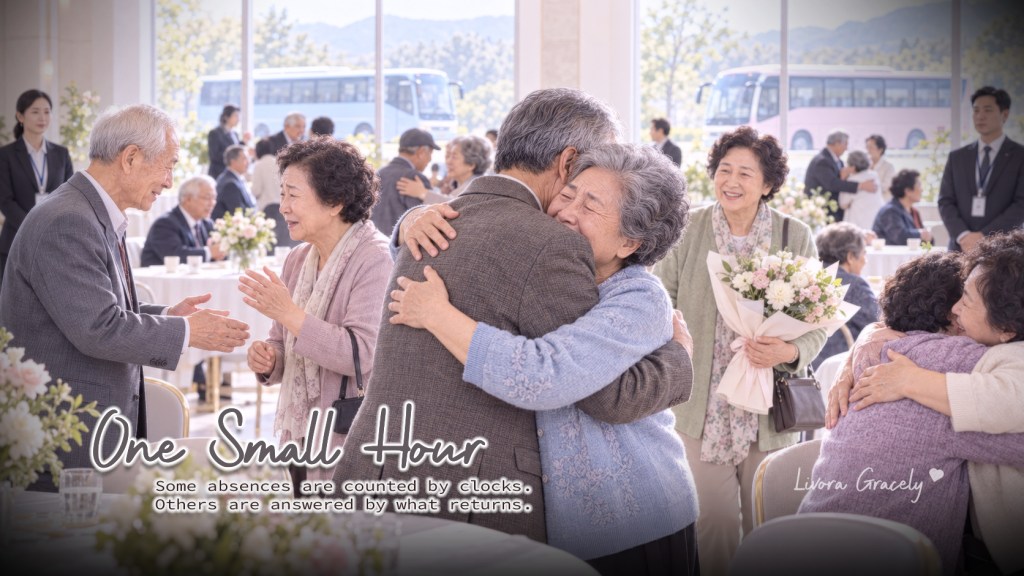
The Korean War had divided homes with a border that became almost impossible to cross. Children grew old without knowing whether their parents were still alive. Brothers and sisters carried photographs of faces that remained young while their own faces changed.
Decades later, a limited number were allowed to meet through carefully arranged family reunions.
Imagine one of those rooms.
An elderly woman enters wearing a name card around her neck. Across the room stands a man she last saw as a boy.
She has prepared questions for years.
Now none of them seems large enough.
They sit close. They compare photographs. They discover which memories survived on both sides of the border and which ones have belonged to only one of them.
For a few days, time behaves strangely.
The child she remembers speaks with an old man’s voice. The sister he lost reaches across the table with a hand lined by years he never witnessed.
Then the reunion ends.
The photographs are packed again. The buses wait outside. The relatives who spent decades hoping for one meeting must endure another goodbye.
They were separated for most of a lifetime.
They were reunited for a little while.
Paul places those measurements in the opposite order.
Onesimus was separated from Philemon for a little while.
Perhaps, Paul says, so that Philemon might have him back forever.
The sentence sounds simple.
Its smallest word opens the deepest door.
A Smaller Word
Paul does not write, “This is why it happened.”
He writes, “Perhaps.”
That is a surprisingly modest word for someone interpreting a dramatic change.
Onesimus had been away from Philemon. During that absence, he had become Paul’s child in faith, useful in service, and precious to him. Now he was returning with a letter that asked Philemon to see him differently.
Paul could look at what had emerged from the separation and imagine providence at work.
But he did not claim to have read the hidden minutes of God.
Perhaps.
The word makes room for faith without pretending to possess omniscience.
We often speak more confidently about providence than Paul does.
Something painful happens, and before the wound has stopped bleeding, someone explains why God allowed it.
A door closes because a better one will open.
A relationship ends because the right person is coming.
A loss occurred because a lesson was needed.
Sometimes later events do reveal an unexpected good.
But a good result does not give us complete access to God’s reason for every part of the road.
Paul sees a possibility.
He does not turn that possibility into a verdict.
This is the first surprise inside the verse: mature faith can recognize providence while remaining humble about its explanations.
Providence can be trusted without pretending it has been explained.
That protects people who are suffering from having someone else’s certainty placed on top of their pain.
It also protects us from calling every detour necessary simply because something meaningful eventually grew there.
Paul does not praise the separation itself.
He wonders whether grace has made more of it than separation intended to become.
The Quiet Passive
Then comes another small surprise.
Paul does not say that Onesimus ran away.
He does not tell us that Onesimus stole money, escaped to Rome, or followed the familiar story later readers often place around him.
In this verse, Paul says he “was separated.”
The passive wording is gentle.
Some interpreters hear a divine passive: God, though unnamed, stands behind the separation and quietly directs it toward a greater good.
Others caution that the Greek verb can simply describe someone departing. The grammar alone does not prove that Paul intended God to be understood as the direct actor.
That disagreement is useful.
The passive opens a window.
It does not tell us who opened it.
Paul’s perhaps keeps us from forcing the window wider than the text allows.
He can see that an absence has become part of a larger story. He can invite Philemon to consider that possibility. But he does not erase human choices, declare every action good, or give a complete explanation of how the separation began.
Scripture contains more obvious patterns of departure and return.
Joseph was taken from his father and brothers, then encountered those brothers again when famine brought them to Egypt. Looking back, Joseph could speak of God preserving life through what others had intended for harm.
Moses left Egypt after his violent attempt to help an Israelite. Decades passed in Midian before God sent him back, no longer as a prince acting in sudden anger, but as a reluctant shepherd carrying a divine commission.
Those stories echo behind Christian imagination.
But they must not become a formula we press onto every separation.
Not everyone who leaves returns.
Not every broken relationship becomes safe.
Not every empty chair receives an explanation in this life.
The fact that God can redeem a separation does not mean we should call every cause of separation His good design.
Paul gives us a wiser language.
Not denial.
Not certainty manufactured after the event.
Perhaps.
An Hour Forever
Paul then places two measurements beside each other.
For a little while.
Forever.
The Greek phrase behind “a little while” can carry the sense of an hour or a brief season. Paul sets that small span against something enduring.
An hour beside forever.
The contrast is intentionally disproportionate.
Of course, the separation may not have felt brief to Philemon or Onesimus. We do not know how long it lasted. Pain does not become small merely because someone later compares it with a larger good.
Paul is not measuring how the absence felt.
He is measuring it against what the relationship might become.
Philemon may have thought primarily about getting Onesimus back.
Paul asks him to imagine receiving more than what had gone away.
The same man would return.
But return is not always rewind.
If Onesimus were received only into the old arrangement, then the distance would have closed while nothing essential changed. The body could return to the house while the relationship continued to live in its former room.
Paul’s word forever presses against that possibility.
An enduring reception cannot simply mean extending the past without end.
It must make room for what has become true during the absence.
This is the second deep surprise: sometimes the opposite of separation is not proximity.
It is reception.
Two people can occupy the same house and remain far apart. Someone can come home without being received. A door can open while memory keeps the old verdict locked in place.
Paul does not merely imagine Onesimus returning to a location.
He imagines Philemon having him back in a way that outlasts the absence.
The sentence continues beyond this verse, because forever still needs to be given relational meaning. But even here, the direction has changed.
The question is no longer only, “Will Onesimus return?”
It is, “What kind of future will receive him?”
The Waiting Middle
The contrast between a little while and forever reaches beyond this one household, but we must follow it carefully.
Onesimus is not a symbol for Christ. His separation from Philemon is not the same event as Christ’s ascension, and Paul’s perhaps is not a prophecy about the Second Coming.
Yet Scripture teaches Christians to hear time in a particular way.
Jesus told His disciples that for a little while they would not see Him, and then they would see Him again. Their sorrow would not be imaginary. It would become joy because absence would not have the final word.
After His ascension, the church began living inside another interval.
Christ has gone from sight.
Christ will come again.
Here the language changes.
Paul says perhaps when considering the hidden reason behind Onesimus’s separation.
The church does not say perhaps about Christ’s promised return.
We may be uncertain about what God is doing through a particular delay.
We are not uncertain about the One who promised to come.
That distinction matters.
Faithfulness does not require us to invent explanations for every absence. It requires us to live by what God has actually revealed while many explanations remain hidden.
In Jesus’ stories, servants waiting for their master are not praised for discovering the secret date of his return. They are praised for being faithful with what was placed in their hands.
Waiting is not empty time.
It is time entrusted to us.
The absent Master still shapes the conduct of the house.
His return reaches backward into the present and asks what kind of people we are becoming while no one appears to be standing at the door.
This is where Filemon 1:15 quietly prepares us.
Temporary circumstances are not necessarily small because they are brief. A single hour can reveal what we believe about forever.
How we speak when the Master seems delayed.
How we treat someone who has returned with a changed life.
How faithfully we carry what has been entrusted to us.
We do not need certainty about every hidden purpose in order to practice visible faithfulness.
We may say perhaps about providence.
We say surely about His return.
No Second Goodbye
Return to the reunion room.
The elderly woman and her brother rise from the table.
They have spent decades apart and only days together. Outside, two buses wait to carry them toward opposite sides of a border neither of them created.
There are photographs now.
There are answers to some questions.
There are new memories painfully small beside all the missing years.
Then comes the second goodbye.
Their story keeps us from making reunion sound easy.
Some separations last longer than anyone expected. Some people die before the door opens. Some relationships cannot be restored safely in the form we once desired.
Christian hope is not the claim that every earthly absence will soon receive a pleasant explanation.
It is the confidence that clocks, borders, distance, and death do not possess the final word.
Paul cannot see every hidden cause behind Onesimus’s absence.
He writes perhaps.
But he can see a possibility standing before Philemon: the brief separation need not determine the lasting relationship.
Onesimus can be received.
Not merely returned.
Received into a future larger than the past that separated them.
And beyond that doorway stands the greater Christian hope.
The One who has gone from our sight will not remain absent.
Until He comes, we do not have to turn mysteries into explanations.
We are asked to remain faithful inside the hour we have been given.
The bee was working on a room nobody would enter for a while.
No honey was waiting inside.
No flower.
No treasure.
Only a pale larva curled quietly at the bottom of a hexagonal cell.
The worker leaned over it.
Nearby, other cells held other small lives, each in its own place. Some chambers remained empty. Some were occupied. One was almost ready to disappear beneath a thin wax covering.
The bee began to close it.
From the outside, it looked like an ending.
Inside, something else was beginning.
The Quiet Room
A honeybee colony raises its young in individual cells.
An egg becomes a larva. Worker bees feed and tend it. Later, when the larva reaches the right stage, the cell is capped with wax.
Then the nursery becomes strangely quiet.
The young bee is hidden.
No applause accompanies this moment.
The colony simply continues working.
Yet behind that little sealed door, development continues.
A body is changing.
What entered the cell will not be what eventually comes out.
There is something beautiful about growth that does not require an audience.
One Cell at a Time
The honeycomb looks remarkably organized.
One hexagon beside another.
Again.
Again.
Again.
No cell appears especially important.
Yet the colony depends upon thousands of small spaces doing their particular work.
The worker bee does not need to understand the future of the entire hive before caring for the life directly in front of her.
This cell.
This larva.
This task.
Then the next.
Humans often become overwhelmed because we can see too much at once.
The unfinished work.
The uncertain future.
The distance still ahead.
A bee lives differently.
The next small thing is enough to begin.
Behind the Cover
The most interesting part comes after the cell is closed.
From outside, almost nothing appears to happen.
That can fool us.
We are accustomed to measuring progress by movement we can see.
A taller plant.
A finished page.
A new skill.
A visible result.
But some forms of becoming happen behind a covering.
A child thinking.
A wound healing.
An idea forming.
A character slowly changing through repeated ordinary choices.
Stillness is not always inactivity.
Sometimes the important work has simply moved somewhere our eyes cannot follow.
Empty Cells
Beside the larvae are empty chambers.
They might look unfinished.
But emptiness has its own purpose.
A space can be waiting.
For food.
For an egg.
For another generation.
For something that has not arrived yet.
Not every empty place is evidence that something has gone wrong.
Some spaces exist because tomorrow needs somewhere to go.
When the Door Opens
Eventually, the sealed cell will open.
A young bee will emerge into a world already humming with work.
She will not know every bee that fed her.
She will not remember the worker who carefully closed the cell above her.
Much of the care that made her life possible will remain anonymous.
And that may be the loveliest detail.
Not every act of care gets to see what it becomes.
A teacher may never know which sentence stayed.
A parent may not witness every consequence of a small kindness repeated for years.
Someone may prepare a place whose future occupant they will never meet.
The bee closes one tiny cell.
Then moves to another.
Tomorrow remains hidden behind wax.
But hidden does not mean forgotten.
Some of the future is being built in places where nothing seems to be happening yet.
Four chapters behind them. A larger silence ahead.
Act I — The Smallest Force
At first, there was only a ship and an unreasonable amount of white.
The icebreaker entered the North with its orange bow lowered into the frozen plain, looking less like a conqueror than a determined punctuation mark.
Around it, the ice was ancient, bright, and entirely uninterested in human ambition.
The crew learned this quickly.
A ship may break ice, but it does not win an argument with winter. It listens to pressure. It follows leads. It slows down when the surface begins making its private cracking sounds beneath the hull.
Real polar travel has always depended on this kind of humility. Machines help. Maps help. Warm soup helps more than anyone admits.
But the ice still gets a vote.
Act II — The Watchers
Then came the people at the rail.
Four orange jackets against the white.
Two pairs of binoculars.
One paper map.
One glowing screen attempting to be useful in a place where batteries, fingers, and optimism all become delicate.
They watched for a route, but also for the small warnings that maps cannot carry: a shift in wind, a line of darker ice, a place where the horizon appears too smooth.
Their task was to prepare for six months ahead.
Not merely to arrive.
To notice.
In the North, observation is not the quiet part before action.
It is action.
Act III — Small Constellations
At the new outpost, the expedition found that the ice had been keeping smaller secrets.
A crystal appeared on a window.
Then another on a support line.
Then dozens, catching the weak daylight like tiny instruments designed by someone with an excellent eye for geometry.
Six arms.
Never eight.
Each snow crystal followed the quiet molecular law of water, building its delicate symmetry from the same cold and vapor that made the whole landscape seem severe.
Mira wrote one in her notebook.
Not because it would change the mission.
Because it changed the morning.
A camp can survive on fuel, food, radios, and careful routines.
But it also survives on small things that remind people the world is still capable of surprise.
Act IV — The Five-Metre World
Then the storm arrived.
The convoy had traveled beyond the main camp, carrying fuel, instruments, shelter equipment, and the beginnings of another research position.
Two snowmobiles led.
Two tracked carriers followed.
The plan was excellent.
The weather had not been consulted.
At 22:17, the route disappeared.
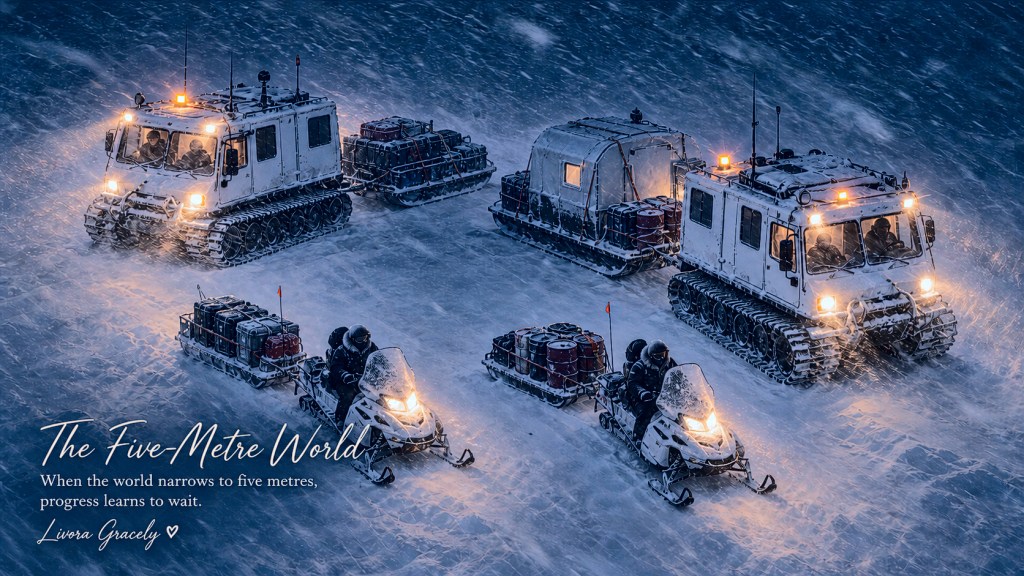
The vehicles stopped. Amber lights turned flying snow into a wall of gold dust. Visibility narrowed to five metres: enough to see the nearest machine, not enough to pretend they were in control.
So they checked the radio.
Fuel.
Straps.
Temperatures.
Each other.
That night, progress did not mean moving forward.
It meant remaining visible.
Now the storm has passed.
The tracks have returned to the surface.
Beyond them lies a place the maps only suggest: a ridge of old ice, a listening instrument waiting to be planted, and a question buried deeper than anyone has yet reached.
The next chapter begins where the convoy starts moving again.
And somewhere beneath the white, the North is already preparing its reply.
When the world narrows to five metres, progress learns to wait.
At 22:17, the road disappeared.
Not gradually.
One moment, the convoy could still see the faint flags marking the route across the ice. The next, the storm lifted the snow from the ground and returned it to the air with such commitment that up and down became suggestions.
The two snowmobiles stopped first.
Their headlights made small tunnels through the white, but the tunnels ended almost immediately. Beyond them, there was no horizon. No safe direction. No convincing argument for continuing.
Behind them, the two tracked carriers slowed, their engines low and patient beneath the wind.
Then the whole expedition stood still.
When the Lights Become Weather
From above, the convoy looked almost organized.
Four vehicles.
Two small white snowmobiles.
Two larger tracked carriers towing fuel, instrument cases, food boxes, emergency shelter equipment, and enough supplies to make a temporary outpost feel briefly like a permanent idea.
Their amber lights blinked through the storm.
The lights did not defeat the darkness.
They simply made the snow visible.
Ice crossed the beams in long, bright streaks. It gathered on the windscreens. It pressed against the sides of the cabins. Every few seconds, another gust struck the convoy with the sound of handfuls of dry sand thrown against metal.
Inside the front carrier, Mira checked the radio again.
The speaker offered static.
Then a voice.
Then more static.
This was not surprising. The weather had been surprising enough for everyone.
Their plan had been simple before the storm arrived. Travel farther from the main base camp. Reach a chosen point. Establish the first small research position there. Prepare a place where the larger team could later work, drill, measure, and wait for the ice to explain itself.
The North had received the plan.
It had not approved the schedule.
The Two Riders
The snowmobile riders had the most difficult seats in the convoy.
Their machines were useful because they could move ahead, test the surface, check flags, and tow smaller loads. They were also useful because they reminded everyone that a person can feel very exposed while wearing almost every layer of clothing ever invented.
Tomas sat behind his windscreen with his fur-ruff hood pulled close around his goggles.
His gloves were thick.
His trousers were insulated.
His boots had been chosen by people who understood that toes can become an urgent administrative matter.
Still, the cold found places to enter.
It lived at the edge of his collar. It pressed against the small space between goggles and skin. It waited inside every pause.
He looked back at the carriers.
Their cabin windows glowed softly. Through the blowing snow, they seemed less like vehicles than two tired animals gathered around their young.
Tomas pressed the radio button.
“Visibility?”
Mira’s answer came through in pieces.
“Five metres. Maybe less.”
He looked ahead.
Five metres was not much of a world.
But it was enough to see the other snowmobile.
Enough to see the nearest carrier.
Enough to know that everyone was still there.
The Small Camp They Carried
A pioneer outpost is not built when the first wall rises.
It begins much earlier.
It begins in a supply list.
A sealed food box.
A fuel drum strapped carefully to a sledge.
A spare radio battery.
A sleeping bag that remains dry.
A small metal stove that can turn snow into water and, with enough patience, water into coffee.
The convoy carried all of this behind it.
It also carried something less visible: the hope that the new site would reveal what the main camp could not.
Perhaps the ice there would be thicker.
Perhaps the layers beneath it would contain a clearer record.
Perhaps the wind would shape the snow differently.
Perhaps nothing dramatic would be found at all, which is often how real research begins: with a careful person looking at something ordinary for longer than anyone else thought necessary.
For now, none of that mattered more than staying together.
Mira asked each vehicle to confirm its position.
One carrier answered.
Then the other.
Then Tomas.
Then the second snowmobile rider.
The radio check took less than a minute.
It made the night feel less enormous.
Five Metres
The storm did not become kinder.
The engines continued to idle. The wind continued to erase the tracks behind them. Snow climbed slowly over the runners of the sledges, as though the ice plain had noticed some unattended furniture and wished to put it away.
No one made a heroic speech.
No one announced that waiting was wise.
They simply waited.
Mira wrote the time in the log.
Tomas flexed his fingers inside his gloves.
The others checked fuel, lights, radios, straps, temperature.
Small tasks.
Repeated tasks.
The kind that rarely appear in photographs, unless a photograph is taken from very high above.
By morning, the convoy might move again.
It might reach the point chosen for the new outpost.
It might begin opening a space for the larger team, the deeper drilling, the long measurements, and the questions waiting beneath the ice.
But tonight, their outpost was already there.
It was the small circle of light around four stopped machines.
It was the radio voice answering from somewhere close.
It was five metres of visibility, carefully shared.
And in a world that had become almost entirely white, that was enough distance to keep everyone from disappearing.
Sharing the gospel is often imagined as knowing what to say. Yet a meaningful conversation begins with something just as important: knowing how to listen.
The person before us is not an audience waiting for our message. They come with a story, questions, experiences, doubts, and sometimes wounds we know nothing about. If we enter the conversation only prepared to speak, we may deliver the right words while missing the person entirely.
This article explores another way of coming close—prepared to share the good news of Jesus, but equally prepared to hear the person receiving it. The conversation can move in both directions: speaking and listening, explaining and understanding.
The gospel does not become weaker when we listen.
Sometimes listening is what allows someone to hear.
The Space Between
He had been thinking about the conversation the entire way there.
He knew how he wanted to begin.
He had the verse in mind. He had even imagined some of the questions that might come up and how he might answer them.
The person sitting across from him was not a stranger. They had met several times before. Coffee arrived, the conversation settled in, and eventually the opening he had been waiting for appeared.
He began talking about Jesus.
There was no strong objection.
No argument.
The person across the table listened politely, nodded now and then, and then said something that had never appeared in any of his preparation.
“My father used to talk about God a lot too.”
Then silence.
A few seconds later, another story began to emerge.
About home.
About church.
About a father who was one person on Sundays and someone else during the rest of the week.
The conversation that had been carefully prepared to explain the gospel suddenly became a place where someone was opening an old wound.
The verse was still true.
The gospel had not changed.
But now there was a human being standing between the message and the response.
And human beings never arrive as blank pages.
The Distance
When Jesus said that the gospel must first be preached to all nations, He said it in a difficult passage.
There was rejection.
There was persecution.
There was betrayal.
There were people who would be brought before rulers simply because they followed Him.
And in the middle of that landscape comes Mark 13:10:
“And the gospel must first be preached to all nations.”
What is striking is that Jesus did not wait for the world to become more welcoming.
The good news would move through a world filled with resistance.
That keeps us from romanticizing what it means to share the gospel. People will not always be interested. A good explanation will not always lead to agreement. Even a warm relationship does not guarantee that someone will believe.
But none of this makes the task hopeless.
Jesus knew the terrain before His disciples ever entered it.
He was not sending them into an ideal world.
He was sending them into the real one.
And that is where distance becomes interesting.
Nicodemus came at night. He already knew a great deal about religion, yet he still carried questions.
The Samaritan woman met Jesus beside a well. Her history was different, her place in society was different, and so was the conversation Jesus had with her.
Then there was Nathanael, who carried a prejudice before he had even met Jesus:
“Can anything good come out of Nazareth?”
Philip did not try to win the argument.
His answer was wonderfully simple:
“Come and see.”
Distance is not always overcome by a longer argument.
Sometimes a person simply needs to come close enough to see for themselves.
The Other Chair
There is something easy to forget when we talk about sharing the gospel.
We usually see the conversation from the chair of the person bringing the message.
Do I understand enough?
Can I explain it clearly?
Which verse do I use?
What if they ask something I cannot answer?
Those concerns are understandable.
But there is another chair at the table.
And the person sitting there carries a life we cannot fully see.
They may have known Christians who were deeply kind.
They may also have known Christians who made them want nothing to do with Christianity.
Perhaps they are not rejecting Jesus at all. Perhaps they simply cannot yet separate Jesus from someone who once hurt them.
Some carry intellectual questions.
Others carry moral ones.
Some have no questions at all. Life seems to be going well, and they do not feel as though they are searching for anything.
Others may want to listen but fear what believing could mean for their family, friendships, work, or sense of identity.
Two people can therefore hear exactly the same words and receive them very differently.
The gospel is the same.
The hearer is not.
This is where a one-to-one conversation can become valuable.
Not because private conversation is some superior evangelistic technique, but because proximity allows us to see the person we had previously only imagined.
We can stop talking.
We can listen.
And we may discover that the question we prepared to answer is not the question they are actually carrying.
The Wrong Door
Even people who walked closely with Jesus sometimes misread the moment.
One day, people brought children to Him.
The disciples saw what was happening and intervened.
They stopped them.
Perhaps they thought they were protecting Jesus’ time. Perhaps they believed more important matters deserved His attention. Mark does not tell us everything that was going through their minds.
But the result is clear.
The very people who might have helped others come closer to Jesus were standing in the way.
Jesus was not pleased.
“Let the little children come to me.”
There is a quiet warning here for anyone carrying good news.
It is possible to stand very close to Jesus and still become an obstacle to someone who is trying to approach Him.
Not always because our message is wrong.
Sometimes because of the way we carry it.
The desire to see “results” can turn a conversation into pressure.
The desire to provide answers can make us stop listening.
And confidence that we know the truth can slowly become confidence that we already understand the person sitting in front of us.
We may not.
So perhaps “effective” needs to mean something larger than securing a decision.
Some conversations end with belief.
Some end with another question.
Some appear to lead nowhere.
And some bear fruit years later, when a person suddenly remembers a sentence, an act of kindness, or someone who once treated them with dignity.
We rarely know exactly where we are standing in another person’s journey.
The Long Road
Philip once met an Ethiopian official on a road.
For anyone hoping to share the gospel, the situation almost seems too perfect.
The man was already reading Isaiah.
Philip approached and listened to what he was reading.
But he did not immediately take over the conversation.
“Do you understand what you are reading?”
The question gave the man room to respond.
“How can I, unless someone explains it to me?”
Only then did the conversation open.
Acts 8 moves quickly from there. Philip explained the good news about Jesus, and the journey eventually led to baptism.
But not every biblical story moves at that speed.
In Athens, Paul spoke to people whose intellectual world was very different from his own.
Some mocked him.
Some wanted to hear more.
Some believed.
One message.
Several responses.
Not everything fits neatly into two boxes marked success and failure.
Paul himself later offered a much quieter picture:
“I planted the seed, Apollos watered it, but God has been making it grow.”
That sentence frees the person sharing the gospel from two opposite burdens.
We do not need to lose heart as though everything depended on our ability.
But neither do we have reason to become overconfident, as though speaking well, knowing Scripture, building a good relationship, or mastering communication could manufacture faith.
We plant.
Someone else may water.
Sometimes we never even see the tree.
The Companion
There is another part of Mark 13 that can easily disappear when our attention is drawn to the difficulties Jesus describes.
Jesus did not only tell His disciples what they would face.
He also told them what would happen when they found themselves in the middle of it.
When they were arrested and called upon to speak, they were not to live anxiously rehearsing every word beforehand.
“For it is not you speaking, but the Holy Spirit.” (Mark 13:11)
That changes the atmosphere of the whole passage.
Jesus did not say the road would be easy.
He did not promise that His disciples would always have the perfect answer.
He gave them something else:
presence.
The God who sends also provides the Helper for those He sends.
Later, before the church began moving outward from Jerusalem, Jesus told His followers that they would receive power when the Holy Spirit came upon them, and that they would become His witnesses to the ends of the earth (Acts 1:8).
The order is beautiful.
Not:
Go as far as you can and find out whether you are strong enough.
But:
You will receive power.
You will be My witnesses.
Then the journey moves outward.
The presence of the Holy Spirit does not make human preparation unnecessary. Philip still needed to know the Scriptures. Paul still had to think. The apostles still learned how to speak with people from very different backgrounds.
But they were never asked to carry the weight of another person’s salvation on their shoulders.
Someone else was already at work in the room.
Three Things
Perhaps these are the things worth carrying when we sit across from someone.
First: do not be discouraged by the distance.
The person in front of us may carry objections, wounds, prejudices, or a long and complicated history.
That does not mean the door is closed.
Nathanael began with a dismissive remark about Nazareth.
A few steps later, he was standing before Jesus.
We rarely know how far someone truly is from a door.
Second: do not become too confident in yourself.
We can explain.
We can answer.
We can live in such a way that our words and our lives do not contradict one another.
But a human being is not a problem that can be solved by a better presentation.
Faith is not a trophy won by the most persuasive speaker.
We carry the good news.
We are not the Savior.
Third: do not walk as though you have arrived alone.
This may be the easiest thing to forget.
Before the disciples faced the world, Jesus already knew what that world was like.
Before they opened their mouths, He had already promised the Holy Spirit.
Before Philip met the Ethiopian official, the Spirit was already directing him toward that road.
Before the church began moving toward the ends of the earth, power to become witnesses had already been promised.
Christian courage, then, has a rather unusual shape.
It does not say,
“I know I can do this.”
Neither does it say,
“There is no way I can do this.”
It walks closer.
It listens.
It speaks when the moment comes.
And then it releases what was never ours to control.
Somewhere at a table, two cups of coffee may already be growing cold.
Someone is still talking about his father.
The verse that had been carefully prepared has not even been opened.
The conversation has wandered far from the original plan.
But perhaps it has not failed at all.
Perhaps, for that day, the distance that needed to be crossed was not the distance between a person and an answer.
Only the distance between two human beings.
And when that distance becomes smaller, we may never know who had already been at work on the other side.
One Step
So begin smaller than we might imagine.
Think of one person, not everyone.
Not someone to turn into a project, but someone we genuinely want to know.
Pray for them.
Spend time with them when the opportunity comes.
Listen a little longer than usual.
Discover the questions they are actually carrying, rather than the questions we came prepared to answer.
If the door to conversation opens, speak simply about why Jesus matters to us and what is good about the good news He brings.
And if a question comes that we cannot answer, there is no shame in saying, “I don’t know yet. I’d like to learn more about that.”
If all they want to do that day is tell their story, listen.
If they want to know more, walk a little farther with them.
If they say no, respect them.
And when the conversation is over, resist the urge to measure the result too quickly.
Pray for them again.
Continue treating them with the same kindness.
Because perhaps we are planting.
Perhaps we are watering something another person planted long before us.
Or perhaps, without realizing it, we have just stepped into a conversation God had already begun preparing.
We do not need to carry someone through the entire journey in a single encounter.
Sometimes our part is simply one step closer.
Then we entrust the next step to the Spirit who was already there before we arrived.