Four chapters behind them. A larger silence ahead.
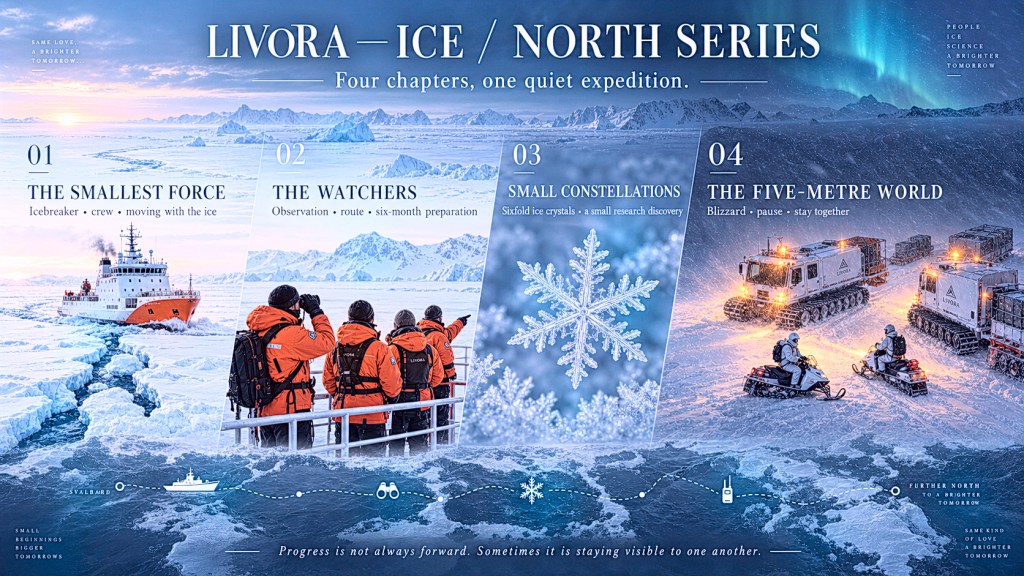
Act I — The Smallest Force
At first, there was only a ship and an unreasonable amount of white.
The icebreaker entered the North with its orange bow lowered into the frozen plain, looking less like a conqueror than a determined punctuation mark.
Around it, the ice was ancient, bright, and entirely uninterested in human ambition.
The crew learned this quickly.
A ship may break ice, but it does not win an argument with winter. It listens to pressure. It follows leads. It slows down when the surface begins making its private cracking sounds beneath the hull.
Real polar travel has always depended on this kind of humility. Machines help. Maps help. Warm soup helps more than anyone admits.
But the ice still gets a vote.
Act II — The Watchers
Then came the people at the rail.
Four orange jackets against the white.
Two pairs of binoculars.
One paper map.
One glowing screen attempting to be useful in a place where batteries, fingers, and optimism all become delicate.
They watched for a route, but also for the small warnings that maps cannot carry: a shift in wind, a line of darker ice, a place where the horizon appears too smooth.
Their task was to prepare for six months ahead.
Not merely to arrive.
To notice.
In the North, observation is not the quiet part before action.
It is action.
Act III — Small Constellations
At the new outpost, the expedition found that the ice had been keeping smaller secrets.
A crystal appeared on a window.
Then another on a support line.
Then dozens, catching the weak daylight like tiny instruments designed by someone with an excellent eye for geometry.
Six arms.
Never eight.
Each snow crystal followed the quiet molecular law of water, building its delicate symmetry from the same cold and vapor that made the whole landscape seem severe.
Mira wrote one in her notebook.
Not because it would change the mission.
Because it changed the morning.
A camp can survive on fuel, food, radios, and careful routines.
But it also survives on small things that remind people the world is still capable of surprise.
Act IV — The Five-Metre World
Then the storm arrived.
The convoy had traveled beyond the main camp, carrying fuel, instruments, shelter equipment, and the beginnings of another research position.
Two snowmobiles led.
Two tracked carriers followed.
The plan was excellent.
The weather had not been consulted.
At 22:17, the route disappeared.
The vehicles stopped. Amber lights turned flying snow into a wall of gold dust. Visibility narrowed to five metres: enough to see the nearest machine, not enough to pretend they were in control.
So they checked the radio.
Fuel.
Straps.
Temperatures.
Each other.
That night, progress did not mean moving forward.
It meant remaining visible.
Now the storm has passed.
The tracks have returned to the surface.
Beyond them lies a place the maps only suggest: a ridge of old ice, a listening instrument waiting to be planted, and a question buried deeper than anyone has yet reached.
The next chapter begins where the convoy starts moving again.
And somewhere beneath the white, the North is already preparing its reply.

 Livora Gracely
Leave a comment