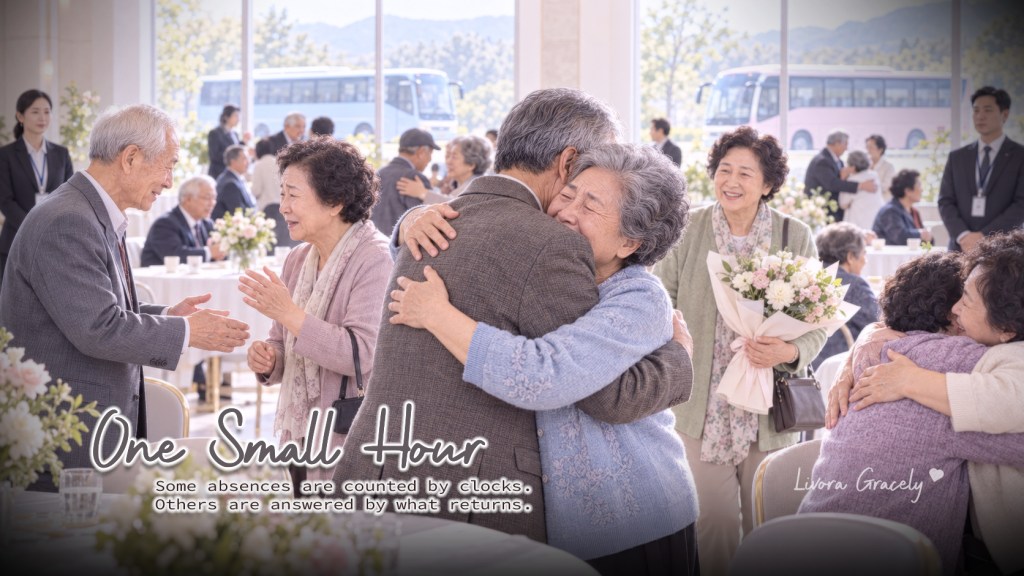
Some absences are counted by clocks.
Others are answered by what returns.
Philemon 1:15
The Second Goodbye
For some families, the reunion lasted only a few days.
The Korean War had divided homes with a border that became almost impossible to cross. Children grew old without knowing whether their parents were still alive. Brothers and sisters carried photographs of faces that remained young while their own faces changed.
Decades later, a limited number were allowed to meet through carefully arranged family reunions.
Imagine one of those rooms.
An elderly woman enters wearing a name card around her neck. Across the room stands a man she last saw as a boy.
She has prepared questions for years.
Now none of them seems large enough.
They sit close. They compare photographs. They discover which memories survived on both sides of the border and which ones have belonged to only one of them.
For a few days, time behaves strangely.
The child she remembers speaks with an old man’s voice. The sister he lost reaches across the table with a hand lined by years he never witnessed.
Then the reunion ends.
The photographs are packed again. The buses wait outside. The relatives who spent decades hoping for one meeting must endure another goodbye.
They were separated for most of a lifetime.
They were reunited for a little while.
Paul places those measurements in the opposite order.
Onesimus was separated from Philemon for a little while.
Perhaps, Paul says, so that Philemon might have him back forever.
The sentence sounds simple.
Its smallest word opens the deepest door.
A Smaller Word
Paul does not write, “This is why it happened.”
He writes, “Perhaps.”
That is a surprisingly modest word for someone interpreting a dramatic change.
Onesimus had been away from Philemon. During that absence, he had become Paul’s child in faith, useful in service, and precious to him. Now he was returning with a letter that asked Philemon to see him differently.
Paul could look at what had emerged from the separation and imagine providence at work.
But he did not claim to have read the hidden minutes of God.
Perhaps.
The word makes room for faith without pretending to possess omniscience.
We often speak more confidently about providence than Paul does.
Something painful happens, and before the wound has stopped bleeding, someone explains why God allowed it.
A door closes because a better one will open.
A relationship ends because the right person is coming.
A loss occurred because a lesson was needed.
Sometimes later events do reveal an unexpected good.
But a good result does not give us complete access to God’s reason for every part of the road.
Paul sees a possibility.
He does not turn that possibility into a verdict.
This is the first surprise inside the verse: mature faith can recognize providence while remaining humble about its explanations.
Providence can be trusted without pretending it has been explained.
That protects people who are suffering from having someone else’s certainty placed on top of their pain.
It also protects us from calling every detour necessary simply because something meaningful eventually grew there.
Paul does not praise the separation itself.
He wonders whether grace has made more of it than separation intended to become.
The Quiet Passive
Then comes another small surprise.
Paul does not say that Onesimus ran away.
He does not tell us that Onesimus stole money, escaped to Rome, or followed the familiar story later readers often place around him.
In this verse, Paul says he “was separated.”
The passive wording is gentle.
Some interpreters hear a divine passive: God, though unnamed, stands behind the separation and quietly directs it toward a greater good.
Others caution that the Greek verb can simply describe someone departing. The grammar alone does not prove that Paul intended God to be understood as the direct actor.
That disagreement is useful.
The passive opens a window.
It does not tell us who opened it.
Paul’s perhaps keeps us from forcing the window wider than the text allows.
He can see that an absence has become part of a larger story. He can invite Philemon to consider that possibility. But he does not erase human choices, declare every action good, or give a complete explanation of how the separation began.
Scripture contains more obvious patterns of departure and return.
Joseph was taken from his father and brothers, then encountered those brothers again when famine brought them to Egypt. Looking back, Joseph could speak of God preserving life through what others had intended for harm.
Moses left Egypt after his violent attempt to help an Israelite. Decades passed in Midian before God sent him back, no longer as a prince acting in sudden anger, but as a reluctant shepherd carrying a divine commission.
Those stories echo behind Christian imagination.
But they must not become a formula we press onto every separation.
Not everyone who leaves returns.
Not every broken relationship becomes safe.
Not every empty chair receives an explanation in this life.
The fact that God can redeem a separation does not mean we should call every cause of separation His good design.
Paul gives us a wiser language.
Not denial.
Not certainty manufactured after the event.
Perhaps.
An Hour Forever
Paul then places two measurements beside each other.
For a little while.
Forever.
The Greek phrase behind “a little while” can carry the sense of an hour or a brief season. Paul sets that small span against something enduring.
An hour beside forever.
The contrast is intentionally disproportionate.
Of course, the separation may not have felt brief to Philemon or Onesimus. We do not know how long it lasted. Pain does not become small merely because someone later compares it with a larger good.
Paul is not measuring how the absence felt.
He is measuring it against what the relationship might become.
Philemon may have thought primarily about getting Onesimus back.
Paul asks him to imagine receiving more than what had gone away.
The same man would return.
But return is not always rewind.
If Onesimus were received only into the old arrangement, then the distance would have closed while nothing essential changed. The body could return to the house while the relationship continued to live in its former room.
Paul’s word forever presses against that possibility.
An enduring reception cannot simply mean extending the past without end.
It must make room for what has become true during the absence.
This is the second deep surprise: sometimes the opposite of separation is not proximity.
It is reception.
Two people can occupy the same house and remain far apart. Someone can come home without being received. A door can open while memory keeps the old verdict locked in place.
Paul does not merely imagine Onesimus returning to a location.
He imagines Philemon having him back in a way that outlasts the absence.
The sentence continues beyond this verse, because forever still needs to be given relational meaning. But even here, the direction has changed.
The question is no longer only, “Will Onesimus return?”
It is, “What kind of future will receive him?”
The Waiting Middle
The contrast between a little while and forever reaches beyond this one household, but we must follow it carefully.
Onesimus is not a symbol for Christ. His separation from Philemon is not the same event as Christ’s ascension, and Paul’s perhaps is not a prophecy about the Second Coming.
Yet Scripture teaches Christians to hear time in a particular way.
Jesus told His disciples that for a little while they would not see Him, and then they would see Him again. Their sorrow would not be imaginary. It would become joy because absence would not have the final word.
After His ascension, the church began living inside another interval.
Christ has gone from sight.
Christ will come again.
Here the language changes.
Paul says perhaps when considering the hidden reason behind Onesimus’s separation.
The church does not say perhaps about Christ’s promised return.
We may be uncertain about what God is doing through a particular delay.
We are not uncertain about the One who promised to come.
That distinction matters.
Faithfulness does not require us to invent explanations for every absence. It requires us to live by what God has actually revealed while many explanations remain hidden.
In Jesus’ stories, servants waiting for their master are not praised for discovering the secret date of his return. They are praised for being faithful with what was placed in their hands.
Waiting is not empty time.
It is time entrusted to us.
The absent Master still shapes the conduct of the house.
His return reaches backward into the present and asks what kind of people we are becoming while no one appears to be standing at the door.
This is where Filemon 1:15 quietly prepares us.
Temporary circumstances are not necessarily small because they are brief. A single hour can reveal what we believe about forever.
How we speak when the Master seems delayed.
How we treat someone who has returned with a changed life.
How faithfully we carry what has been entrusted to us.
We do not need certainty about every hidden purpose in order to practice visible faithfulness.
We may say perhaps about providence.
We say surely about His return.
No Second Goodbye
Return to the reunion room.
The elderly woman and her brother rise from the table.
They have spent decades apart and only days together. Outside, two buses wait to carry them toward opposite sides of a border neither of them created.
There are photographs now.
There are answers to some questions.
There are new memories painfully small beside all the missing years.
Then comes the second goodbye.
Their story keeps us from making reunion sound easy.
Some separations last longer than anyone expected. Some people die before the door opens. Some relationships cannot be restored safely in the form we once desired.
Christian hope is not the claim that every earthly absence will soon receive a pleasant explanation.
It is the confidence that clocks, borders, distance, and death do not possess the final word.
Paul cannot see every hidden cause behind Onesimus’s absence.
He writes perhaps.
But he can see a possibility standing before Philemon: the brief separation need not determine the lasting relationship.
Onesimus can be received.
Not merely returned.
Received into a future larger than the past that separated them.
And beyond that doorway stands the greater Christian hope.
The One who has gone from our sight will not remain absent.
Until He comes, we do not have to turn mysteries into explanations.
We are asked to remain faithful inside the hour we have been given.
Some hours last longer than we imagined.
But the clock is not sovereign.
The One who promised to return is.

 Livora Gracely
Leave a comment