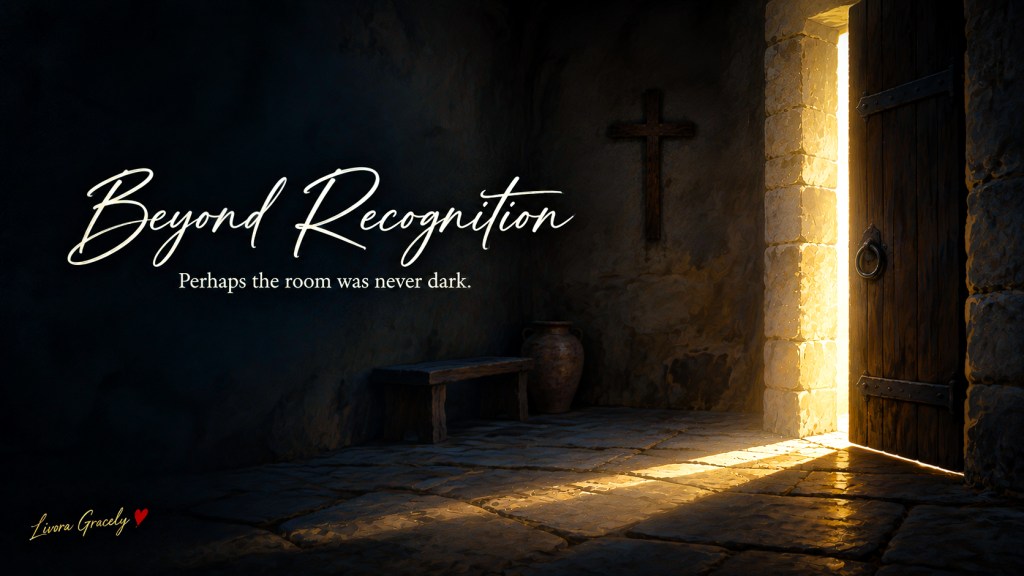
Some things do not become glorious when we finally notice them.
The Unasked Question
Can something become valuable because we recognize it?
The question sounds reasonable.
A painting hangs in a dark room. Someone turns on the light and discovers it is beautiful. We say the light revealed its value.
We do not usually say the light created the painting.
The painting had been waiting in the dark with remarkable patience.
Gold does not become gold when someone finds it. A mountain does not become high when a traveller finally looks up. The sun does not begin shining because one person has decided that daylight seems useful.
Recognition matters to the person who recognizes.
It does not always add anything to the thing being recognized.
This is one of the quiet questions behind the way John and Hebrews present Jesus.
Neither writer appears to be trying to make Jesus important.
That would be a rather exhausting assignment.
They are not arranging a public-relations campaign for heaven. They are not asking humanity to vote on whether Jesus deserves a larger title. They are opening a door and suggesting that the room was already full of light before we entered it.
John opens with a sentence that leaves very little room for a smaller interpretation.
“In the beginning was the Word.”
Not when Jesus began preaching.
Not when people began following Him.
Not when a crowd saw a miracle and decided that something unusual might be happening.
In the beginning.
Before the first human recognition, there was already the Word.
Two Witnesses
John and Hebrews do not look at Jesus from the same window.
John writes with the language of life, light, signs, bread, water, birth, sight, and glory. His Gospel often feels like a series of ordinary objects becoming unexpectedly deep.
Water is no longer only water.
Bread is no longer only bread.
A tomb is no longer only a tomb.
Light enters darkness, and darkness does not appear to have received the memo.
Hebrews looks through another window.
Its world contains angels, Moses, priests, sacrifices, blood, covenants, tabernacles, curtains, altars, rest, wilderness, and a city still to come.
John shows us what Jesus is.
Hebrews shows us what everything else was pointing toward.
This is why Hebrews can feel different even when it speaks of the same Christ. It does not merely introduce another teacher into the history of Israel. It walks through the sacred architecture of Israel and begins opening its hidden doors.
The old arrangements were not meaningless.
They were signs.
The priesthood mattered.
The sacrifices mattered.
The sanctuary mattered.
But Hebrews asks us to consider whether a sign can be mistaken for its destination.
A shadow is real.
It simply does not contain the person who casts it.
Seven Windows
John does not place all his light in one room.
He gives us windows.
Through one, Jesus is the Word who was with God and was God.
Through another, we see that all things came into being through Him. Creation is not a later achievement added to His résumé. It is already part of the opening sentence.
Another window reveals life and light.
Another reveals the astonishing descent: the Word became flesh and lived among us.
The One through whom the world came into being accepted the inconvenience of having a human body.
Bodies require sleep.
They become tired.
They get hungry at inconvenient times.
They walk dusty roads and sit near wells.
He is then shown as the Lamb of God, the One whose work is not merely to inspire but to deal with sin.
He speaks with the ancient words, “I am,” and John records the reaction of those who hear Him. The problem is not that the sentence is unclear. The problem is that it is clear enough to be dangerous.
Finally, Jesus is presented as the resurrection and the life.
Not merely someone who knows the way out of death.
Life itself, standing beside a grave and asking a question of people who are still crying.
John’s seven windows are not seven decorations.
They are seven invitations to enlarge the room.
A teacher may fit inside our understanding.
A prophet may fit inside our categories.
A miracle-worker may fit inside our amazement.
But John keeps moving the walls.
A Higher Order
Hebrews continues the work with a different vocabulary.
It tells us that God created the world through the Son.
It describes the Son as the radiance of God’s glory and the exact imprint of His nature.
He does not merely reflect glory the way the moon reflects sunlight. Hebrews presents Him as the radiance itself.
That is a more demanding image.
A mirror can show a face without possessing the face.
The Son is not described as a religious mirror placed in the corner of creation. He is presented as the exact expression of God’s being.
Hebrews then says that He sustains all things by His powerful word.
The world is not merely made through Him and then left to continue on its own. It is held.
Somewhere beneath the noise of history, the universe is being carried by a word more dependable than our morning plans.
Then the letter places Him above the angels.
This matters because angels are not small figures in the imagination of Hebrews. They are servants, messengers, and heavenly beings. Yet even they are not the Son.
He is worshiped by them.
He is given a throne.
His kingdom is described as everlasting.
He enters human suffering and is not ashamed to call human beings brothers.
And He becomes the great High Priest—the One who does not merely stand near the holy place, but opens a way for others to draw near.
The list is beginning to feel less like an introduction and more like an attempt to stop the reader from making Jesus smaller than the evidence allows.
Hebrews does not appear to be saying, “Please admire Him.”
It is saying, “Before you decide what kind of person He is, notice the room He already occupies.”
The Rare Thing
There is a temptation to call Jesus rare.
The word is attractive.
Rare things are valuable. They are difficult to find. They are kept carefully. They are sometimes placed behind glass while people stand nearby and admire them.
But Jesus is not a spiritual object in a cabinet.
He is not a rare possession for people who have discovered what everyone else missed.
That would make faith sound rather like an expensive hobby.
The deeper truth is more unsettling.
Jesus does not become precious because He is difficult to understand. He is precious because He is who He is, whether or not we understand Him.
Our recognition is not His source of value.
It is our moment of awakening.
This also protects us from a certain kind of religious pride.
If we say, “We saw what others could not see,” we may quietly turn revelation into personal achievement.
But John begins with the Word.
Hebrews begins with God speaking.
The light is not praised because the room congratulated itself for finding the switch.
The light was already there.
We were the ones standing in the dark, offering theories about the furniture.
The Opened Sight
Why, then, do some people receive Jesus while others resist Him?
The answer cannot simply be lack of information.
John gives us people who see signs and still do not see.
Hebrews warns people who have heard the voice of God not to harden their hearts.
A person can stand near light and remain committed to darkness.
Not always because the light is weak.
Sometimes because the light is inconvenient.
It reveals the room as it is.
It shows the dust.
It exposes the arrangement we had called acceptable.
It may even reveal that the chair we placed in the centre belongs to someone else.
We like a Jesus who can be admired without being obeyed.
We like a Jesus who can inspire without interrupting.
We like a Jesus who confirms our ideas about goodness, but does not ask what we will do with our pride, our fear, or the person standing outside our door.
The blind spot is not always unbelief in its loudest form.
Sometimes it is reduction.
Jesus becomes a teacher, but not Lord.
A symbol, but not a living presence.
A solution, but not the One who asks us to change.
John and Hebrews do not force the reader to pretend.
They do something more demanding.
They keep showing us Jesus from angles that our preferred definition cannot contain.
John shows the Word becoming flesh.
Hebrews shows the Son entering the sanctuary, carrying the weight of human weakness, and opening a way toward God.
At some point, the question is no longer whether the light has been given.
It is whether we are willing to see what it reveals.
Before Applause
The glory of Jesus does not wait for human approval.
John does not begin with a committee.
Hebrews does not begin with a survey.
No one asks the angels whether the Son deserves worship. They worship Him.
No one asks creation whether it feels adequately impressed. It continues to depend on Him.
No one asks the darkness whether it is ready for light.
The light comes.
This does not make human response unimportant.
It makes it revealing.
When someone receives Jesus, that response does not create His glory. It shows that the person has begun to recognize it.
When someone rejects Him, that rejection does not diminish His glory. It may reveal how strongly a human heart prefers a smaller room.
Perhaps this is why Hebrews can follow Philemon so naturally.
Philemon leaves us with a man standing outside a house and a letter asking that he be received as a brother.
Hebrews opens a larger question.
What happens when the One who stands before us is greater than the categories we have prepared for Him?
Will we open the door?
Will we keep the old arrangement and call it wisdom?
The light does not become brighter when someone opens his eyes.
He simply stops calling the room dark.


Leave a comment