Livora Gracely is a pen name.
This little corner gathers whimsical stories, gentle reflections, and Scripture-inspired writing for readers who still enjoy noticing small things.
Some stories begin with questions.
Others begin with a quiet morning, a cup of tea, an old bench, or a verse that refuses to be forgotten.
The person behind the name simply prefers the words to arrive before the writer.
Writing to remember.
Sharing to inspire.
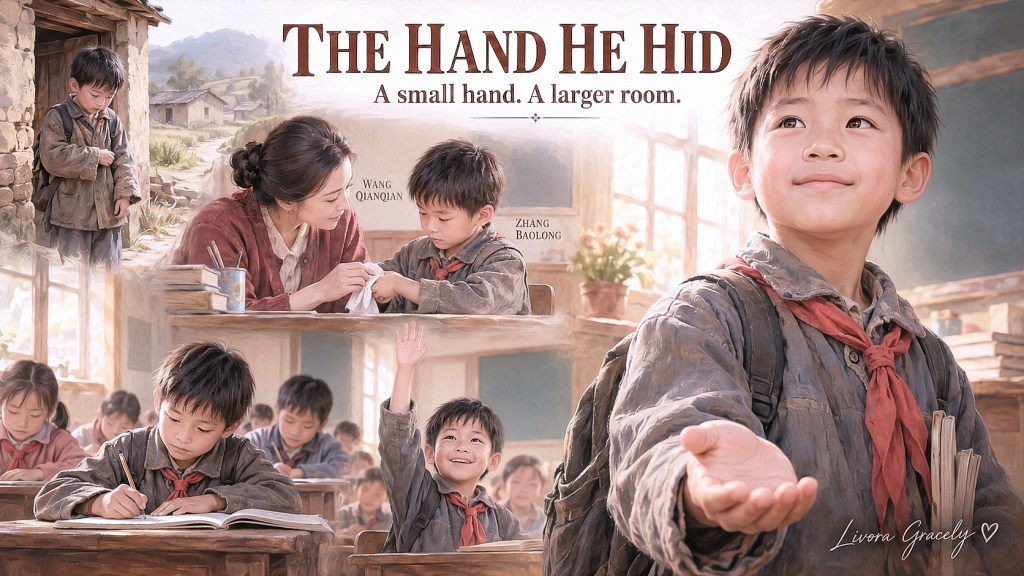
The first thing Wang Qianqian noticed was his hand.
She had called Zhang Baolong over during class. He came toward her in old clothes and loose slippers, his eyes lowered and his shoulders slightly bent.
“Let me see your hand.”
Zhang held it out.
His fingers were rough. The nails were dark. The skin around them was cracked and dirty. It was the kind of hand that made adults start asking questions about a child’s home before asking the child anything about himself.
Wang took it gently.
She cleaned his nails and held his hand between both of hers. Zhang watched her without speaking.
His mother had died when he was very young. His father was raising two boys while also caring for an elderly grandmother. They lived in a rural home where money had to stretch across more needs than it could easily cover.
Zhang had learned to remain quiet.
Wang did not begin with a lesson.
She began with his hand.
The First Smile
After that day, Wang kept calling him over.
She told him that she liked him. She told him that he was handsome. She asked him to think of her as a mother.
The words were simple.
Zhang did not answer with a speech. He stood in front of her, looking slightly uncomfortable, as though affection were another subject he had not yet studied.
Wang continued.
She said it again the next day.
And the day after that.
The classroom remained busy around them. Children opened their books, moved between desks, answered questions, and waited for the teacher to finish speaking. Zhang stood among them, quiet and watchful.
Then something changed.
Not dramatically.
He looked up.
The next time Wang called him, he came a little faster. When she spoke, he stayed close instead of looking toward the door. Once, she asked him to smile.
He tried.
The first attempt was small and uncertain. It appeared briefly, then seemed to reconsider the decision.
Wang smiled back.
Zhang tried again.
This one stayed a little longer.
The teacher began sharing short videos of him. In the early ones, Zhang looked stiff and withdrawn. He kept his arms close to his body and avoided the camera.
Wang kept speaking to him.
She called him good-looking. She told him that he was loved. She placed a hand on his shoulder. She asked him to come closer.
The camera remained in the same classroom.
Zhang did not.
The Classroom
There was no new uniform to announce the change.
No prize.
No examination result.
The desks stayed where they had always been. The other children continued moving around him. Someone was always opening a notebook or asking a question. Someone else was probably finishing an exercise before everyone else, which is one of the small injustices of every classroom.
Zhang began joining them.
He started responding when Wang spoke to him. He became more willing to stand near the other children. He allowed himself to play.
Sometimes Wang asked him to perform a small dance for the camera.
At first he looked embarrassed.
Then he did it.
The movements were not perfect. That was part of their value. He was no longer waiting until he could perform without making a mistake.
He began making faces at the camera too.
A child who had once kept his face still now seemed to have discovered that it could do several different things.
Wang laughed.
Zhang laughed because she laughed.
The next time, he made the face first.
His father still had the same responsibilities at home. The old clothes had not explained everything, and the new smile did not erase anything. Zhang’s mother was still absent. The family’s house was still poor.
But the boy in the videos was no longer standing at the edge of every moment.
He came when Wang called.
He looked when she spoke.
He stayed when the other children gathered around.
The classroom had not become quieter.
Zhang had simply begun to take part in its noise.
Sixty Days
About sixty days after the first videos, Wang shared another one.
Zhang was standing in front of the camera.
He smiled.
Then he made a face.
He looked toward the other children and moved among them with the restless energy of someone who had remembered that school was allowed to contain more than lessons.
Wang was nearby.
She did not need to pull him forward.
He had already stepped into the picture.
The first time she called him over, Zhang had approached with his hand hidden and his eyes lowered.
Now he lifted his hand toward the camera.
The fingers were still small.
The hand still belonged to the same child.
This time, it was not being offered because an adult had asked to see it.
The first rabbit had been studying the stone for quite some time.
It was a perfectly ordinary stone.
Round.
Gray.
Wet around the edges.
Unfortunately, it was also on the other side of some water.
The rabbit crouched.
He leaned forward.
He leaned backward.
He examined the distance again.
Behind him, three rabbits waited.
One was patient.
One was less patient.
The fourth had already begun stretching.
This seemed unnecessary.
The First Jump
The stream moved gently between the stones with a bright little shhh-shhh, carrying tiny leaves around their edges. The air smelled of wet grass and cool mud. Moss softened the rocks in dark green patches.
The first rabbit lowered himself until his belly nearly touched the stone.
One.
Two.
Three—
Hop.
He landed on the next rock.
All four feet arrived together.
Nothing terrible happened.
He looked back with the expression of someone who had personally established that stone travel was possible.
The second rabbit required no further evidence.
He jumped.
Splash.
Not into the stream.
Almost.
One back foot clipped the water and sent a cold spray across his tail.
He froze.
The other rabbits froze.
A drop slid from one ear.
Then he shook himself and jumped again.
Apparently dignity dried quickly in sunshine.
Four Techniques
By the third stone, everyone had developed a method.
The careful rabbit inspected every landing place before moving.
Crouch.
Measure.
Hop.
Check.
The smallest rabbit preferred tiny jumps.
Hop.
Hop.
Hop.
If two stones were close enough to be reached in one leap, she used two anyway.
Nobody knew how.
The third rabbit simply jumped whenever enthusiasm reached sufficient pressure.
This produced excellent speed and questionable landings.
And then there was the fourth.
He waited until the others were watching.
He backed up.
Lowered his head.
Raised his tail.
The stream continued flowing, unaware that an important athletic event was about to occur.
He ran three steps and launched himself.
His front legs stretched forward.
His back legs stretched backward.
His ears streamed behind him.
For one magnificent second, he appeared to believe there might be judges.
He landed safely on the next stone.
Then slid six inches.
Scrrrp.
One foot entered the water.
Splash.
The smallest rabbit laughed so hard she nearly fell in too.
Across
They continued.
Stone.
Crouch.
Jump.
Land.
Sometimes splash.
The four rabbits never crossed the stream in quite the same way.
One needed certainty.
One needed small steps.
One needed momentum.
And one apparently needed an audience.
Yet somehow they kept arriving at the next stone together.
Perhaps shared happiness has never required matching technique.
A picnic can contain the person who eats immediately and the one arranging everything beautifully first. A puddle invites one child around it and another directly through it. Even laughter has different speeds.
Sameness is remarkably unnecessary when everyone is having a good time.
The rabbits, fortunately, had no interest in discussing this.
There was one stone left.
The Other Side
The careful rabbit crossed first.
Hop.
The smallest followed.
Hop-hop.
The enthusiastic rabbit landed beside them with a little spray.
The athlete came last.
Naturally, he made it enormous.
He soared over the final gap and landed on the grassy bank with all four feet spread dramatically.
Success.
Four rabbits.
One stream.
No casualties.
They stood together on the far side, breathing quickly, fur ruffled by the breeze.
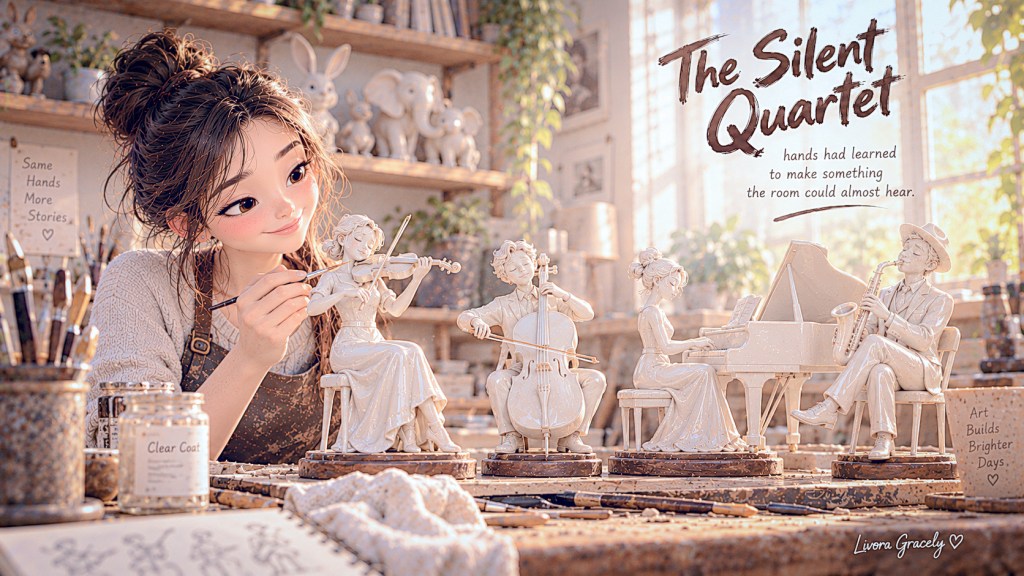
Her hands had learned to make something the room could almost hear.
The violinist had been playing the same note for three days.
Nobody complained.
The cellist had been holding one long note for even longer.
The pianist had ten perfectly silent fingers.
And the saxophonist had somehow managed to look exhausted after performing absolutely nothing.
At twenty-one, the young artist found this deeply satisfying.
She leaned over the worktable and touched a fine brush to the violinist’s shoulder.
The clay was no longer brown.
She had chosen a smooth white body for this project, shaped carefully, dried slowly, and fired until the four musicians could finally survive hands less gentle than hers.
Now came the finishing.
A jar of clear coating stood open beside her.
The studio smelled different these days.
Damp earth was still there somewhere, familiar and faint, but now it mingled with the cleaner scent of finishing materials. Brushes stood upright in jars. Fine tools were arranged by size. A soft cloth waited beside the figures.
Even the table seemed to have learned some discipline.
Some.
She brushed a thin layer across the violinist’s sleeve.
The surface changed immediately.
Not color.
Light.
The afternoon window appeared as a tiny gleam along the shoulder. Another reflection traveled down the violin. The white clay seemed suddenly deeper, smoother, almost porcelain-like.
She rotated the figure.
The violinist’s eyes were closed.
That detail had taken an entire evening.
Years ago, she would have worried whether closed eyes looked realistic.
Now she had been asking a different question.
What was the violinist hearing?
That question had changed everything.
The cellist leaned slightly into the instrument, bow suspended across the strings. The pianist sat forward, shoulders relaxed, fingers arriving at different heights above the keys.
And the saxophonist—
she smiled.
He had become her favorite.
One ankle crossed casually over the other. His shoulders sat lower than the rest. His head tilted just enough to suggest that whatever the quartet was playing, he intended to bend the rules before the final bar.
Four figures.
Four instruments.
Four different ways of inhabiting the same invisible music.
She applied another stroke of clear coating.
Swish.
Turn.
Swish.
Wait.
Light crossed the wet surface.
Behind her, the shelves held a much older audience.
The first lumpy creature.
The rabbit with its impossible teeth.
The elephants.
She rarely noticed them while working now.
But sometimes, when evening light reached the shelf, seven years could fit into a single glance.
Brown clay.
Crooked ears.
A father’s hands.
A calf looking upward.
And now this.
She looked at her own fingers.
They were steadier.
Certainly.
But steadiness wasn’t the largest change.
At fourteen, her hands had been busy trying to control clay.
At seventeen, they had begun understanding form.
At twenty-one, something stranger was happening.
Her hands were trying to express things that had no shape at all.
Sound.
Mood.
Rhythm.
Personality.
How does clay play music?
It doesn’t.
That was precisely the problem.
A violin could be sculpted accurately and still remain silent in every sense.
So could a face.
So could a hand.
Technical correctness could produce four musicians who looked as though they were posing for photographs with borrowed instruments.
She wanted something else.
She wanted the viewer to arrive after the first note had already begun.
So the cellist’s bow was caught halfway through its journey.
The pianist’s fingers did not sit neatly on the keys.
The violinist leaned.
The saxophonist breathed.
Nothing actually moved.
Yet everything had been shaped around movement.
Perhaps this was what her father had been teaching years ago when he spent eleven minutes on one eye.
She had thought he was shaping an eyelid.
He had been shaping a wink.
The difference had taken her years to understand.
Craft learns the object.
Art begins listening for what the object is supposed to carry.
A photographer eventually stops seeing only exposure.
A writer stops seeing only sentences.
A cook stops following only measurements.
A musician stops merely producing correct notes.
Skill becomes interesting when technique grows quiet enough for something else to speak through it.
The young artist placed her brush down.
Four polished figures caught the window light.
The studio remained silent.
No violin.
No cello.
No piano.
No saxophone.
She stepped backward.
For a strange second, she could almost hear them.
Then she noticed the saxophonist.
His chair was slightly crooked.
She stared at it.
Seven years earlier, she would have fixed it immediately.
She reached toward him.
Stopped.
Looked again.
Then smiled.
The chair stayed crooked.
Apparently, even after seven years of practice, one member of the quartet still needed to misbehave.
And somewhere on the shelf behind them, a rabbit with two enormous teeth would have understood perfectly.
None of those things looked particularly important at first.
The file contained a difficult beginning.
The sleeve belonged to a young man almost ready to advise Athens—until Socrates pulled it.
The chair belonged to a counselor whose advice had become so respected that kings waited for him to speak.
Three people.
Three very different rooms.
And three names that had become surprisingly heavy.
The First Name
Julius came from Kenya carrying facts that were completely true.
A difficult childhood.
A children’s home.
Financial limitations.
He had needed help.
Nothing about his later success made those facts disappear.
But something happened when more pages were added.
The boy described by the first pages eventually completed his studies with first-class honors and was recognized among the outstanding students of his academy.
The old file survived.
It simply became much less impressive at predicting the future.
There was still room for another page.
The Second Name
Alcibiades had the opposite problem.
His file would have looked wonderful.
Family. Education. Connections. Talent. Ambition.
Athens was waiting for him.
He was almost ready to climb the steps and begin advising the city when Socrates interrupted the journey with questions.
Not accusations.
Questions.
That proved inconvenient.
Alcibiades had spent years acquiring reasons for Athens to listen to him. Socrates needed only a few minutes to discover subjects on which Alcibiades needed to listen.
Nothing was taken away from the young man.
He remained gifted.
The steps remained available.
Athens remained interested.
Socrates eventually released his sleeve.
The questions went with him.
The Third Name
Ahithophel no longer needed to climb any steps.
He had arrived.
Kings listened when he spoke.
His advice carried extraordinary weight, and on one particular night his plan was good enough that Absalom and the elders agreed with it.
The map could almost be rolled.
Then another chair was brought into the room.
Hushai spoke.
The room changed its mind.
Ahithophel went home.
Later, someone finally rolled the map and pushed his chair back toward the table.
The room was ready for another meeting.
Three stories had reached three very different endings.
The file remained.
The questions remained.
The chair remained.
People moved on.
Still Learning
A difficult beginning can become a name.
So can talent.
Eventually, even expertise can become one.
None is necessarily a lie.
Julius really had needed help.
Alcibiades really was gifted.
Ahithophel really was a remarkable counselor.
Perhaps that is why the names become comfortable.
The danger does not always arrive wearing an insult.
Sometimes it arrives as a compliment that has been true for a very long time.
Learning without end asks for something surprisingly small.
This twenty-first article closes our journey through Philemon. It returns to the whole letter, from the names at the door to the grace at the final line, and asks what kind of growth the letter quietly requires from everyone inside it.
Philemon is not merely the man expected to settle Paul’s request concerning Onesimus. Paul addresses Apphia, Archippus, and the church meeting in Philemon’s house. As host and fellow worker, Philemon’s response would carry unusual weight. If he refused Onesimus, the congregation gathered beneath his roof might find its own response arranged around that refusal. If he received Onesimus as a brother, his welcome could become the welcome of the room.
The letter never tells us which way the room moved.
That silence will remain. Hebrews will not supply the missing biography of Onesimus, and this series will not ask it to. But Hebrews will take us through the next doorway: toward believers who must resist hardened hearts, encourage one another, move toward maturity, endure, and keep growing into what they confess.
Philemon closes with one man holding a letter and one brother waiting for room. Hebrews will widen the question: what kind of people can keep making room because they have not stopped growing?
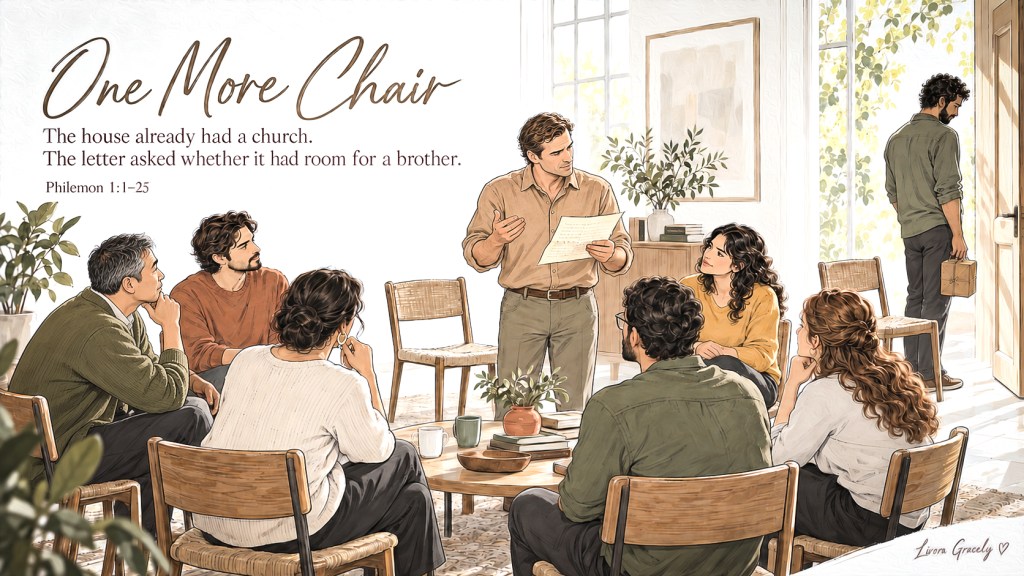
The house already had a church. The letter asked whether it had room for a brother.
Philemon 1:1–25
Front Door
The letter arrived at a house that already knew how to open its door.
Paul addressed Philemon, Apphia, Archippus, and the church meeting in their home. There must have been places to sit, voices crossing the room, bread being passed, and enough welcome for a congregation to gather beneath one roof. Philemon was not being introduced to hospitality. It had already become part of his name.
Paul began with grace and peace.
He would end with grace too. Between those two words, however, someone had to enter the house.
Onesimus was returning with a history the letter does not fully narrate. Paul does not begin by listing it. He first addresses the room into which that history will arrive. The appeal is personal, but it is not private. Apphia, Archippus, and the church are named before Onesimus is.
The house has witnesses.
That makes Paul’s greeting more than courtesy. Peace is about to be asked to govern an actual relationship. Grace is about to require furniture.
The house already had chairs.
One of them was about to become complicated.
Comfortable Reputation
Paul thanks God for Philemon.
He has heard of Philemon’s love and faith. The hearts of the saints have been refreshed through him. This is not strategic flattery laid down before a difficult request. Paul names something true: Philemon has become a source of joy and encouragement to other believers.
The compliments are accurate.
This is going to make them less convenient.
A good reputation can become a comfortable chair. After enough people have praised it, a person may sit down inside the name and assume the learning portion of the evening is over. But Paul’s gratitude does not frame Philemon’s character and hang it safely on the wall. He brings that character to the next test.
The man known for refreshing hearts will soon be asked what happens when one particular heart arrives carrying an inconvenient past.
Paul writes elsewhere, “Do not be conceited.” He places the warning beside harmony, humility, and willingness to associate with people of low position. In Romans 12:16, these are not separate virtues. Harmony becomes impossible when one person’s social height is treated as proof of superior sight.
Philemon’s standing in the church does not make him the villain of the letter. It also does not make him the one person in the room who has nothing left to learn.
His reputation is real.
Paul simply refuses to let it become final.
Folded Authority
Paul could command.
He says so himself: he is bold enough in Christ to order Philemon to do what is required. The authority is present, properly identified, and then left unused.
It remains folded inside the letter.
Instead, Paul appeals on the basis of love. He calls himself an old man and a prisoner of Christ Jesus. The apostle does not disappear, but he chooses not to make his title the loudest person in the room.
This is Romans 12:16 before the verse is quoted. Paul does not regard his own wisdom, age, calling, or relationship with Philemon as permission to stand above everyone else. He lowers his voice without lowering the truth.
Then he introduces Onesimus.
Not as a case.
Not as property under discussion.
As “my child,” whose father Paul became while in chains.
The prisoner has somehow acquired family. Rome supplied the chains. It appears not to have checked Paul’s guest list.
Paul even calls Onesimus his own heart. Authority has now done something unusual: rather than protecting its distance, it has placed itself beside the person with the least power in the arrangement.
Paul knows what he believes Philemon should do. Yet he still leaves room for Philemon to do it willingly. A command might produce compliance. Paul is asking whether love can produce recognition.
The difference will matter when someone chooses where Onesimus may sit.
Useful Trouble
Paul allows himself one piece of wordplay.
Onesimus, whose name is associated with usefulness, had formerly been useless to Philemon. Now, Paul says, he has become useful both to Philemon and to Paul.
The sentence smiles briefly.
The situation does not.
Onesimus is being sent back. Paul would have liked to keep him nearby, but he will not quietly arrange Philemon’s response in Philemon’s absence. He returns the man, the question, and the freedom to answer.
Then Paul offers a possibility: perhaps the separation happened for a while so that Philemon might have Onesimus back forever—no longer merely as a slave, but more than a slave, as a beloved brother.
“Perhaps” matters. Paul does not claim secret knowledge of God’s purpose. He looks at a painful situation and notices that grace may be doing more with it than anyone first expected.
This is where Romans 12:2 enters the house. “Be transformed by the renewing of your mind.” Renewal does not merely give Onesimus a better description. It asks Philemon to see the same man within a new relationship.
The doorway has not changed.
The category has.
Paul describes inward renewal elsewhere as happening “day by day.” It is not a ceremony awarded to beginners while mature believers watch. Onesimus needs a renewed life. Philemon needs renewed sight. Paul’s own authority is renewed in the way he uses it.
No one graduates from this work.
A name may be true and still be incomplete. A person may be changed through an encounter he did not plan. A difficult situation may arrive looking like an interruption and quietly rearrange the room.
The furniture, so far, has offered no objection.
Charged Account
Paul now makes the request impossible to keep abstract.
“If you consider me a partner, welcome him as you would welcome me.”
If Onesimus has wronged Philemon or owes him anything, Paul says, the amount may be charged to Paul’s account. Then he takes the pen and writes the promise in his own hand.
The debt is not declared imaginary. Grace does not require poor bookkeeping. It asks who is willing to carry the cost so that a relationship need not remain imprisoned by it.
Paul places himself inside the account.
Then, with a small turn of the pen, he reminds Philemon that Philemon owes Paul his very self.
The arithmetic has become crowded.
There is a possible debt from Onesimus to Philemon, a larger debt from Philemon to Paul, and an offer from Paul to pay. Everyone appears in someone else’s column. The ledger was doing reasonably well until brotherhood arrived.
Paul writes elsewhere, “By the grace of God I am what I am.” That confession does not mean, “I need never change.” It means that identity begins in grace rather than self-invention. To the Colossians he adds another instruction: let Christ’s peace rule among the members of one body—and be thankful.
Gratitude keeps identity from becoming pride. Renewal keeps gratitude from becoming passivity.
Paul can be an apostle and still appeal. Philemon can be a respected host and still be corrected. Onesimus can acknowledge a troubled past without agreeing that the past is his permanent name.
Each may say, in a different way, “By grace, I am what I am.”
None may use it to say, “Therefore I shall remain exactly as I am.”
Paul is confident that Philemon will obey and do even more than requested. He does not describe the “more.” Perhaps some answers become smaller when written too early.
The account remains open.
So does the door.
Spare Room
Then Paul asks Philemon to prepare a guest room.
The request is wonderfully ordinary. After love, partnership, slavery, debt, reconciliation, and brotherhood, Paul would also appreciate somewhere to sleep.
Philemon is to prepare it because Paul hopes to be restored to them in answer to their prayers. The letter suddenly gives the future a bed, a doorway, and the possibility of an apostle arriving to see what happened after his appeal was read.
Paul may be a prisoner, but his travel plans have not received the news.
The guest room also places a quiet question beside Philemon. Preparing for Paul would be natural. Paul is honoured, beloved, and expected. Receiving Onesimus is harder precisely because the same welcome must cross a social boundary.
It is possible to prepare a beautiful room for an apostle while leaving no ordinary chair for a brother.
Paul then names Epaphras, Mark, Aristarchus, Demas, and Luke. The appeal that began among names closes among names. Some carry histories of restoration. Some will remain. One will later leave. None has become unnecessary to the sentence simply because his story is unfinished.
Finally, Paul writes, “The grace of the Lord Jesus Christ be with your spirit.”
That final blessing gathers the whole letter.
Do not assume you are wise enough to place another person permanently beneath you. Let the mind be renewed, because yesterday’s categories are often surprisingly punctual. Receive your life as grace, and let gratitude make room for peace within one body.
Philemon must remain teachable despite his good name. He must allow an unplanned person and an awkward situation to reshape what welcome means. Then he must choose an action that Paul cannot perform for him.
The strength for that choice does not come from reputation alone.
Grace has been present since the first line.
The letter ends there. We are not told whether Philemon rose from his chair, crossed the room, or called Onesimus brother. We are only shown what had been placed before him.
Sometimes the first lesson in flying is discovering who will catch you.
The first cub had been flying for approximately three seconds.
This was already longer than expected.
He floated above his mother’s enormous paws, all four legs stretched toward directions that had apparently been agreed upon only moments before. His belly faced the pale sky. His ears disappeared into the white fur around his head.
His mouth was open.
Whether he was laughing or issuing instructions to the clouds was difficult to determine.
Below him, his mother lay comfortably on her back in the snow.
She pushed him higher.
The cub squealed.
Behind them, two other cubs watched.
They had seen enough.
A queue formed.
First Flight
Snow fell lightly over the valley, the flakes so fine that some landed on the mother’s nose and stayed there.
She ignored them.
There were more important matters overhead.
The cub came down.
Soft belly against softer belly.
For half a second he disappeared into his mother’s fur.
Then his head popped up.
Again.
Apparently one successful landing had convinced him that aviation was now a family business.
His mother raised him once more.
Up he went.
The mountains behind them were barely visible through the mist. Their gray shapes rose and vanished again as the snow moved across the valley. Everything smelled clean and cold—the dry scent of snow, damp fur, and that sharp frozen air that made every breath visible.
The cub was the only one who had not been consulted.
Next, Please
Eventually he landed beside her and immediately began bouncing through the snow.
The second cub stepped forward.
He had been studying the procedure carefully.
Lie on mother.
Climb onto paws.
Go up.
Come down.
Become expert.
Simple.
He approached with the seriousness of someone reporting for an important appointment.
The third cub followed directly behind him.
There was now unmistakably a line.
Their mother looked at both of them.
Then at the first cub, who was still running in circles nearby.
Then back at the line.
Three children.
Four paws.
This had seemed like better mathematics before the children became interested.
The second cub climbed aboard.
Up.
His legs stiffened at first.
Then one paw opened.
Then the other.
A little snow collected on his belly.
Higher.
His ears flattened in the breeze.
And suddenly his whole body loosened.
There it was.
That strange little moment when caution forgot what it had been doing.
His paws opened completely.
His mother watched from below.
He could not see her anymore.
But he could still feel her paws beneath him.
Again
By the time the third cub received his turn, the snow around their mother had become a battlefield of tiny footprints.
There were landing marks.
Takeoff marks.
Several marks with no obvious explanation.
The third cub was the smallest.
He climbed more slowly.
One paw onto his mother’s belly.
Then another.
He looked upward.
The distance suddenly seemed considerably larger from here.
His mother waited.
Snow gathered along the curve of her shoulder.
The cub looked at his siblings.
They were watching.
He looked at the sky.
Then at his mother.
She nudged him gently with her nose.
That was all.
He climbed onto her paws.
At first his little legs remained tucked close to his body.
She lifted him.
A few inches.
He grabbed at her fur.
She lowered him.
Nothing happened.
No lecture.
No disappointed audience.
Only snow.
The first cub sneezed.
They tried again.
This time, a little higher.
His paws loosened.
Again.
Higher.
One paw stretched outward.
Then the other.
By the fourth attempt, the smallest cub was flying.
At least according to the smallest cub.
And perhaps that was enough for one afternoon.
What Hands Do
There is a peculiar courage available only to those who know something is beneath them.
Children discover it before they have words for it.
They climb one stair higher because a hand is nearby. They jump from the edge of a swimming pool toward someone waiting in the water. They ride a bicycle farther once they stop checking whether the hand is still holding the seat.
For a while, confidence can be borrowed.
Someone else’s hands become the ground from which a smaller person experiments with the sky.
Eventually, of course, the hands have another job.
They loosen.
That is harder.
The one being lifted must discover balance.
The one doing the lifting must discover release.
But this afternoon had not reached that lesson yet.
This afternoon was still about going up.
So the mother remained on her back beneath the pale sky, wet snow melting into her fur.
One cub flew.
Two waited.
Then they changed places.
Again.
And again.
Until the mountains disappeared almost completely behind the evening mist.
At last the mother rolled onto her side.
Enough.
Three exhausted cubs collapsed against her.
For several minutes nobody moved.
Snow settled over four white bodies until their outlines almost disappeared into the valley.
“The grace of the Lord Jesus Christ be with your spirit.”
Perhaps the room became quiet after that. Someone may have folded the letter. Someone may have looked toward Filemon. Onesimus may have been near enough to hear his own future discussed, or he may have been waiting beyond the room. The text does not arrange the furniture for us.
It leaves one thread loose.
Paul has greeted the church, thanked God for Filemon, spoken of love and faith, pleaded for Onesimus, offered to carry any debt, and asked that a guest room be prepared. He has named the people beside him and placed the entire appeal beneath grace.
Then he stops.
There is no final paragraph reporting Filemon’s decision. No second hand adds, “He agreed.” No line tells us what Onesimus saw when the letter was lowered.
The letter is complete, but the moment is not.
That distinction matters. A finished sentence can place an unfinished decision into someone’s hands. Paul has said what he can say. The ink has reached the bottom of the page. What remains cannot be written from prison.
It must be lived somewhere else.
Door Logic
A letter can cross a distance more easily than a person can cross a room.
Paul’s words have travelled toward Filemon, but Onesimus is not merely a message attached to them. At some point, the appeal must acquire a face. A name spoken in the letter must stand within the household to which it was sent.
That changes the logic of the door.
Before the letter, the door could be understood through ownership, failure, debt, offence, or fear. Paul does not pretend those realities never existed. He does something more demanding: he asks Filemon to open the same door under a different description.
“Receive him as you would receive me.”
The sentence gives Onesimus no new height, clothing, accent, or history. He arrives as the same man. What changes is the way Filemon is being asked to see him.
This is where spiritual language becomes inconveniently physical. “Beloved brother” must eventually affect distance, voice, posture, and welcome. It must decide who may enter, where he may stand, and whether the past will be the only thing allowed to speak.
Paul can place his name beside Onesimus.
He cannot open Filemon’s door from Rome.
Borrowed Courage
Paul’s appeal is gentle, but it is not light.
Filemon is asked to make a decision that may disturb the familiar arrangement of his household. Onesimus must return carrying a letter that cannot guarantee the expression on the face of the man who receives it. Paul sends both his confidence and his affection across a distance while remaining unable to control the result.
Each man is standing inside a different limitation.
So Paul lends what can be lent.
He lends Onesimus his own name: “Receive him as you would receive me.” He lends Filemon confidence: “I am confident of your obedience.” He lends the unpaid account his signature: “Charge that to me.” He even lends the future a small domestic detail by asking for a guest room.
But borrowed courage is still courage that another person must use.
Filemon cannot admire Paul’s generosity and leave Onesimus untouched by it. Onesimus cannot remain forever inside Paul’s protection. Paul cannot turn affection into obedience by pressing harder on the page.
This may be why the letter ends with grace rather than certainty.
Grace does not make human response unnecessary. It makes a new response possible. It reaches people where persuasion, reputation, and obligation have carried them as far as they can go—and then asks them to take a step that cannot be borrowed from anyone else.
Blank Margin
The blank space beneath Paul’s final words has attracted many answers.
Perhaps Filemon welcomed Onesimus immediately. Perhaps the household watched a difficult reconciliation begin. Perhaps old habits survived longer than anyone hoped. Perhaps Onesimus later became a known leader in the church.
Some possibilities are moving. None of them is written in this letter.
The silence should not be treated as an invitation to manufacture certainty. It is possible to love an ending so much that we quietly invent it. But an invented answer can make the real question disappear.
The question is not only, “What did Filemon do?”
It is also, “What had the gospel now made possible for him to do?”
Paul does not leave Filemon without direction. He has called Onesimus his child, his heart, a beloved brother, and someone to be received as Paul himself. He has appealed through love, accepted the cost, and brought the matter before the church that meets in Filemon’s house.
The road is marked clearly.
Only the footsteps are missing.
That missing sound keeps the letter alive. If Filemon’s response had been neatly summarized, we might admire it from a safe distance. Instead, the blank margin refuses to let us remain only spectators. It waits beside every relationship in which a Christian confession must become a Christian reception.
Not Yet
No one in this letter can be reduced to the name by which he first entered it.
Onesimus is not only the man whose past has created a problem. Paul is not only the apostle with the right answer. Filemon is not only the respected believer expected to behave well. Even the companions named at the end are not fixed portraits. Their histories contain restoration, endurance, quiet faithfulness, and, in one case, a departure still to come.
The letter catches all of them in motion.
Paul is still learning how authority can kneel without becoming weak. Filemon is still learning whether love praised in public can make room for costly obedience at home. Onesimus is still learning what a changed relationship may require after the letter has spoken on his behalf.
Grace meets them there—not as finished men displaying a lesson, but as people for whom the next faithful act still matters.
This does not diminish them. It tells the truth about them.
A good name does not place someone beyond correction. A wounded name does not place someone beyond renewal. A useful past does not guarantee a faithful future. A failed past does not own the future either.
The final word over these unfinished people is not success, failure, usefulness, status, or reputation.
It is grace.
Not grace with their stories already completed, but grace with their spirits while the answer is still being formed.
Open Hands
The letter began with an open house.
A church gathered there. Friends were named there. Faith and love were already visible there. Yet one returning man would reveal whether the house had room for what its people confessed.
Paul does not ask Filemon to erase the past. He asks him to hold it differently. Any debt may be charged to Paul. Any usefulness may be received as something restored. Any authority Filemon possesses must now stand beside the word brother.
These are not abstract adjustments. They require open hands.
An open hand releases the need to make another person remain forever inside an old description. It also receives responsibility rather than sending it back to the person who raised the question. Paul has written. Onesimus has returned. The church has heard. Now Filemon must answer with more than ink.
The letter never tells us whether he did.
Perhaps that is why its ending has travelled so far.
The missing answer has passed from one household to another, from one century to another, until the page has reached us. We may not own servants or receive an appeal from a Roman prison, but we know the temptation to preserve someone inside a name that no longer tells the whole truth. We know how easily grace can remain beautiful in a sentence and unopened at a door.
Paul’s letter cannot make the choice for us either.
It can only arrive, unfold, and place the name before us.
Then the room grows quiet.
The final line has already been written. The next one may never appear on paper.
Perhaps this is the answer Paul was waiting for: not a sentence added beneath his letter, but a door opened by a man still learning how to call another man brother.
Ahithophel had given Absalom a plan that did not require much decoration.
Give him twelve thousand men. Let him leave that night while David was tired and his people were still unsettled. Strike quickly, scatter the men around him, kill David, and bring everyone else back.
One man.
One night.
One war brought much closer to its end.
Absalom liked the plan.
So did the elders of Israel.
A map lay open on the table between them. Lamps burned around it, cups had been left wherever their owners happened to put them, and the men in the room had begun wearing the comfortable expressions of people who believed the difficult part of the meeting was finished.
Ahithophel knew that expression.
He had seen it around David.
Now he saw it around David’s son.
His counsel had acquired an extraordinary reputation. When Ahithophel spoke, people listened with the seriousness normally reserved for an answer from God.
Tonight seemed no different.
There were twelve thousand men to summon and very little night to waste.
Someone could probably roll the map.
Then Absalom had another thought.
“Call Hushai too.”
One More Chair
The map stayed open.
Hushai came in and heard what Ahithophel had proposed.
Absalom wanted his opinion.
Hushai gave it.
Not good.
Not this time.
That was an awkward beginning for a plan everyone else had approved.
Hushai reminded the room that David had spent much of his life surviving unpleasant situations involving armed men.
He was an experienced fighter. So were the men around him. They were angry and dangerous, Hushai said, like a bear robbed of her cubs.
And David knew how to disappear.
Perhaps he would not be sleeping among his troops at all. Perhaps he would be hidden somewhere, waiting for the first mistake.
If Absalom’s men suffered an early defeat, somebody would hear about it.
Then somebody else would repeat it.
Soon twelve thousand soldiers could acquire a much larger enemy:
a story that they were losing.
Hushai had another suggestion.
Gather Israel from Dan to Beersheba.
All of it.
An army as numerous as the sand by the sea.
Ahithophel had asked for twelve thousand men.
Hushai apparently felt twelve thousand had enjoyed enough attention for one evening.
Then came another detail.
Absalom himself would lead the army.
Absalom seemed particularly interested in this part.
Hushai continued. If David stood in the open, overwhelm him. If he retreated into a city, bring ropes and pull the place down until nothing remained.
Ahithophel had brought a plan.
Hushai had brought scenery.
The room liked the scenery.
A few minutes earlier, twelve thousand had sounded like a very large number.
It was having a difficult evening.
Absalom looked around the table.
The elders agreed.
Hushai’s plan would be followed.
Ahithophel was still sitting there.
Not This Time
Nobody called Ahithophel foolish.
His plan did not suddenly become a bad plan because the room preferred another one.
It simply became the plan nobody was going to use.
There was no second presentation. No revised map appeared, and Ahithophel did not try to make twelve thousand men sound larger than they had sounded the first time.
The meeting moved on.
So did Hushai.
Messages quietly left Jerusalem. David must not stay where he was. He and his people needed to cross the Jordan before morning.
The warning travelled through several hands before reaching him.
Soon people were moving through the darkness toward the river. Men and women crossed with children, belongings and animals. One bank slowly emptied while the other filled.
Ahithophel had wanted David tired, exposed and reachable.
Darkness had offered him the chance.
But darkness does not last very long.
By morning, David and his people were across the Jordan.
Tonight had been the strongest word in Ahithophel’s plan.
Morning removed it.
The Donkey
When Ahithophel saw that his advice had not been followed, he did not return to the meeting with a better speech.
He saddled his donkey.
After an evening involving a king, a fugitive king, military strategy, twelve thousand soldiers and nearly all Israel, the next thing in the story was an animal waiting for the road.
Ahithophel climbed on.
Jerusalem receded behind him.
There is no recorded argument with Hushai on the way out, no final confrontation with Absalom and no palace-door speech announcing that everyone would regret ignoring him.
The donkey simply carried him home.
It did not ask what had happened in the meeting.
Back in his own town, Ahithophel entered his house.
There were still things requiring his attention.
He put his household in order. Whatever arrangements needed making, he made them.
Then Ahithophel died by suicide.
He was buried in his father’s tomb.
The road remained where it was.
So did Jerusalem.
And somewhere inside the city was a map that had been left open.
The Last Meeting
Eventually, someone had to clear the room.
It was no longer the place where two famous counselors had competed for a king’s attention. It was simply a room after a meeting.
The lamps had burned low.
Someone collected a cup.
Then another.
The papers and scrolls were gathered.
At last, the map could be rolled.
There was no need for it anymore.
One chair was still standing slightly away from the table.
Perhaps nobody thought much about whose it had been.
Chairs are practical things.
Another meeting would come.
Another problem would need solving.
Another person would have something important to say.
Someone reached for the chair and pushed it neatly back into place.
The elephant had been holding the ball for nine minutes.
This was impressive.
Mostly because three years ago, its maker could barely persuade a rabbit’s ear to remain attached.
The girl—seventeen now—leaned back from the table and studied her work.
The mother elephant sat proudly on a round circus stool, trunk curled upward. At its tip rested a small ball, balanced with such improbable confidence that the elephant seemed to know an audience was watching.
Beside her sat the calf.
It wasn’t looking at the ball.
It was looking at her.
The girl noticed this and smiled.
That expression had taken nearly an hour.
Not the eyes themselves. Those had been straightforward. Nor the little raised trunk.
It was the looking.
Too much upward tilt and the calf seemed confused.
Too little and it appeared interested only in its mother’s ear.
She had reshaped the neck twice.
Three years earlier, she would have blamed the clay.
Now she simply turned the sculpture toward the window.
Warm afternoon light traveled across the mother’s wrinkled forehead, slipped into the folds behind her ears, and settled along the calf’s small back. The clay was still damp enough to carry a dark earthy smell. A wooden modeling tool rolled slowly across the table.
Tok.
She caught it before it fell.
Her father wasn’t standing behind her this time.
He didn’t need to be.
His old lessons were already in the room.
Look.
Wait.
Touch.
Look again.
She picked up the tool and deepened one fold beneath the mother’s eye.
Then stopped.
There it was.
She had become better.
Anyone could see that.
On the shelf behind her were the witnesses.
The lumpy first creature.
The rabbit with two magnificent front teeth.
Several other experiments had joined them over the years—crooked animals, ambitious heads, one mysterious object that had originally intended to become a horse.
She kept them all.
Not because they were good.
Because they were true.
They recorded hands before those hands knew what they would eventually learn.
The girl turned back to the elephants.
Something bothered her.
Technically, the mother was the more difficult sculpture. Larger body. More wrinkles. Better proportions. The ball required balance. Even the circular stool had taken careful measurement.
Yet her eyes kept returning to the calf.
It was doing almost nothing.
Just sitting.
Looking up.
Admiring.
And suddenly she laughed.
She knew that look.
Three years earlier, she had sat at this same table with her chin resting in her hands, watching her father turn a lump of clay into a face.
She remembered the impossible wink.
The tiny movements.
The long pauses.
She had thought she was merely watching him work.
Perhaps she had been doing what this little elephant was doing now.
Looking upward at something it could not yet do.
There is a peculiar moment in learning when admiration changes shape.
At first, skill looks like magic.
Someone draws a line we cannot draw. Plays a phrase our fingers cannot find. Repairs something we cannot even understand. Writes a sentence that seems to have arrived whole.
We see the result.
We don’t yet see the years inside it.
Then we practice.
Badly.
Repeatedly.
We make rabbits with enormous teeth.
And somewhere along the way, the impossible becomes difficult.
Then the difficult becomes familiar.
Then one afternoon, without ceremony, our own hands do something that would have astonished the person we used to be.
The girl brushed a crumb of clay from the calf’s ear.
The mother elephant still held her ball.
The calf still looked upward.
But now the girl understood something else.
Learning had not made her stop looking up.
It had simply changed what she could see when she did.
At fourteen, she had seen her father’s finished face.
At seventeen, she would have noticed the pressure of his thumb, the angle of his tool, the pause before the next decision.
Greater skill had not made wonder smaller.
It had given wonder more details.
She placed the tool down.
For a moment, the three of them seemed perfectly still:
the mother with her impossible ball,
the calf with its impossible admiration,
and the young artist standing somewhere between the shelf behind her and everything her hands had not made yet.
Three years ago, she had watched someone else’s hands and wondered:
How can he do that?
Now the little elephant appeared to be asking the same question of her.
Sometimes the smallest pleasure needs only enough time to become large.
The cheese had been in the room for eleven seconds.
The mouse had already forgiven the world.
He stood in the middle of his little yellow room, holding the piece with both paws as though someone had handed him a very important document.
He did not bite it.
That would have been premature.
First, he closed his eyes.
Then he lifted the cheese toward his nose.
And breathed in.
Slowly.
There was the warm, slightly salty smell he knew immediately. There was also the faint smell of the wooden stool beside him, the old books stacked near the wall, and whatever had been in his mug that morning—which, judging by the mug, had apparently required a heart.
None of these things mattered now.
The cheese had the room.
A Proper Meeting
He had found it earlier beside the cupboard.
Not an entire wheel. Nothing dramatic. Just one small piece, pale gold, with three excellent holes and one corner slightly broken.
For someone else, it might have been leftovers.
For him, it required both paws.
He carried it home carefully.
Past the little table.
Past the books.
Across the rug.
He even passed the chair in his sleeping nook without sitting down.
This was serious.
Now he tilted his head and inhaled again.
His whiskers moved forward.
His eyes remained closed.
His mouth opened just a little.
The first bite was clearly approaching, although the mouse saw no reason to rush negotiations.
The cheese, to its credit, did not move.
The First Bite
Eventually, his teeth reached the corner.
A tiny sound followed.
Crk.
He stopped.
Chewed.
The room became very quiet.
The lamp continued glowing inside the little doorway. A daisy leaned slightly from its pot. Somewhere outside, something scratched briefly along the wall and disappeared.
The mouse heard none of it.
His cheeks rounded.
His shoulders dropped.
One foot lifted from the rug.
This was no longer eating.
This was an appointment.
Another bite followed, smaller than the first. Then another.
Curiously, the slower the cheese disappeared, the longer it seemed to last.
He inspected what remained.
Still enough.
Excellent.
So he sat on the rug.
There are advantages to having a small house. The table is never far away. The bed is almost within conversation distance. And when something wonderful enters the room, it does not need to be very large before it becomes the main event.
The mouse took another bite.
Crk.
Again, the eyes closed.
Apparently they were contributing nothing useful.
Enough Room
By evening, the piece had become considerably smaller.
So had his ambitions.
He did not need another piece.
He did not begin searching the cupboard for a larger one. He did not wonder whether some other mouse had found more.
For the moment, his paws were full.
That was enough.
Perhaps this is one of the strange things humans gradually forget.
A child can spend twenty minutes with a cardboard box. Someone can stop walking because the evening air suddenly smells of rain. An old song can enter a kitchen and make a person remain beside the sink long after the plate is dry.
The thing itself may be small.
The room it occupies in us is not.
Tomorrow there would be ordinary mouse matters again. Crumbs to locate. Corners to investigate. Suspicious noises requiring immediate and completely unnecessary attention.
But tonight there was cheese.
One final piece remained between his paws.
He raised it.
Closed his eyes.
Smelled it once more.
Then, very carefully, he took the last bite.
The room was exactly the same size as before.
It simply felt fuller.
And somewhere on the empty plate lay three crumbs.