Livora Gracely

Writing to remember, sharing to inspire

  • Late Checkout

    A man once spent three nights in a small hospital room after a severe accident on a mountain road. The doctors had already stabilized him hours earlier, but he did not know it yet. Tubes remained attached. His hands still trembled whenever nurses adjusted the blankets. Machines continued sounding beside the bed while visitors lowered their voices near the doorway.

    He kept asking whether he would survive.

    Outside the room, paperwork had already changed category.

    Not critical anymore.

    But inside the bed, fear continued working long after the turning point had passed.

    Sometimes the body arrives late to news the doctors already know.

    The letter to the Colossians moves through a similar atmosphere. The churches around Colossae were not collapsing publicly. Daily routines still held together. Traders still crossed the valley roads. Families still gathered for evening meals beneath oil lamps.

    But other voices had begun entering the rooms.

    Some promised hidden spiritual ascent through visions and intermediaries. Some treated the material world as lower and impure. Some spoke as though Christ alone was insufficient without additional practices, secret knowledge, severe discipline, or spiritual hierarchy.

    Meanwhile ordinary believers still worked, repaired roofs, folded garments, raised children, and gathered in borrowed spaces while lamps burned low.

    Into that movement, Paul sent a letter from prison.

    Not panic.

    Not slogans.

    A steady insistence that the victory had already been settled somewhere deeper than the visible world.

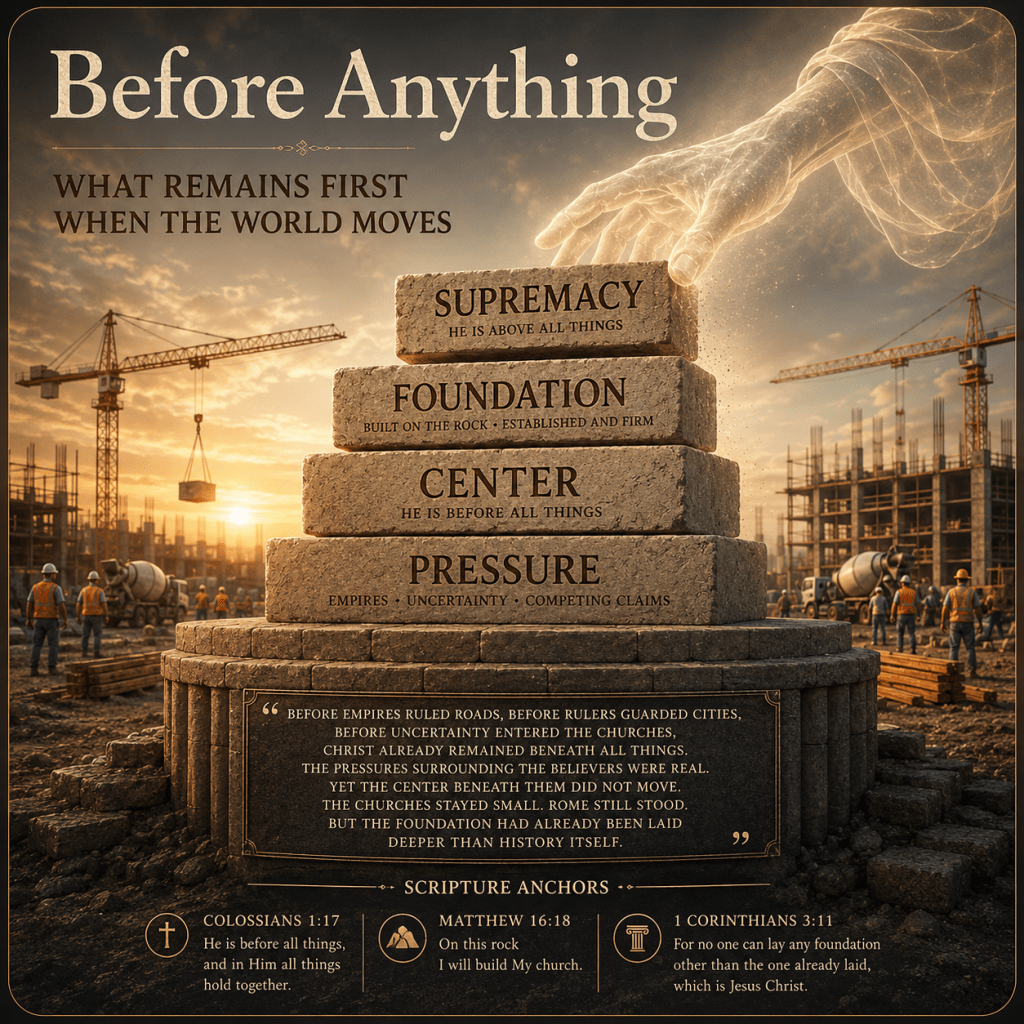
    Before Everything

    The roads around Colossae carried more than merchandise. Ideas traveled there constantly beside wool shipments, market conversations, Roman announcements, and wandering teachers searching for listeners.

    Paul writes into that atmosphere almost immediately.

    “He is before all things, and in him all things hold together.” — Colossians 1:17.

    The sentence arrives before argument fully develops, almost like a foundation stone lowered beneath the rest of the letter.

    Outside their homes, Rome still appeared permanent. Temples still received offerings. Imperial power still organized public life through visible authority and taxation.

    But Paul places Christ earlier than all of it.

    Before governments.

    Before systems.

    Before the invisible structures people feared but could not fully name.

    The roads remained crowded anyway.

    And somewhere along those same roads, the letter itself was moving slowly toward Colossae in the hands of tired travelers.

    Fullness Without Rivals

    By the second chapter, the pressure surrounding the church becomes easier to recognize.

    Some teachers promoted spiritual fullness through ascetic practices. Others emphasized mystical visions, strict regulations, food laws, sacred calendars, or reverence toward angelic beings. The language sounded elevated, layered, difficult enough to feel important.

    Complex systems often do.

    Paul answered differently. Not with theatrical certainty. Not with philosophical performance. He wrote from confinement, likely beneath rough walls guarded by Roman authority that looked far more immediate than abstract theology.

    “For in Christ all the fullness of the Deity lives in bodily form…” — Colossians 2:9.

    Fullness already present.

    Not partial.

    Not borrowed.

    Not hidden behind another gate.

    A few lines later he warns them against those who delighted in “false humility and the worship of angels” while claiming access through visions and spiritual elevation.

    The prison walls remained standing around him while he wrote those words. Guards still changed shifts. Meals still arrived through ordinary routine. Ink continued drying slowly across parchment.

    The empire still looked organized.

    The concern did not.

    Nailed Records

    Roman administration depended heavily on written record: decrees, debts, census registrations, accusations, sentencing notices, public declarations fixed visibly before crowds.

    Paper carried power because empire trusted visible accounting.

    Paul reaches directly into that world.

    “Having canceled the charge of our legal indebtedness… he has taken it away, nailing it to the cross.” — Colossians 2:14.

    The image would not have sounded symbolic to first-century listeners.

    Public notices were nailed visibly.

    Charges were displayed openly.

    Executions themselves functioned partly as announcements.

    Yet Paul describes the cross not as Rome’s final statement about Jesus, but as the place where another record disappeared entirely.

    The nails remained in the memory of the empire as instruments of fear.

    Inside the Gospel, they became something else.

    A boundary marker.

    A dividing line between old accounting and a different beginning.

    Not every victory changes appearances immediately.

    Some readers in Colossae likely still carried private fear while hearing those lines read aloud beneath dim lamps. Debts still existed in ordinary life. Rome still preserved records carefully. Accusations still ruined households and reputations.

    The letter does not mock that fear.

    It simply keeps placing another reality beside it.

    Stripped Thrones

    The Roman world carried visible power everywhere: soldiers in armor, local magistrates, imperial images stamped onto coins, public ceremonies honoring Caesar.

    But invisible fears traveled just as widely.

    Spiritual intermediaries.

    Regional gods.

    Ancestral spirits.

    Protective rituals.

    Cosmic hierarchies.

    People learned early how to live cautiously beneath forces they did not fully understand.

    Paul writes from prison as someone visibly underneath Roman authority himself. Yet in the center of the letter, another sentence appears:

    “He disarmed the powers and authorities…” — Colossians 2:15.

    No dramatic battle follows the line.

    No cinematic description.

    Only the slow force of reversal.

    The same authorities still appeared armed outside the prison walls. The empire still controlled roads, courts, punishments, and public order.

    But Paul writes as though another unveiling had already taken place beyond visible arrangement.

    As though the thrones themselves had lost something essential while still appearing intact.

    The believers hearing the letter could not yet see history proving him right.

    Not fully.

    They still had to wake the next morning beneath Rome.

    Yet Paul writes as someone already standing inside a different era.

    Raised Interiors

    By the third chapter, the letter moves inward without abandoning ordinary life.

    Paul begins speaking about speech, patience, forgiveness, labor, meals, households, marriages, children, masters, servants, songs sung together in gathered rooms. The victory he describes does not remain suspended above reality like distant doctrine.

    It enters kitchens.

    It follows people into work.

    “Set your minds on things above, not on earthly things.” — Colossians 3:2.

    The line appears beside practical instructions ordinary people would hear after exhausting days beneath Roman pressure.

    Not escape.

    Reorientation.

    Some believers in Colossae may still have wondered whether they lacked something hidden or superior. Whether another spiritual ladder existed somewhere beyond Christ. Whether fear itself still carried final authority inside the body.

    The letter keeps returning them to the same center.

    Not away from life.

    Inside it.

    Outside, market roads still filled with dust by afternoon. Families still argued. Workers still carried stone, cloth, grain, and water through crowded streets.

    But something interior had already shifted position.

    A new era rarely announces itself first through governments.

    Sometimes it appears first inside households.

    Lamp Smoke

    The letter eventually arrived by hand.

    Someone carried it across roads, lodging places, weather, checkpoints, fatigue, and conversation until it reached the believers gathered in Colossae. Perhaps it was first read aloud in a modest room while lamps burned low against evening walls.

    Some listeners were likely tired from labor.

    Some uncertain which voices deserved trust anymore.

    Some still frightened by powers they could not see.

    Outside, the Roman world continued moving with complete confidence in its own permanence.

    Inside the reading of the letter, another permanence remained unforced and steady.

    Christ before all things.

    Christ above all powers.

    Christ holding all things together.

    The lamps eventually dimmed.

    The words did not.

  • Friendship is one of the few things in life that becomes stronger through nonsense. Real friends are not impressed by perfection anyway. They laugh at your strange stories, understand your random moods, and somehow survive your dramatic “I’m fine” speeches without running away.

    The funny part is this: friendship is often built from tiny moments nobody plans. Sharing snacks. Sending ridiculous stickers at midnight. Sitting together in silence. Arguing over where to eat for thirty minutes and still ending up happy with fries. Big memories usually begin with very ordinary afternoons.

    Good friends also make life softer. Not easier all the time—just softer. They remind you that bad days are survivable and embarrassing moments are not the end of civilization. Sometimes the greatest therapy is simply someone saying, “That was weird… but I’m still here.”

    Maybe that is why friendship feels magical without trying too hard. It gives people a place where they can be unfinished, imperfect, loud, quiet, awkward, hopeful, and still deeply loved. Honestly, that kind of connection is rarer than treasure and probably healthier than overthinking everything alone.

  • Happiness Is Smaller Than We Think

    Happiness rarely arrives with fireworks. Most days, it sneaks in quietly—through warm bread, silly laughter, sunlight on the floor, or a message from someone who remembered you. We keep searching for giant moments while tiny ones patiently wave at us from the corner of ordinary life.

    Sometimes happiness is simply letting yourself breathe without turning everything into a competition. The world keeps shouting, “Be more.” But joy often whispers, “You are allowed to rest too.” A slow morning, soft music, or doing absolutely nothing important can heal more than we expect.

    Funny enough, happiness grows faster when shared. A compliment, a goofy joke, helping someone carry their invisible burden for one minute—these small acts brighten rooms more than expensive things ever could. Kindness has strange math: the more you give away, the more remains.Maybe happiness is not a destination after all.

    Maybe it is a habit of noticing. A little gratitude. A lighter heart. A decision to keep smiling, even while life is still unfinished.

  • Somewhere between a strawberry that looked too cheerful to be professional and an orange that insisted happiness was part of productivity, the entire orchard quietly lost control of the meeting. The apples tried to maintain dignity for at least six minutes, but then the pears arrived looking oddly confident for fruit shaped like tiny lamps. By noon, nobody was discussing “success strategies” anymore. They were mostly debating whether growing slowly beside sunlight and rain perhaps counted as achievement too.

    The strawberries voted yes immediately.
    The oranges celebrated before the vote even finished. One pear reportedly whispered, “Ripening is still progress,” before dramatically rolling off the table for emotional effect. And honestly? The orchard has never looked healthier since. No fruit became famous overnight. No leaf rushed the season. Yet the branches still filled quietly, color returned little by little, and sweetness arrived without panic. Perhaps success was never meant to feel like a race through a noisy supermarket after all. Perhaps it was always something closer to this: growing well, laughing often, staying rooted, and learning that even the smallest fruit can brighten an entire branch.

    — Livora Gracely
    Writing to remember, sharing to inspire


  • Roads Beneath Pressure

    The gatherings in Colossae remained small beneath the larger movement surrounding them.

    Merchants continued crossing the valley roads carrying wool, grain, parchment, oil, and conversation between crowded cities already filled with competing visions about power, holiness, purity, wisdom, and unseen realities. Roman order still held the visible structure together through taxation, military presence, trade movement, and public authority spread quietly across the region.

    Meanwhile believers gathered inside ordinary rooms beneath all of it.

    Rough tables.

    Folded garments.

    Dim lamps lowering slowly toward evening.

    Some arrived carrying exhaustion from labor. Others carried questions difficult to answer cleanly while too many voices continued entering the same streets and households from multiple directions at once.

    Life did not pause around the church.

    The pressure did not either.

    Somewhere far from Colossae itself, Paul continued hearing reports about what was beginning to move beneath the surface of the gatherings there. Faith still remained visible among them. Yet the center itself appeared increasingly surrounded by competing claims pressing inward gradually through ordinary conversation, spiritual language, religious discipline, and persuasive teaching.

    The instability does not appear openly violent.

    Only close.

    Close enough that Paul no longer circles the center slowly.


    Hard Bread

    Years earlier Paul had written differently to Corinth.

    “I fed you with milk, not solid food…” — 1 Corinthians 3:2

    The churches there still carried jealousy, rivalry, division, and immaturity visibly enough that deeper instruction could not yet settle properly among them. Paul adjusted his language to the condition before him.

    Yet Colossae receives something denser almost immediately.

    The movement feels surprising at first.

    The church remained small.

    The pressures remained real.

    Different teachings already moved through the region carrying competing structures beneath spiritual language disciplined enough to appear convincing beside ordinary fatigue and uncertainty.

    Still Paul does not simplify the center.

    Perhaps the pressure itself explains why.

    When too many things begin moving at once, unstable foundations become dangerous quickly.

    Yet the letter appears to trust less in its own sharpness than in the One capable of giving understanding where understanding still remains incomplete.

    Long before the letter reached Colossae, Paul had already prayed that God himself would fill them “with the knowledge of His will in all spiritual wisdom and understanding.” — Colossians 1:9

    The movement begins there.

    Not persuasion alone.

    Illumination.

    So the movement keeps returning toward Christ before returning anywhere else:

    “He is the image of the invisible God…” — Colossians 1:15

    The sentence arrives with unusual weight inside a fragile church.

    Not caution first.

    Center first.


    Before All Things

    The roads outside Colossae still carried ordinary movement each morning.

    Animals pulled loaded carts slowly through dust while traders continued negotiating prices beneath changing weather. Workshops opened early. Public fountains gathered conversation before labor resumed again across the city.

    Nothing outwardly suggested the world had changed.

    Rome still stood visibly over everything.

    Yet inside the letter another claim quietly appears beneath visible reality itself:

    “He is before all things, and in Him all things hold together.” — Colossians 1:17

    The sentence does not arrive like philosophical speculation.

    It lands more like structural foundation beneath instability already spreading quietly through the churches.

    Paul does not argue extensively for the claim.

    He simply places it beneath everything else.

    Before rulers.

    Before powers.

    Before institutions.

    Before the roads themselves.

    Years earlier another voice had once spoken directly toward Peter’s confession:

    “on this rock I will build my church…” — Matthew 16:18

    The words still appear to remain beneath the churches long afterward.

    Not merely memory.

    Foundation.

    The pressure surrounding Colossae may partly explain why the language now becomes so direct. Paul no longer seems interested in leaving the center partially defined while competing teachings continue approaching the church from multiple directions at once.

    Older men sometimes stop circling subjects when time itself begins feeling shorter.

    The letter carries some of that weight.

    Not louder.

    Only nearer the foundation.


    Blood Beneath Glory

    The movement inside Colossians becomes stranger the further it rises.

    The language reaches toward supremacy, fullness, creation, and all things holding together through Christ himself. Yet suddenly the movement descends toward blood.

    Toward crucifixion.

    Toward death beneath Roman execution.

    “…making peace through His blood, shed on the cross.” — Colossians 1:20

    The supremacy never separates itself from suffering.

    That may partly explain why Paul writes this way toward pressured believers instead of avoiding harder language entirely. A weaker center could not survive collision with actual suffering for very long.

    Outside the church, Rome still exercised visible authority openly enough that crucifixion itself remained recognizable public reality throughout the empire. Bodies still weakened. Fear still moved through cities. Exhaustion still settled quietly into ordinary labor and ordinary homes by evening.

    The cross did not remove suffering immediately.

    The resurrection did not immediately remove Rome.

    Still Paul writes as though something decisive had already shifted beneath visible reality itself.

    Not fully visible yet.

    Still holding.

    The supremacy only becomes complete through death, resurrection, and the strange claim that the crucified one now stands above every visible authority still operating across the earth.


    Established and Firm

    By the time the letter reaches the believers directly again, the movement sounds almost like reinforcement beneath a structure already under strain.

    “Continue in your faith, established and firm…” — Colossians 1:23

    The wording matters carefully.

    Paul does not ask them to invent another foundation.

    Nor does he direct them toward novelty.

    The church already possessed the center now being pressured by competing voices entering beside ordinary life.

    So the letter repeatedly returns there again.

    Christ before all things.

    Christ holding all things.

    Christ reconciling all things.

    The movement beneath the passage feels less like theological expansion and more like someone driving foundation stones deeper while pressure continues building quietly around the structure above them.

    Earlier generations had once heard other sayings beside ordinary roads and crowded gatherings:

    “I am the vine…” — John 15:5

    “I am the way…” — John 14:6

    The words continued surviving because believers kept finding beneath ordinary instability the same center holding everything together repeatedly through different generations of pressure.

    Outside the gatherings, roads still carried the same tensions between empire, religion, commerce, fatigue, and uncertainty moving endlessly between cities.

    Inside the gatherings, lamps still lowered gradually beside copied letters read aloud between tired believers trying to remain steady beneath realities larger than themselves.

    The pressures remained real.

    The center remained first.


    Earlier Than Rome

    Empires usually appear permanent while they are still standing.

    Roads continue functioning.

    Markets continue filling.

    Taxes continue collecting quietly through ordinary routine until most people begin assuming the visible structure around them will simply remain indefinitely.

    Rome carried some of that atmosphere.

    So did its armies.

    So did its authority over roads, prisons, commerce, punishment, and movement itself.

    Yet Paul writes toward Colossae as though another order beneath history itself had already begun preceding the empire surrounding them visibly.

    “All things have been created through Him and for Him.” — Colossians 1:16

    The sentence reaches beyond local pressure entirely.

    Beyond Colossae.

    Beyond Caesar.

    Beyond the churches themselves.

    Paul never pretends the empire has weakened.

    He simply writes as though Rome itself already belongs beneath something older and far more permanent than imperial visibility.

    The churches remained vulnerable.

    The center did not.

    And somewhere beneath the long movement of history itself, the writings continued carrying another expectation quietly forward as believers waited for the same Christ not only to remain above history, but to return openly as king over it.

    The waiting itself became part of the faithfulness.

    Not panic.

    Not retreat.

    Remaining.


    What Remains First

    Evening eventually returned the rooms to silence again.

    Some folded garments before leaving. Others gathered bread slowly from rough tables while conversations lowered toward quiet voices beneath dim lamps. Outside, the larger structures of the empire still appeared unchanged enough that most people likely assumed Rome itself would continue indefinitely.

    Yet the letter continued passing between hands anyway.

    “He is before all things…”

    The sentence itself sounds almost immovable beside the instability surrounding it.

    Not because every question had disappeared.

    Not because pressure had weakened.

    Not because suffering had ended.

    But because Paul no longer seemed willing to let the church build itself upon anything smaller than the One already standing beneath creation itself before the pressures arrived.

    Some teachings moved constantly.

    Empires did too.

    The center remained earlier than all of them.

    And still the churches waited quietly beneath unfinished history for the same center to appear fully beyond it.

    Before rulers.

    Before roads.

    Before uncertainty.

    Before anything.

  • By late afternoon, the little bee had officially given up trying to look “productive.”
    First, he floated through the garden holding a daisy almost bigger than himself, smiling as if pollination could wait another five minutes. Then he discovered an entire jar of honey unattended near the fence and decided this clearly qualified as “an emergency.” By sunset, he somehow convinced himself that flying with a pink balloon counted as efficient transportation. The other bees were not entirely convinced. One reportedly flew into a tulip after staring too long.

    But the real scandal came later.
    While the hive buzzed through endless schedules and serious wing business, the little bee quietly curled up on a leaf and fell asleep beneath the evening breeze. No spreadsheets. No pollen reports. No motivational speeches. Just tiny snores and one very satisfied smile. And strangely enough, the garden still bloomed the next morning anyway. Perhaps that was the bee’s greatest discovery of all: sometimes joy is also part of the work.

    — Livora Gracely
    Writing to remember, sharing to inspire


  • Stone Before Morning

    The questions reached Galilee before the execution did.

    They traveled through roads already crowded with traders, soldiers, fishermen, tax collectors, and rumors moving between villages faster than most people themselves. Somewhere beyond those roads, John remained behind stone walls east of the Jordan while ordinary life continued pressing forward around him.

    “Are you the one who is to come, or shall we look for another?” — Matthew 11:3

    The sentence does not sound hostile.

    Only tired.

    By then John had already pointed publicly toward Jesus beside the riverbanks. Crowds had once gathered around him in wilderness dust while soldiers, laborers, and religious leaders stood listening near the water. Yet prison changes the shape of waiting. Time inside walls does not move like time beside open ground.

    Outside, ovens still burned before sunrise.

    Fishermen still repaired torn nets near the shoreline. Roman patrols still crossed the same roads between villages while public punishments remained visible beside ordinary life.

    Life continued there anyway.

    The uncertainty did too.


    Walls Without Answers

    The reply Jesus gave did not include escape plans.

    No mention of prison doors.
    No promise concerning Herod.
    No visible timeline for release.

    Instead the answer moved outward through ordinary bodies already changing in ordinary places:

    “The blind receive their sight and the lame walk, lepers are cleansed and the deaf hear…” — Matthew 11:5

    The reports returned to the prison the same way the questions had left it.

    Carried by tired feet.

    Somewhere behind the walls, John received confirmation without rescue.

    The disciples returned with the answer.

    The cell did not change.

    The Messiah had come.

    The prison remained.

    Not every true thing immediately alters the surrounding conditions.

    Some cells remain occupied even after certainty arrives.

    By then Judea already carried pressure beneath ordinary routine. Roman authority remained visible in taxes, executions, military presence, and public fear. Religious expectations moved restlessly between crowds waiting for deliverance strong enough to overturn visible power.

    The kingdom appeared near.

    Rome still stood.


    Sleep Before Chains

    Years later another prison held another apostle.

    Herod Agrippa had already executed James the brother of John with the sword. The reaction pleased enough people publicly that Peter was arrested soon afterward during the Feast of Unleavened Bread. Guards multiplied around the prison. Morning carried the expectation of another execution.

    Yet the record pauses strangely beside the danger.

    “Peter was sleeping between two soldiers…” — Acts 12:6

    Not preparing arguments.

    Not bargaining.

    Sleeping.

    The stillness feels almost misplaced beside the chains.

    Outside the prison, believers gathered through the night praying quietly inside crowded rooms while oil lamps slowly lowered toward morning. Conversations likely softened whenever footsteps sounded outside the house.

    The empire had not weakened.

    James still lay dead.

    The prison still held its chains.

    Yet one man slept beneath confinement as though the center beneath events had already settled elsewhere long before the cell closed around him.

    The uncertainty visible in John now appears differently inside Peter.

    Not removed.

    Settled.

    The walls remained stone.

    The fear did not fully remain with them.


    Letters From Confinement

    Paul’s imprisonments carried different textures.

    Some involved iron restraint. Others unfolded beneath guarded movement, delayed hearings, uncertain outcomes, and long stretches of confinement beneath Roman administration. Yet the imprisonments repeatedly became places of labor rather than interruption.

    Letters continued leaving rooms the empire likely assumed had already fallen silent.

    Ink beside chains.

    Parchment beside uncertainty.

    Visitors arrived carrying reports from distant churches. Messengers departed again beneath changing weather carrying folded pages along Roman roads toward gatherings Paul himself could no longer reach physically.

    Inside confinement came sentences later copied beside dim lamps for generations afterward:

    “Continue steadfastly in prayer…” — Colossians 4:2

    “Rejoice in the Lord always…” — Philippians 4:4

    The words do not sound detached from suffering.

    Rome remained Rome while they were written.

    The churches receiving them still faced exhaustion, pressure, false teachings, suspicion, economic strain, and ordinary fatigue beneath daily labor.

    Yet the letters continue returning toward another center repeatedly.

    Not away from reality.

    Inside it.

    What appeared uncertain in John and settled in Peter now becomes productive inside Paul.

    The confinement itself begins carrying fruit outward.

    Something larger than freedom had already taken root beneath the imprisonment itself.

    The walls remained occupied.


    Groaning Rooms

    The pressure eventually widened beyond prisons themselves.

    Paul later described creation using language usually attached to suffering bodies:

    “The whole creation has been groaning together…” — Romans 8:22

    Not merely individuals.

    Everything.

    Fields beneath drought.
    Bodies beneath illness.
    Nations beneath violence.
    Families beneath fracture.
    Minds beneath exhaustion.
    Labor beneath futility.

    The groaning spreads outward without immediately disappearing after faith arrives.

    Christ is proclaimed.

    The world still groans.

    Believers gather.

    The weight does not immediately lift.

    Some waited inside prisons.
    Others waited inside occupied cities.
    Others waited inside tired bodies continuing ordinary routines beneath invisible burdens.

    Morning still arrived each day anyway.

    Water still needed carrying.
    Bread still needed making.
    Children still needed feeding.
    Letters still continued moving between hands.

    History rarely pauses for suffering.

    Faithfulness continues inside it.


    Before the Day

    When the disciples once pointed toward the stones of the temple, they spoke with the admiration common to people standing before visible permanence.

    Jesus answered differently.

    “There will not be left here one stone upon another…” — Matthew 24:2

    The conversation that followed carried no immediate atmosphere of triumph.

    Wars.
    Betrayals.
    False messiahs.
    Persecution.

    Waiting.

    “the one who endures to the end will be saved.” — Matthew 24:13

    That order matters.

    John waited inside prison and died there.

    Peter slept before an execution that never arrived.

    Paul continued writing while uncertain how his confinement itself would end.

    Creation continues groaning before restoration appears openly.

    The kingdom does not always remove the cell immediately.

    Sometimes it remains present inside the cell first.


    Remaining Light

    By evening the rooms usually grew quieter.

    Lamps lowered.
    Conversations softened.
    Travelers searched for places to sleep before roads darkened fully.

    Somewhere beyond the visible movement of the empire, believers still gathered inside borrowed rooms listening to copied letters read aloud beside rough tables. Some carried grief. Others carried exhaustion. Others carried questions that had not fully disappeared.

    The pressures surrounding them remained real.

    So did the waiting.

    Yet the writings continued passing between steady hands anyway. Not because every prison had opened. Not because every question had resolved. Not because every burden had lifted.

    But because something beneath the visible order of events had already begun holding them together before the outward world changed around them.

    Some doors opened.

    Others did not.

    The center remained anyway.


  • Rooms Before Collapse

    The prayer begins before the collapse does.

    Long before visible fracture appears inside Colossae, Paul begins writing from confinement far away. The roads between the prison and the Lycus Valley remained crowded with movement. Merchants continued crossing city gates carrying wool, grain, oil, arguments, rumors, philosophies, and religious practices beside one another.

    Inside the church, ordinary life still continued.

    Shared bread.
    Folded garments.
    Low evening lamps.
    Voices reading copied pages aloud beneath smoke-darkened ceilings.

    From a distance, little may have appeared urgent.

    Yet the prayer arrives with unusual density.

    Paul writes:

    “…that you may be filled with the knowledge of His will in all spiritual wisdom and understanding…” — Colossians 1:9

    The sentence does not begin with protection.

    It does not begin with escape.

    It begins further inside.

    Something within the church appears to require strengthening before the visible structure itself begins failing.


    Interior Weather

    The pressures surrounding Colossae do not seem to come from one direction alone.

    Different systems already moved through the same valley roads long before the church appeared there. Travelers carried inherited traditions beside mystical speculation. Philosophical language traveled beside ritual practices. Additional voices continued offering deeper access, stronger certainty, hidden knowledge, spiritual hierarchy, visible discipline.

    The pressure rarely announces itself loudly at first.

    It enters gradually.

    Conversation beside conversation.
    Meal beside meal.
    Voice beside voice.

    Paul does not fear activity alone.

    The church remains active.
    The gatherings continue.
    The language of faith remains present.

    Yet the prayer keeps returning toward understanding.
    Toward wisdom.
    Toward knowledge rightly ordered.

    The concern appears quieter than outward collapse.

    Something within the center of perception itself may already have begun drifting.

    Inside crowded rooms, people can remain sincere while slowly losing direction.


    Measured Knowledge

    The movement of the prayer unfolds carefully.

    Knowledge.
    Then walking.
    Then fruit.
    Then deeper knowledge again.

    Paul writes:

    “…to walk in a manner worthy of the Lord, fully pleasing to Him…” — Colossians 1:10

    The sequence matters through its arrangement alone.

    The movement begins inward before it appears outward.

    Not behavior first.
    Not pressure first.
    Not reaction first.

    Understanding stands nearer the center.

    The letter does not begin by demanding visible performance.

    It moves toward understanding first.

    Not information alone.
    Not accumulation alone.
    Not louder certainty.

    The prayer appears to reach beneath behavior toward the structure producing behavior.

    Outside the prison, roads continued carrying competing claims about wisdom and spiritual fullness from city to city.

    Inside the letter, another movement quietly takes shape:

    understanding shaping walking.

    walking shaping fruit.

    fruit returning toward deeper knowledge again.

    The church does not seem to lack movement.

    It risks movement without center.


    Fruit Under Pressure

    Paul writes:

    “…bearing fruit in every good work…” — Colossians 1:10

    The language shifts slightly here.

    Fruit no longer appears only as growth spreading outward through regions and households.

    It appears inside ordinary actions.

    Work.
    Speech.
    Endurance.
    Relationships.
    Patience.
    Repeated decisions beneath pressure.

    Outside, larger systems continued competing for authority across the valley.

    Inside smaller homes, quieter choices continued shaping the atmosphere of the gatherings.

    The church appears fragile when viewed closely.

    Borrowed rooms.
    Copied manuscripts.
    Slow communication.
    Human memory.
    Tired bodies continuing after long labor.

    Still the prayer keeps moving toward rootedness rather than reaction.

    Toward lives capable of remaining fruitful while pressure continues building around them.

    Tall trees meet stronger wind.

    The fruit remains exposed first.


    Power for Staying

    By the middle of the prayer, the language turns toward strength.

    “…being strengthened with all power according to His glorious might…” — Colossians 1:11

    Yet the direction of that strength remains unexpectedly quiet.

    The sentence does not move toward conquest.

    Not expansion.
    Not retaliation.
    Not visible dominance.

    Instead:

    “…for all endurance and patience…” — Colossians 1:11

    Outside the church, Rome continued measuring strength through force, visibility, and control.

    Inside the letter, strength appears attached to remaining steady.

    Patient.
    Unmoved.
    Still capable of thanksgiving.

    The pressure surrounding the church may already have been visible enough to provoke fear.

    Still the prayer keeps returning toward endurance rather than alarm.

    Toward stability rather than spectacle.

    Toward inward capacity rather than outward reaction.

    The language itself remains measured.

    The urgency does not disappear.

    It settles deeper.


    Lamps After Midnight

    Near the end of the passage, the prayer widens further.

    Paul writes:

    “…giving thanks to the Father, who has qualified you to share in the inheritance of the saints in light.” — Colossians 1:12

    The thanksgiving arrives late in the movement of the prayer.

    After endurance.
    After patience.
    After strengthening.

    Not before.

    The prison walls still remained standing.

    The roads outside Colossae still carried competing voices between neighboring cities.

    The church itself still appears vulnerable when viewed from close range.

    Yet the language speaks as though a deeper transfer has already taken place.

    “He has delivered us from the domain of darkness and transferred us to the kingdom of His beloved Son…” — Colossians 1:13

    Not geography.
    Not empire.
    Not visible security.

    Another center.
    Another belonging.
    Another kingdom.

    Inside ordinary homes, the letter continued passing quietly between tired hands beneath dim lamps late into the evening.

    No immediate triumph appears.

    No sudden disappearance of pressure.

    Still the prayer continues moving inward:

    toward wisdom,
    toward endurance,
    toward rootedness,
    toward light.

    The rooms remained occupied.


    Quiet Operations

    The prayer in Colossians 1 does not read like emergency panic.

    Yet neither does it read casually.

    Something careful appears to be taking place beneath the visible surface of the church.

    Not reconstruction of roads.
    Not removal of enemies.
    Not public reorganization.

    Something quieter.

    The strengthening of perception.
    The repairing of direction.
    The preservation of center.

    Outside, the valley roads continued carrying voices from city to city long after the letter itself was first read aloud.

    Inside smaller gatherings, believers continued listening beneath low lamps while ordinary life moved around them.

    The pressure did not fully disappear.

    The prayer did not fully stop either.

    Some repairs begin where almost nothing visible has broken yet.

    And sometimes the deepest surgeries remain hidden beneath steady breathing.

  • When the Ground Moved

    The report reached the prison before the church reached collapse.

    In Colossae, gatherings still continued inside borrowed rooms beneath ceilings darkened by lamp smoke. Bread crossed rough tables. Sandals rested near narrow doorways. Evening voices still read copied pages aloud while traders moved along the valley roads outside.

    Life still appeared stable from a distance.

    From closer inside, something else had already begun moving.

    Paul writes:

    “…since we heard of your faith in Christ Jesus…” — Colossians 1:4

    The sentence arrives quietly.

    The roads behind it do not.


    Valley Traffic

    The Lycus Valley remained crowded with movement.

    Wool merchants crossed between neighboring cities carrying trade goods, stories, arguments, and rumors beside one another. Religious discussions traveled through workshops, marketplaces, family networks, and shared meals. Philosophers arrived beside travelers. Mystical practices stood beside inherited traditions.

    Different systems already occupied the same roads long before the church appeared there.

    Inside that atmosphere, the congregation continued growing.

    Paul writes:

    “…bearing fruit and growing…” — Colossians 1:6

    Fruit rarely remains hidden for long.

    Especially in valleys where many voices keep entering the same rooms.


    Pressure Lines

    The pressure surrounding the church does not seem to arrive from one direction alone.

    Throughout the letter, different currents appear close together:
    human tradition,
    special observances,
    visions,
    food restrictions,
    hidden knowledge,
    spiritual intermediaries.

    Some of those voices had already begun standing close enough to the gathering to be heard from inside the room.

    No open collapse appears in chapter one.

    No visible fracture is announced.

    Still the tension leaves traces inside the language itself.

    Prayer deepens.
    Repetition increases.
    The name of Christ keeps returning to the center of the page.

    The church appears to stand at a crossing point:
    still fruitful,
    still gathered,
    yet increasingly exposed.


    Folded Distances

    Far from Colossae, Paul the Apostle remained confined behind Roman walls.

    The confinement did not stop movement.

    Reports continued arriving.
    Letters continued traveling.
    Names traveled across provinces beside blankets, oil jars, clothing, and personal belongings.

    Another name appears again:
    Epaphras.

    The church had first heard the gospel through him. Later, concern returned along the same roads that once carried good news outward.

    The churches themselves appear fragile when viewed closely:
    borrowed spaces,
    slow communication,
    copied manuscripts,
    human memory,
    shared meals,
    dim lamps burning late into the evening.

    Yet the response begins almost immediately after the report arrives.

    Paul writes:

    “…we have not ceased to pray for you…” — Colossians 1:9

    The sentence remains small on the page.

    The concern does not.


    Fullness Against Fear

    By the middle of chapter one, the language rises sharply upward.

    “He is before all things…” — Colossians 1:17

    “In Him all things hold together…” — Colossians 1:17

    “In Him all the fullness was pleased to dwell…” — Colossians 1:19

    The statements stand beside a church already surrounded by competing claims to wisdom, certainty, and spiritual security.

    Additional practices continued circulating through the valley.
    Additional voices continued offering deeper access.
    Additional structures continued promising stronger protection.

    Not openly.

    Something quieter appears instead.

    Attention begins scattering across multiple directions at once.

    Outside the prison, roads remained crowded with travelers, teachers, rituals, philosophies, and restless searching.

    Inside the letter, another voice kept returning toward one name repeatedly.

    Again and again.

    Christ before all things.


    Measured Hands

    The later movement of chapter one does not move toward panic.

    The urgency remains restrained.
    Measured.
    Deliberate.

    Paul writes:

    “…strengthened with all power according to His glorious might…” — Colossians 1:11

    The sentence appears beside endurance, patience, and thanksgiving rather than alarm.

    The letter does not tighten itself into command.

    It keeps returning instead.

    Toward strength already given.
    Toward roots already present.
    Toward a center the church had not entirely lost.

    Inside smaller homes, believers still gathered beneath lamplight while the letter moved quietly from hand to hand.

    The rooms remained occupied.


    Trees Above Wind

    By the time the letter reached Colossae, the church had already grown enough to carry visible fruit.

    Growth itself seems to have exposed the congregation to stronger pressure from multiple directions at once.

    Tall trees meet open wind first.

    Outside, the roads through the valley continued carrying competing voices from city to city.

    Inside ordinary rooms, copied pages continued passing between tired hands while the name of Christ kept returning quietly to the center of the gathering.


  • Borrowed Roads

    The letter arrived before the man ever did.

    In Colossae, traders still crossed the valley roads carrying wool, oil, and grain between neighboring towns. Dust gathered along sandal straps and low stone edges worn smooth by years of passing feet. The larger coastal cities carried more influence by then. Colossae remained farther inland, quieter beneath the movement of empire and trade.

    Life continued there anyway.

    Far to the west, Paul the Apostle remained under guard.

    The distance between the prison and the Lycus Valley stretched across provinces, roads, checkpoints, harbors, and changing weather. Yet the letter still crossed it.

    Not through direct presence.

    Another name appears first:
    Epaphras.

    Paul writes:

    “You learned it from Epaphras…” — Colossians 1:7

    The sentence rests quietly near the beginning of the letter, though much of the church’s story seems to stand behind it.

    No account in Acts records Paul entering Colossae itself. No public gathering beneath the city walls survives in Scripture. The movement appears to have traveled another way instead.

    Years earlier, Paul spent long periods teaching in Ephesus, where merchants, laborers, travelers, and pilgrims moved constantly through crowded streets and workshops. During those years, Epaphras likely heard the gospel there.

    Then the roads reversed direction.

    Back toward:
    Laodicea,
    Hierapolis,
    and Colossae itself.

    A man returns home carrying words that continue speaking after the journey ends. Conversations begin beside ordinary meals. Households change quietly. Gatherings form in rooms already used for daily life.

    The church appears inside existing life rather than outside it.


    Prison Traffic

    The prison did not stop information from moving.

    Visitors entered.
    Messengers departed.
    Letters crossed regions folded carefully beside clothing, supplies, and personal belongings.

    The Roman world depended heavily upon roads and sea routes, and the churches moved within those same systems. Reports traveled slowly, but steadily.

    At some point, Epaphras reached Paul carrying concerns about Colossae.

    The letter itself preserves traces of what had begun entering the church:

    philosophy,
    human tradition,
    visions,
    food regulations,
    ascetic severity,
    spiritual intermediaries.

    Different influences appear close together in the text, as though several systems had begun attaching themselves to the congregation at once.

    The region already stood inside overlapping worlds:
    Roman political authority,
    Greek philosophical influence,
    Jewish religious tradition,
    local spiritual practices,
    public temples,
    private mysticism.

    Against that background, several warnings appear throughout the letter:

    “See to it that no one takes you captive through philosophy…” — Colossians 2:8

    “Do not let anyone disqualify you…” — Colossians 2:18

    “Why submit to its regulations…” — Colossians 2:20

    The warnings arrive without dramatic language.

    Steady.
    Measured.
    Repeated.

    Paul later writes:

    “…for all who have not met me personally.” — Colossians 2:1

    The sentence leaves behind an unusual image:
    a prisoner carrying pastoral concern for people known mostly through reports, names, and prayer.

    The walls surrounding him remained fixed.

    The concern did not.

    And from within that confinement, some of the densest language about Christ in the New Testament began taking shape.


    Fullness Theft

    The opening chapter of Epistle to the Colossians moves with unusual density.

    “He is before all things…” — Colossians 1:17

    “In Him all things hold together…” — Colossians 1:17

    “In Him all the fullness was pleased to dwell…” — Colossians 1:19

    The statements appear beside repeated warnings concerning additional spiritual systems and practices.

    Food restrictions.
    Special observances.
    Claims of hidden wisdom.
    Severe self-denial.
    Interest in angels and visions.

    Not openly.

    Something quieter appears instead.

    Attention begins scattering across multiple spiritual layers at once.

    Paul writes:

    “In Christ are hidden all the treasures of wisdom and knowledge.” — Colossians 2:3

    A few verses later:

    “You have been filled in Him.” — Colossians 2:10

    Outside the prison, teachers continued speaking across the region. New ideas traveled the same roads used by merchants and travelers. Spiritual hierarchy fascinated much of the ancient world. Systems promising deeper access, stricter discipline, or hidden understanding carried strong appeal across many communities.

    Inside the prison, another letter continued forming beside dim light, guarded movement, and uncertain duration.


    Trusted Dust

    The church grew through people willing to keep walking.

    Before any letter could be copied, preserved, or read aloud publicly, someone first carried it across long roads between cities.

    Near the close of Colossians, two names appear together:
    Tychicus
    and Onesimus.

    Paul describes Tychicus as:

    “a beloved brother and faithful minister…” — Colossians 4:7

    Journeys between churches stretched across difficult terrain and uncertain conditions. Inns varied in safety. Political tensions shifted from region to region. Travel depended upon weather, timing, and endurance.

    Still the letters moved.

    Paul remained physically confined.
    The churches did not become isolated from one another.

    Reports continued crossing valleys.
    Prayers moved in return.
    Names traveled farther than faces.


    Room Theology

    By the later chapters of Colossians, the letter settles into ordinary life again.

    Marriage appears.
    Children appear.
    Work appears.
    Speech appears.
    Forgiveness appears.

    After long passages concerning Christ, wisdom, fullness, and spiritual authority, the language returns to households and recurring routines.

    Paul writes:

    “Let your speech always be gracious…” — Colossians 4:6

    The instruction belongs to ordinary conversation, where irritation, fatigue, and misunderstanding still remain close at hand.

    Elsewhere:

    “Forgive as the Lord forgave you.” — Colossians 3:13

    The letter does not remain suspended in abstraction.

    It returns to rooms where labor continues each morning.
    Where patience thins.
    Where words heal or wound.
    Where believers still live beneath Roman authority, economic pressure, social tension, and competing loyalties.

    Outside, the empire remained enormous.

    Inside smaller homes, believers gathered around shared meals, repeated prayers, copied letters, and remembered teachings carried from city to city by ordinary travelers.

    The theology of Colossians eventually settles into speech, memory, labor, relationships, and endurance.

    Not away from life.

    Inside it.


    Fading Footprints

    No detailed account survives describing how the church in Colossae responded after the letter was first read aloud.

    The silence remains.

    Yet the letter endured.

    Copied carefully.
    Shared between churches.
    Preserved through generations.

    The roads changed over time. Earthquakes struck parts of the region. Empires shifted. Trade routes weakened. Cities faded.

    The letter continued moving.

    No single path fully explains where the letter finally reached.

    No single set of footsteps accounts for its endurance across generations.