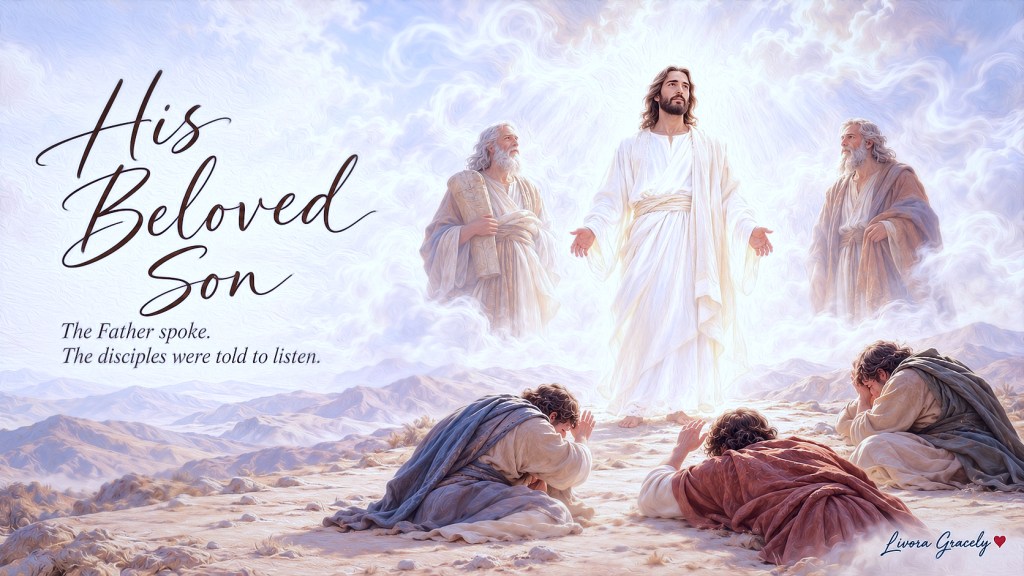
The Father spoke.
The disciples were told to listen.
Peter was still speaking when a bright cloud covered them.
He had seen Jesus’ face shine and His clothes become dazzling white. Moses and Elijah were there, speaking with Him. Peter offered to make three shelters, one for each of them. Then a voice came from the cloud, identifying Jesus as the Father’s beloved Son and telling the disciples to listen to Him.
They fell facedown, terrified. Jesus came near and touched them.¹
Hebrews brings that same identity into view through words God had spoken long before:
“You are my Son; today I have become your Father.”
And again:
“I will be his Father, and he will be my Son.”²
These words follow the account of His completed sacrifice and His seat in heaven. They explain why the name He bears places Him above the angels.
The Father Speaks
The verse begins with a question: which angel did God ever address this way?
The answer is none. Hebrews is drawing attention to the Son’s unique relationship with the Father and His place as the promised King. Angels carry God’s messages. This Son is the One through whom God has spoken, the heir of all things, and the One through whom the universe was made.
His identity rests upon the Father’s declaration. The title belongs within everything the letter has already said about Him: His glory, His sustaining power, His cleansing work, and His heavenly seat.
On the mountain, Peter had been looking at three extraordinary figures. Moses and Elijah belonged to Israel’s long history of hearing God. Yet the voice singled out Jesus and directed the disciples to hear Him.
Hebrews begins with that same movement. God truly spoke through the prophets. Now He has spoken through His Son. The earlier voices lead toward the Person standing before the disciples.
Truly Human
But how can the One through whom the universe was made also be born?
His birth brings Him among us as a human being. The Son already present in Hebrews’ account of creation enters our world as a real child, born of Mary. He takes our humanity into His own life.
Luke places two promises together in the angel’s announcement to Mary: her child will be called the Son of God, and He will receive David’s throne. When she asks how this can happen, the answer is the work of the Holy Spirit. Matthew connects this birth with Isaiah’s promise of Immanuel, God with us. Mary conceives while still a virgin.³
The birth is miraculous, and the humanity is genuine. Hebrews later says that He shared our flesh and blood.⁴ He could be held as an infant, grow, become tired, and suffer. The body in which He gave Himself for sins belonged to the Son whom the Father sent.
Calling God His Father therefore does not describe physical reproduction within God. It speaks of who Jesus is in relation to Him. His birth from Mary brings that Son into human history, where His obedience and sacrifice can be lived in a human body.
The hand that touched the frightened disciples was a human hand.
The Royal Day
The word today needs its own setting.
Hebrews takes this declaration from a psalm about God’s appointed king. There, God establishes His king and promises him the nations as his inheritance. The Father–Son language expresses the king’s relationship with God and the authority God grants him.⁵
This helps explain why the quotation appears just after Hebrews describes Jesus seated at God’s right hand. The letter is presenting the Son in royal honour, following the purification He has provided.
Some Christians understand the begetting language in connection with His birth as a man. That birth belongs fully within His story. Yet the quotation’s royal setting gives today a more specific emphasis here: God declares the standing of His appointed King. It should not be treated as a date when the divine Son first began to exist.
His birth and His heavenly seat belong to one continuous life. The Son who entered our flesh and blood accomplished His mission and now reigns. Hebrews has already called Him the Son before telling us about His sacrifice or His exaltation.
The mountain gives the disciples a glimpse of His glory while He is still walking among them. The Father identifies Him; the same Jesus then comes close enough to touch them.
The Promised King
The second quotation carries a promise made to David. God spoke of a descendant whose kingdom He would establish and whose relationship with Him would be described as father and son. That promise first concerned David’s royal household. Hebrews applies its Father–Son words to Jesus.⁶
The announcement to Mary gathers the same themes together: a child, the Son of God, David’s throne, and a kingdom that will endure. His human birth belongs within a promise already moving through Israel’s history.
Daniel adds a sober part of that expectation. His prophecy of seventy sevens speaks of dealing with sin and bringing lasting righteousness; it also speaks of an anointed one being cut off. Christians read this passage in connection with the Messiah’s coming and death. Its contribution here is the scope of His mission, rather than a calculation of His birthday.⁷
Hebrews brings that mission into focus. The Son has provided purification for sins and sits in heavenly honour. The promised King has given Himself for the people He came to save.
The Father’s declaration therefore holds together the Person and His work. The One born of Mary, the One who suffered, and the One now seated beside the Majesty are the same Son. His humanity brings Him close; His royal authority gives weight to His words.
On the mountain, the disciples remained facedown until Jesus touched them and told them to rise without fear.
When they lifted their eyes, they saw Jesus alone.
The Father had told them whom to hear. His Son was beside them.
Scripture References
- Matthew 17:1–8.
- Hebrews 1:1–5; quotations from verse 5, NIV.
- Luke 1:30–35; Matthew 1:18–25, citing Isaiah 7:14.
- Hebrews 2:14.
- Psalm 2:6–9.
- 2 Samuel 7:12–16.
- Daniel 9:24–27.


Leave a comment