Livora Gracely

Writing to remember, sharing to inspire


  • Unsent Arrival

    A letter arrives where no one is waiting for the writer.

    Dust has gathered along the lower edge of the doorway where the wind rarely reaches. Someone folds the cloth back from the table before placing the page there, careful not to disturb the small cup left from earlier in the day. Outside, a cart passes over uneven stone. The sound fades slowly.

    Nothing in the room expects history.

    And yet, something has crossed into it.

    The letter has traveled farther than the hands now holding it. Passed through roads where the sender’s name was never spoken aloud. Carried by people who did not begin what they carried and could not fully explain why it mattered.

    By the time it is read, the voice already feels strangely familiar. Not because they have heard it before. But because something in it recognizes something already moving within them.

    The room itself remains unchanged. The same walls. The same ordinary wear in the wooden table. The same evening light resting unevenly against the floor.

    And still, something settles.

    The distance does not weaken the letter. It reveals something.

    Something has arrived without the one who first spoke it. It has taken root in ground he never walked, among people who would not recognize his face if he entered the marketplace beside them.

    And still— it holds.

    What moved was never only his words. Not his presence. Not even his authority.

    Something moved through those things. And what it left behind did not require him to remain in order for it to continue.


    Borrowed Roots

    No one who began this is here.

    The one who first spoke elsewhere never came to this city. The roads he traveled passed through other places—ports, synagogues, crowded courtyards where arguments gathered faster than understanding. But not here.

    This place received what had already been moving long before it arrived.

    What remained was not a structure. Not a movement arranged carefully enough to survive. Not even a visible beginning people could point back toward.

    Only a man who had heard. Who returned. Who stayed.

    No title announced him. No institution explained him. The people who listened still woke before dawn, still bought grain in the market, still buried their dead outside the city walls the same way they always had.

    Nothing outward suggested a new world had begun.

    And yet something had already entered their ordinary lives deeply enough that it could no longer remain hidden there.

    He did not arrive to manufacture belief. He recognized what was already beginning. Like someone seeing the first green line beneath winter soil before the field itself understands what season it has entered.

    There are moments when truth begins before language fully catches up to it. This was one of them.

    What he carried was never fully his. And because it was never his, it did not depend on him to survive.

    What does not begin with the one who carries it does not end with him.


    Heard Beforeheld

    There was no plan here.

    No careful strategy for expansion. No visible architecture designed to guarantee continuation. No sense that history was being assembled by expert hands.

    Only a message. And people who could not entirely return to who they had been after hearing it.

    At first, nothing dramatic appears. No public shift. No visible break from ordinary life. The baker still opens his stall before sunrise. Children still run dust-footed through the narrow streets. Lamps still burn low when oil becomes expensive.

    But beneath those unchanged rhythms, direction begins to move.

    What arrived did not feel constructed. It entered quietly, the way rain enters dry ground before the surface shows any sign of softening.

    It was heard. And that hearing did not remain at the level of information.

    It moved deeper. Not loudly. Not all at once.

    Faith appeared. Not performed. Not arranged carefully enough to convince. Received.

    And once received, it did not wait for complete understanding before beginning its work.

    What is truly heard rarely remains where it first entered.


    Invisible Weight

    Something eventually became visible.

    Not because anyone tried to display it. But because what is alive eventually alters the shape of the life surrounding it.

    Faith took direction. Not merely upward as devotion, but outward into the way people remained with one another.

    Love followed. Not efficiently. Not cleanly. Not without cost.

    It crossed old boundaries slowly, sometimes awkwardly, among people still learning how to belong to one another.

    Hope remained beneath all of it. Not ahead like ambition. Behind them. Holding.

    Like roots beneath stone. Invisible, but carrying more weight than the surface could explain.

    Three things were named quietly from far away: faith, love, hope.

    And the one naming them had not been there to produce any of them.

    That mattered.

    Because what continued without him revealed what had never depended on him.


    Placed Elsewhere

    There is a movement here that does not negotiate.

    No ladder is described. No gradual refinement of the old self into something improved.

    Only movement. Out of one kingdom. Into another.

    The old world could not generate what was needed to leave itself. It did not possess the strength required for its own rescue.

    And so they were carried.

    Not dramatically. They still walked the same roads and carried the same tiredness in their bodies.

    But inwardly, direction had shifted completely.

    What had been transferred did not belong to the old order anymore. Not because they climbed high enough. Not because discipline perfected them.

    But because they had been brought.

    There is a difference between reaching and being placed.

    And this movement does not come from reaching.

    What has been moved does not need to drag itself back.


    After Their Absence

    There is no record of what came next.

    No detailed account of the next generation. No preserved description of how the city carried these words after the first voices disappeared.

    History becomes quieter. Then thinner.

    The city itself eventually declined. Trade routes changed. Earthquakes reshaped parts of the region. The names that once carried weight slowly lost their place in the memory of the world.

    And yet— the letter remains.

    Not because the city survived. Not because the people preserved themselves strongly enough.

    But because what moved through them was never confined there.

    Kolose was one place it appeared. Not the place where it could be contained.

    The same pattern surfaced elsewhere: quiet growth, unannounced endurance, fruit that rarely understood itself while it was forming.

    What cannot be owned does not remain confined.

    And what was never confined does not end where it first appeared.


    Coda-Still Traveling

    The letter still moves.

    Not through the same roads. Not through the same language. Not toward the same kind of rooms.

    But it still arrives among people who did not begin what now shapes them.

    A woman reads alone before sunrise while the rest of the house still sleeps. A tired worker pauses over a paragraph after returning home long after dark. A small gathering somewhere sings words older than the buildings around them.

    None of them were present at the beginning. And yet something continues to reach them.

    What moves is not merely memory. Not preservation alone. Not institutional survival.

    What moves now is what moved then. Before it was fully understood. Before anyone knew how far it would travel.

    It was never held securely by those who carried it. And it does not continue because they remained.

    It continues because what began it has not stopped.

    And what has not stopped does not depend on the strength of those who carry it.

    Only— to be received.

    It only needs to be received.


    Col 1:1–8 ● Col 1:13–14 ● Col 1:23 ● Jn 15:16 ● Acts 17:6

  • Intro — Held, Then Not

    The table is narrow, its surface worn where hands have returned to the same place. Light falls from one side, not filling the room, just enough to keep the page visible, with dust drifting through it without urgency.

    The hand rests for a moment before it writes, not empty, not searching—only waiting for what is already there to settle into place. The body is not fully at ease. There is still a trace of the day in the shoulders, something unfinished in the breath.

    Nothing in the room suggests readiness.

    And still, the line begins.

    Ink moves across the page in a steady path, not fast, not hesitant. Each word appears as if it had been carried before it was written. The hand pauses between sentences, not because there is nothing to continue, but because what follows does not come from what is present in the moment.

    The room does not change. The light holds its place. The chair remains where it was.

    What was once held within
    is no longer staying in the same way.


    Not Intended

    The page was not opened to give anything. It was placed there because it belonged to the day, the way the chair belongs to the room, the way the breath continues whether it is noticed or not.

    The hand follows the line rather than leading it. A sentence forms, then another, without a point where intention is named. There is no moment that divides before and after, no clear turn from inward to outward.

    And still, what appears on the page does not remain where it began.

    The movement is small, almost unmarked. A word crosses from thought into form, another settles beside it, and nothing announces that something is being shared.

    It continues the way something continues when it has already started.

    Only later, when the page is no longer being written, does it become visible that something has moved beyond what once held it.

    Not sent, not arranged.

    It simply did not stay.


    Before Enough

    The chair holds the same weight. The body adjusts, not to rest, but to remain. The shoulders carry what has not fully left. If measured, there would not be enough to call this strength.

    The room does not add anything—no new air, no shift in light, no sign that the moment has improved.

    And still, the line continues.

    The hand pauses, not long, just enough for the thought to settle:

    this could wait.

    Nothing would break if it did. The page would remain. The moment would pass. The fingers loosen slightly around the pen.

    Then they close again.

    The hand moves.

    Not because it must, not because it should.

    Only because it does not stay still.

    A word is written while the breath is still uneven, another appears before the body fully agrees with the motion. Nothing has reached completion.

    And yet, something does not wait for completion to begin.


    The Moment That Could Stop

    The line slows, not because it has finished, but because it could.

    The sentence could end where it is. The page could remain as it stands. Nothing would be lost if the hand were to lift away now. The body leans slightly back, as if already agreeing with the pause.

    The thought is simple: this is enough.

    It does not come as resistance. It comes as reason.

    The room allows it. The quiet holds it without pressure. No one waits for the next line. Nothing requires it to continue.

    The hand rests on the page, just long enough for stopping to become complete.

    Then it moves again.

    No argument answers the pause. No force replaces it. The next word appears the same way the previous ones did, without announcement, without change in the room.

    Only one more line.

    Then another.

    The body remains the same. The light does not shift.

    And still, something has taken place that does not need to be named.


    More Than What Remains

    Nothing has been added.

    The same chair, the same table, the same body that has not recovered from what it carried earlier. If anything, there is less now than before.

    And still, the line holds.

    Not stronger, but steadier; not faster, but without interruption. The hand does not press harder, the ink does not thicken, there is no visible increase.

    Yet the movement continues in a way that does not match what is left.

    The words appear in sequence, not drawn from what can be measured, not limited by what can be counted. There is no visible reserve, no stored strength that explains the continuation.

    And still, it continues.

    The boundary that was present before does not hold in the same way. What remains is not enough to explain what follows.

    The page fills, not from surplus, not from recovery, but from something that does not stop where the body would.


    Still Within

    The quiet inside does not thin. The same stillness remains in place, holding what it held before. Nothing has been emptied. Nothing has been taken.

    And yet, the lines now exist outside the body that formed them.

    They rest on the page. The ink is still slightly dark where the hand paused. One line leans closer to the margin than the others, as if it arrived without being placed. Another presses a little deeper into the paper, where the grip had tightened without notice.

    Nothing about them suggests removal.

    They are simply there.

    And still, what was within
    is not only within.


    Coda — Not Staying

    The pen is set down beside the page. The room returns to its earlier quiet, unchanged in shape, unchanged in light. The body remains aware of what has not lifted, what will still be there when this moment passes.

    Nothing outward marks what has taken place.

    And yet—

    what was held
    is no longer held in the same way.

    No decision released it. No effort sent it outward. It did not leave.

    And still, it did not stay.

    The lines remain on the page. The presence that formed them remains where it was.

    Both are there.

    And in that, without explanation, without conclusion, something has occurred that does not come from what was available, and does not end where it began.

    Quietly.

    It remains,
    and does not remain.


    Ac 1:8 • Zec 4:6 • 2Ti 1:7 • Col 1:10–14 • Php 2:13 • Jn 15:5


  • Intro-Quiet Naming

    A letter moves across distance.
    Not carried by speed, but by hands that know where it must arrive.

    It reaches a place that has never seen the writer, yet carries his voice with weight that does not feel new.

    No urgency in the ink.
    No need to persuade.

    Only a recognition already formed elsewhere—faith that holds, love that moves, hope that does not stay where it is placed.

    And behind it, a man sits where movement has been taken from him.
    Not inactive.
    But no longer able to go where he once walked.

    What is written does not come from theory.
    It has already passed through what it now names.

    Still, something continues.
    Not outward first.
    But inward.

    What cannot move outward begins to deepen instead.


    Heard Unseen

    They are addressed as if already known.
    Not corrected.
    Not examined.
    Named as those who belong.

    There is no effort to build identity here.
    No instruction to become something else before being seen.

    What is spoken does not create them.
    It recognizes.

    Faith is mentioned.
    Love follows.
    Hope remains behind them, not ahead—as something already placed, not something they are trying to reach.

    Nothing feels urgent.
    Because what is growing is not fragile.

    It has already taken root somewhere beyond immediate sight.

    And what is rooted does not rush.

    What is named does not need to prove itself.


    Before Asking

    The writer has not been there.
    Yet he speaks as if he has witnessed something steady.

    Not events.
    Not activity.
    But continuity.

    Faith that does not collapse under absence.
    Love that does not stay selective.
    Hope that does not shrink into present conditions.

    This is not growth that announces itself.
    No visible expansion.
    No measure offered.

    Only a pattern that continues without interruption.

    And that is enough to be recognized.

    Because what is real does not require proximity to be known.

    It travels.
    Quietly.

    What continues does not depend on who is watching.


    No Excess

    A prayer begins.

    Not for change of position,
    but for depth of understanding.

    No request for more activity.
    No push toward visible outcomes.

    Instead:

    to know.
    to understand.
    to see what has already been given—but not yet fully perceived.

    Wisdom is not introduced as something new.
    It is uncovered.

    Understanding does not arrive from outside.
    It forms where alignment begins.

    And what begins to be seen
    does not remain without direction.
    It does not turn toward itself.

    And from that—
    a life that fits.

    Not forced.
    Not constructed.
    But aligned.

    What is seen differently begins to be lived differently.

    What is uncovered does not remain without direction.


    Silent Yield

    Nothing is demanded.
    No instruction to produce.

    And yet—fruit appears.

    Not as achievement.
    Not as proof.
    But as consequence.

    It does not come first.
    It does not define the root.
    It follows.

    Quietly.

    In ways that are not always measured,
    not always noticed,
    not always named.

    It does not remain for itself.

    Good work is mentioned, but not listed.
    Growth is spoken of, but not quantified.

    Because fruit that is counted too early is often not yet fruit.

    And what grows slowly
    tends to remain.

    Strength is also present.
    But not as resistance.
    As endurance.

    A kind that holds under pressure without needing to display its effort.

    What shows itself too quickly
    is rarely what remains.


    Unforced Strength

    There is no image of force here.
    No overcoming.
    No visible struggle.

    Only a quiet strengthening.

    Not to escape difficulty.
    But to remain within it—without breaking.

    Patience appears.
    Not as waiting for change,
    but as staying without losing form.

    Endurance follows.
    Not loud.
    Not dramatic.
    But steady.

    And in that steadiness, something else emerges—

    joy.

    Not dependent on release.
    Present before conditions shift.
    Not because circumstances settle.
    But because something deeper already has.

    What is strengthened does not always become louder—
    it becomes steadier.

    What remains does not wait for relief to exist.


    Coda-Still Becoming

    The letter does not end where it began.

    It returns.
    But not in the same way.

    Now there is gratitude.

    Not added at the end,
    but revealed as something that was already there.

    Given.
    Not earned.
    Not produced.

    A place already prepared.
    A belonging already established.

    Light is mentioned.
    Not as something approaching,
    but as something already entered.

    And those who read—
    do not all respond the same way.

    Some continue as before.
    Some recognize parts but not the whole.

    And some—
    without urgency,
    without display—
    begin to grow.

    And later,
    without announcing it—
    bear fruit.


    Col 1:3–6 • Col 1:9–11 • Col 1:12 • Jn 15:5 • Eph 1:17–18 • Ps 1:3 • Jas 1:2–3

  • Open Ground

    The ground does not hide anything.

    Light falls without interruption. Heat settles into the surface. Nothing stands between what happens and what can be seen.

    It is all there.

    The marks on the sand. The scattered steps that do not finish where they began. The quiet that follows movement that could not be stopped.

    And in that open place, something stands.

    A pole, set upright where no shadow can conceal it.

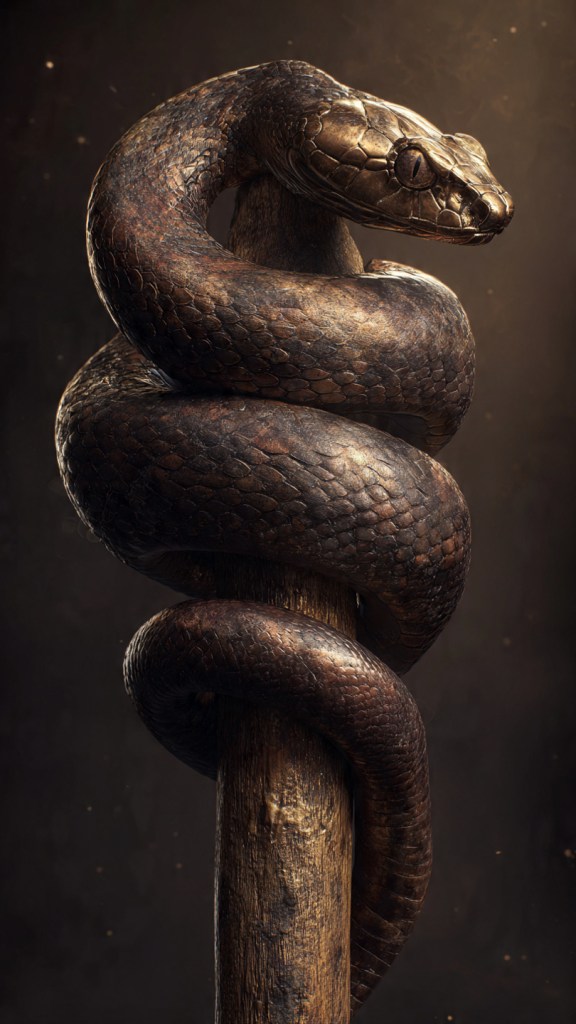
    Around it, a form catches the light—not dull, not faded, but carrying a muted shine, as if the surface remembers something it was not meant to keep. The shape coils upward, tightening as it rises, its body following a line that does not return to the ground. The head lifts slightly, not striking, not moving—only held in that position where it can be seen from every direction.

    Not hidden.
    Not lowered.

    But raised.

    And below it, people remain where they are.

    Some already slowing. Some already fallen. Some still standing, but not for long.

    What has begun does not wait.


    The Wound Within

    It does not announce itself.

    No sound marks the moment. No signal separates before from after. It enters without asking to be noticed.

    A small break.
    A brief contact.

    And then it moves.

    Not on the surface. Not where the eye can follow. It travels inward, quiet and certain, spreading where no hand can reach. What is felt comes later. What is happening has already begun.

    There is no time to measure it.

    What carries the harm does not remain outside.

    It does not stay where it touched.

    It moves beneath.

    And what once felt stable begins to shift in ways that cannot be steadied from the outside. The body responds, but not with control—only with the awareness that something is already working beyond it.

    Nothing added will stop it.
    Nothing held will slow it.

    It does not wait to be understood.


    Set in View

    The answer does not come close.

    It is not brought into the hand. It is not placed within reach.

    It stands at a distance.

    Not far, but not near.

    There are no steps given. No sequence explained. Nothing is arranged so that it can be completed piece by piece.

    It is simply there.

    Visible.

    No instruction follows it. No explanation surrounds it. What is offered does not expand itself to meet the one who needs it.

    Seen.

    That is all.

    And yet, that is where the resistance begins.

    Because nothing else is asked. No effort can be added to it. No correction can improve it.

    The hand pauses—not because it cannot act, but because there is nothing to do with what is seen.

    It cannot be adjusted.
    It cannot be carried.

    It remains where it is placed.


    The Unlikely Form

    It is not removed.

    The shape that stands above is not different from what brought the harm. It does not replace it with something softer, something easier to accept.

    It takes its form.

    The same curve.
    The same line.

    What once moved unseen now stands exposed.

    Not hidden beneath the sand. Not slipping through what cannot be guarded.

    Lifted.

    The form is not changed into something comforting. It does not distance itself from what it represents. It holds it, fully, without turning away from it.

    And this is where the question settles, even if it is not spoken:

    Why this?

    Why would what wounded become what is seen?

    Why would the shape of harm be placed where healing is found?

    The answer does not come in words.

    It stands in place.

    What once remained below now rises where it cannot be avoided. What could not be faced while it moved in secret now holds its position in the open.

    Not to repeat it.

    But to end its hold.


    Only This

    Nothing is added.

    No action completes it. No sequence leads into it. There is no path that must be followed to reach it.

    Only a direction.

    Not of the feet.
    Not of the hands.

    Of the gaze.

    And that is what does not settle easily.

    Because it leaves no place for contribution. Nothing can be placed beside it to strengthen it. Nothing can be improved through effort.

    It offers no role to play.

    Only a turning.

    And even that is not demanded—only made possible.

    The eyes move.

    Or they do not.

    And in that small movement, something shifts that cannot be measured from the outside. Not because something is added, but because something is no longer held in the same way.

    Nothing to claim.
    Nothing to improve.
    Nothing to hold.


    The Same Pattern

    What stands in that open ground does not end there.

    It appears again.

    Not in the same place. Not in the same material. But along the same line that moves from what is below to what is lifted above.

    What once rose in the desert does not disappear.

    It continues.

    Not repeated, but fulfilled in a way that does not alter its structure. The direction remains. The movement holds.

    What brings death.
    What is lifted.
    What is seen.
    What follows.

    The pattern does not change.

    It does not become more complex. It does not unfold into something that requires more understanding.

    It remains as it was.

    Clear.

    Unprotected by explanation. Uncovered by method. It stands without layers, without distance, without a system to enter.

    And still—

    it is not easily received.

    Not because it is hidden, but because it does not offer anything to hold onto.


    Seeing

    It is not the act itself.

    Not the movement of the eyes, not the adjustment of sight.

    It is what that movement releases.

    The turning is small.

    Almost nothing.

    But it leaves something behind.

    What was relied on does not come with it. What once carried weight does not move in the same way.

    The direction shifts.

    Not outward into distance, but away from what was held as enough.

    And in that shift, something else takes place—not added, not produced, not constructed.

    Given.

    It does not come from what was done. It does not follow effort. It does not build on what was already there.

    It meets.

    And what it meets does not remain the same.


    Coda

    The ground does not change.

    The light remains where it falls. The heat holds its place. The surface keeps what it has always been.

    The pole still stands.

    The form above it does not move.

    And those below—

    do not all remain the same.

    Some continue as they were. Some move past without turning. Some slow, but do not look.

    And some—

    lift their eyes.

    And yet, something is no longer carried in the same way.

    Not because it was taken away.

    But because it was no longer held.


    Nu 21:8–9 • Jn 3:14–15 • Isa 45:22 • Jn 12:32 • Heb 12:2 • 2Co 3:18 • Ps 34:5 • Ro 8:2

  • Intro

    Night does not remove what the day reveals.

    It only lowers the noise around it.

    The city settles into a quieter rhythm, where movement becomes less visible but not absent. Lamps remain where they must, holding small circles of light that do not reach far enough to explain what lies beyond them. Footsteps carry further now, not because the streets are empty, but because fewer things compete with them.

    He moves within that space.

    Not hidden, but not seen in the same way.

    There are moments when the night does not conceal, but allows what would have been overlooked to remain long enough to be noticed. The air does not press. The path does not demand. It simply holds.

    His name is known. It has weight where words are measured before they are spoken. He has stood where decisions form, where questions are not asked lightly, where knowledge is not gathered without purpose. He has listened where others conclude too quickly, and spoken where others hesitate.

    Nothing suggests that he lacks.

    Nothing suggests that something has been missed.

    And yet he comes.

    Not where others gather.

    Not where recognition is exchanged.

    But here—where what is known does not follow.


    Known Ground

    He begins with what he can name.

    A teacher sent from God. Signs that do not stand alone. Works that do not appear without something beyond them. What has been seen has already arranged itself into something stable enough to speak.

    It is not a question.

    It is a conclusion.

    No one does these things unless God is with him.

    The words are placed carefully, not as doubt, but as recognition. What he says carries weight because it has been formed from what can be observed, agreed upon, confirmed.

    It should be enough.

    It has always been enough.

    But what is said remains where it is placed.

    It does not move.


    Sightline Shift

    The response does not meet what has been said.

    It moves before it.

    Unless one is born again, he cannot see the kingdom.

    Not enter.

    See.

    The order does not follow what he knows. It does not build from what has been placed. It opens something that does not attach itself to what is already understood.

    What cannot be seen cannot be entered.

    And what cannot be seen does not become visible by effort.

    It does not arrive through extension.

    It does not emerge through refinement.

    The words do not explain.

    They do not adjust.

    They remain.


    Old Frame

    He stays within what has always held.

    How can this be?

    The question does not resist. It does not refuse. It asks from within what has already been formed.

    Birth is once.

    Origin is fixed.

    What begins does not begin again.

    Everything he has received confirms it. Everything he has taught rests on it. What is known holds, not because it is forced to hold, but because nothing has ever required it to move.

    There are structures that do not feel like structures because they have never been tested.

    The frame is intact.

    And within it, the question does not cross over.


    From Above

    The answer does not return to where he stands.

    We speak of what we know.

    We bear witness to what we have seen.

    But it is not received.

    The words do not press.

    They do not argue.

    They remain where they are spoken.

    No one has gone up.

    Only One has come down.

    The direction does not reverse.

    What is from below continues within what it already holds. It does not rise into what is above. It does not extend itself far enough to reach what it cannot see. It can move, refine, expand—but only within its own boundary.

    And that boundary does not break from within.

    What is sought cannot be climbed into.

    What is from above does not begin there.

    It comes.

    Not as something discovered.

    Not as something concluded.

    But as something that arrives without being produced.

    And when it comes, it does not fit into what was prepared for it.

    It does not settle into existing forms.

    It does not complete what was incomplete.

    It interrupts.

    Quietly.


    New Birth

    Born of water.

    Born of Spirit.

    The words do not describe improvement.

    They do not describe continuation.

    What is born of flesh remains as it is. It moves within the same limits, under the same frame, carrying forward what it already is.

    Nothing in it crosses over.

    Nothing in it shifts its ground.

    But what is born of Spirit does not remain where it began.

    It does not move from the same ground.

    It does not see from the same place.

    It becomes other.

    Not refined.

    Not extended.

    Other.

    Like something that once moved close to the ground, tracing only what it could reach—measuring its world by what it touched, limited to what lay directly before it.

    And then, without the ground changing, the movement no longer follows the same line.

    It lifts.

    Not by force.

    Not by effort.

    Not by stretching what it was.

    The ground remains.

    But it is no longer where seeing begins.

    The measure changes.

    The reach changes.

    The direction changes.

    What once could only approach now no longer needs to.

    What could not be reached is no longer approached.

    It is placed where it cannot be missed.


    Coda

    He came with what he knew.

    He left with what did not fit.

    The night held.
    The city held.

    The path beneath him did not change.

    And yet something did not remain where it was.

    Not seen.

    Not entered.

    But no longer held in the same way.


    Jn 3:1–3 ● Jn 3:5–6 ● Jn 3:11 ● Jn 3:13 ● Jn 3:14 ● Jn 3:27–31

  • Intro

    The road has already taken something from Him.

    Dust clings to His feet. The heat does not move. He sits beside the well, not as one who has come to stay, but as one who has arrived and paused because the body asks for it. The others have gone ahead into the city. Their voices have faded into distance.

    He remains.

    The well does not speak. It does not offer. It waits the way it always has—deep, unmoving, holding what it holds without coming closer to those who stand above it.

    She arrives carrying what she needs.

    Not looking for Him.

    Not expecting to be addressed.

    There is space enough between them for nothing to happen.

    It does not stay that way.


    The Request That Opens

    The first movement does not come from her.

    It comes from Him.

    A request, simple enough to pass without notice. Water. Something she already has the means to draw, something He cannot reach without her.

    He asks.

    Not because He does not know.
    Not because He cannot.
    But because the asking itself creates a place where something can begin.

    The distance is still there. It does not dissolve with the request. It remains in the way she hears it, in the way she answers—not refusing, not agreeing, but holding the question in front of her as something that does not fit.

    Why would He ask?

    The difference is not hidden. It has been carried long before either of them arrived. It sits between them, not spoken in full, but understood well enough to shape the moment.

    Still, the request remains.

    Waiting, not for water alone.


    What She Hears

    The conversation does not begin as openness.

    It begins as distance speaking back.

    You have nothing to draw with. The well is deep. Where would this come from? Are you greater than what has already been given to us?

    The question does not stay with the well alone.

    It carries what has been held.

    Not just depth. Not just water. But what has been received, named, and kept as final.

    Nothing in what He says fits into that arrangement. It does not meet the question where it was asked. It moves past it, not by ignoring it, but by not staying within it.

    What she hears does not settle.

    It shifts.


    What Is Offered

    The well remains where it is.

    The water below does not rise.

    But something else is placed into the space between them.

    Not drawn.
    Not lowered.
    Given.

    Whoever drinks from what is here will return. The thirst does not end with what is taken up from below. It returns, as it always has, asking again for what must be drawn again.

    But what is given does not follow that movement.

    It does not depend on the well.
    It does not wait for the rope.
    It does not remain outside.

    It moves from within.

    Not carried upward,
    but rising outward.

    And in rising, it does not return to where it began.


    Where It Turns

    She asks for it.

    Not because she has understood, but because something in what she hears reaches further than what she can name. The request changes. Not for water she can draw, but for something that would remove the need to return.

    Give me this.

    So that I do not come back.

    So that I do not draw again.

    The movement is clear.

    It is still within what she knows.

    Then the direction shifts.

    Go.

    Call your husband.

    The request does not follow the one she made. It turns elsewhere, not away from her, but toward something she has not brought into the conversation.

    What she came with remains at her side.

    What is asked of her now does not.


    What Is Seen

    The well has not changed.

    The water is still there.

    The depth remains.

    But something else has already moved.

    What was not spoken becomes visible, not by exposure, not by force, but by being named without being searched for.

    Nothing is added.

    Nothing is taken.

    And yet what was carried unseen no longer remains where it was.

    She does not answer from where she began.

    Something has already shifted.


    Before She Knew

    She speaks of what is to come.

    Of One who will explain.

    Of One who will make clear what is not yet understood.

    It is still ahead of her.

    Still expected.

    Still placed somewhere beyond the moment she stands in.

    He does not move it forward.

    He does not point beyond.

    He does not delay.

    He speaks from within the moment itself.

    I am He.

    Not as something to be reached.

    Not as something to be awaited.

    But as One already speaking.

    Already present.

    Already known—though not yet recognized.


    Coda

    She leaves what she carried.

    Not because it is no longer needed.

    But because something else now moves faster than what she came to do.

    The well remains.

    The water remains.

    The jar remains.

    And the question—

    moves ahead of her.


    Jn 4:7–9 ● Jn 4:13–14 ● Jn 4:15–16 ● Jn 4:25–26 ● Jn 4:28–29

  • Intro

    They do not arrive unnoticed.

    Dust follows them in from the road, settling along the edges of garments that have traveled far enough to gather attention. Their presence carries a certain weight, not because they announce it, but because it is already recognized. The folds of their robes, the way they stand, the distance they keep even when near—these things speak before they do.

    They come from Jerusalem.

    Not to sit at the table, not to share what is placed there, but to observe what unfolds around it. Their eyes move carefully, not searching for something new, but for something that does not align.

    The table itself is ordinary. Bread is taken without ceremony. Hands reach, break, pass. No basin is brought forward. No water is poured. Nothing interrupts the rhythm of the meal.

    It continues as though nothing is missing.

    But something has already been seen.

    Not the bread.

    Not the table.

    The hands.


    What Is Not Washed

    The question forms before it is spoken, shaped by something carried long before the moment arrived. It does not grow out of what is happening at the table. It arrives with them, intact, waiting only for a point of contact.

    Why do they not wash?

    The absence is small. It does not disturb the meal itself. It does not change the bread, nor the act of eating, nor the quiet exchange between those seated together.

    But it is enough.

    Enough to confirm what had already been settled.

    Water is not there. The sequence is not followed. What should come first has been left undone.

    And in that small omission, something larger is named without needing to be said.

    Not clean.

    Not as it should be.

    The hands become the place where judgment rests, not because they carry meaning in themselves, but because they are seen through something that has already decided what they must mean.


    The Distance That Remains

    They stand near enough to see every movement, yet nothing they see enters beyond the surface.

    The distance is not measured in steps. It does not widen across the space between them and the table. It remains where it has always been—within what has already been formed and held in place.

    They know what should be done.

    They know what has been handed down.

    They know what preserves what they serve.

    And because they know, nothing needs to shift.

    The meal continues in front of them, unchanged by their presence. Bread is broken, shared, received. The hands do not pause, do not reach for water, do not adjust to the watching.

    What is seen remains outside.

    It can be named there.

    It can be judged there.

    But it does not enter.


    What Has Been Replaced

    The response does not begin with the hands.

    It turns elsewhere.

    Not away from the moment, but deeper into it—toward something that existed before the question was formed, before the journey was made, before the table was set.

    Something has been lifted above what was given.

    Not visibly. Not in a way that interrupts the form. The actions still follow. The structure still holds. The order appears intact.

    But what holds the order has shifted.

    What was spoken has been set aside, not by rejection, but by replacement. Something else now carries the weight of authority, though it was never given to bear it.

    And where that weight is placed, something else quietly loses its place.

    A word once meant to honor becomes the reason something is withheld.

    A hand that could have given remains closed.

    What is placed above becomes the reason for what is left undone below.


    The Key That Does Not Turn

    A key does not force a door.

    It does not change the door, nor reshape the frame, nor call attention to its presence. It simply fits, or it does not. It opens, or it remains unused.

    What is bound does not loosen by itself. What is closed does not open because it could.

    Something must turn.

    Something must enter.

    The key is not absent.

    It has not been withheld.

    It is given.

    Not once, not in passing, but placed where it can be taken and turned.

    And still, nothing opens.

    Not because the door resists, but because the turning does not come. What stands before it remains as it was, not locked by force, but untouched by what was placed into the hand.


    What Comes From Within

    The meal does not change.

    Bread is taken, eaten, passed along. The rhythm holds. Nothing in the movement suggests that anything essential has been disrupted.

    What enters the mouth does not remain.

    It passes through, leaving nothing that settles.

    But what remains is not what has been taken in.

    It is what comes from within.

    Not gathered.

    Not arranged.

    Not prepared.

    It does not wait for what was prepared to come first.

    It does not rise from what has been learned to be shown.

    It appears, and in appearing, it reveals.

    Not by argument.

    Not by correction.

    But by what it carries with it.

    What is kept outside cannot reach it.

    What is maintained cannot contain it.

    And what has been given—

    is seen there, though it was never taken in.


    Coda

    They came to observe.

    They found what they were prepared to see.

    Hands that did not follow the pattern they carried.

    The table remains as it was. The bread is still taken and shared. Nothing in the scene rearranges itself to answer the question that was brought into it.

    And yet something does not return with them.

    What was given has not moved.

    What could have opened has not been turned.

    The hands are still there.

    The key is still there.


    Mt 15:1–2 ● Mt 15:9 ● Mt 15:10–20 ● Mt 16:19

  • The stones catch the light before anything else does. Not evenly, not all at once—just enough to draw the eye upward, to hold it there a little longer than needed. Someone points. Another steps closer. The air feels almost arranged, as if admiration itself has weight.

    Hands move across carved surfaces, not hurried, not uncertain. Fingers follow lines shaped long before this moment, as if touch could confirm what sight already suggests. Words gather nearby—about beauty, about devotion pressed into form—but they do not interrupt the scene. They belong to it.

    Nothing here feels unstable. Nothing hints at interruption. What stands seems settled, and what is settled invites trust without asking for it.

    There is a quiet agreement in the way people look—that what holds this firmly will continue to hold, that what appears complete has already proven itself.

    No one says it aloud.

    The gaze settles.


    The Angle of Looking

    They are not mistaken in what they see. The structure rises with intention, its details holding together without strain. Offerings rest where they were placed, their presence part of the whole, not separate from it. Everything appears in place, as if it has always been so.

    But the angle matters more than the object.

    To look from where one stands is effortless. It requires no adjustment, no reconsideration. The eye meets what is in front of it and settles there. But to remain in that position—unchanged, unquestioned—is something else.

    Height does not announce itself. It enters quietly, almost unnoticed at first. The shift is not in the structure, but in the relation to it. What once seemed complete begins to loosen—not because it changes, but because distance introduces another layer.

    Nothing is removed. Nothing is added.

    Still, the meaning begins to shift.

    A different line of sight opens—one that does not deny what is seen, but does not stay with it either. The eye lingers there, adjusting, not fully settled, not entirely certain of what it is beginning to notice.

    It does not rush.


    The Admiration That Holds

    Admiration has its own rhythm. It gathers slowly, almost imperceptibly, and then settles into something stable. What is seen repeatedly begins to feel certain. What is certain begins to feel trustworthy.

    The stones help with that. They do not move. They do not argue. They remain as they are, without explanation, without resistance.

    And in that remaining, something else attaches itself—not visibly, not abruptly, but steadily. A quiet assumption forms: that what stands must be right, that what endures must be safe to rely on.

    No voice interrupts immediately. The moment is allowed to extend, to fill itself out until it feels complete.

    Completeness carries a certain ease. It removes the need to question, to shift, to look again from somewhere else.

    And for a while, that is enough.


    When Height Interrupts

    The words do not arrive as disruption. They do not raise their voice or demand attention. Yet they do not blend with what is already there.

    What is seen will not remain.

    Not one stone.

    The statement does not touch the structure directly. It does something quieter than that. It loosens what had been assumed, what had settled unnoticed beneath the surface of admiration.

    The eye, once steady, hesitates.

    From above, the lines do not arrange themselves in the same way. What seemed fixed begins to carry a trace of something else—not visible before, not needed before. Patterns emerge that cannot be held from within the scene itself.

    It is not the fall that shifts the moment.

    It is the knowing.

    The gaze does not return easily to where it was.

    Something has already moved.

    Quietly.


    The Wider Field

    Beyond the stones, the space does not narrow—it opens. Not with order, not with clarity, but with movement that resists being arranged. The field extends outward, carrying voices that do not agree, rhythms that do not align.

    Nothing gathers into a single direction.

    Fear enters here, but not evenly. Some encounter it without distance, without any frame to hold what is happening. For them, the ground does not give warning. It simply shifts.

    Others stand in the same field and do not move in the same way. The events are not different. The tension is not reduced. Yet something holds.

    Not control. Not certainty.

    Something else.

    From one place, the movement appears as collapse—uncontained, without pattern, impossible to follow. From another, the same movement does not become panic.

    Words are not gathered in advance. They do not assemble into prepared responses.

    Still, something answers.

    Given.


    The Weight of Alignment

    There is a line that does not present itself openly. It does not separate the field into clear sides. It does not announce where it runs.

    Yet it is there.

    To remain with what is visible is easy. The world offers enough to hold attention, enough to shape a sense of belonging within it. Nothing in that movement feels abrupt. Nothing demands resistance.

    It simply continues.

    And in that continuation, something settles—not suddenly, not consciously, but over time. A direction forms before it is named, before it is examined.

    When what is visible begins to shift—when what once held certainty loosens—what has already settled begins to show itself.

    Not loudly.

    The pull does not argue. It does not force its way forward. It remains, drawing quietly, either toward what depends on remaining or toward what does not.

    Nothing declares itself.

    Still, something leans.

    Without sound.


    Coda

    The stones still catch the light. Not differently, not less than before. The surface holds, the lines remain, the eye still rises when it meets them.

    Nothing in the scene insists that anything has changed.

    The movement is elsewhere.

    The gaze does not settle as easily. It pauses, almost without reason, as if something beneath the surface no longer aligns as it once did. Admiration remains, but it no longer closes the moment.

    The field is still there, though not all of it is visible at once.

    The stones remain.

    The height remains.


    Scriptural Anchors
    Lk 21:5–6 ● Lk 21:7–19 ● Lk 21:20–37 ● Jas 4:4 ● Ex 20:3 ● Prv 14:12 ● Jer 17:5

  • A Tree, A Street, A Pause

    Dust hangs lightly over the road into Jericho, settling on sandals and hems without asking. A man is already in the tree before anyone thinks to look up—not high, just enough to see beyond shoulders that never quite made space for him.

    The branches hold him in a way the crowd does not.

    Below, the road keeps moving. Coins shift in small cloth bags. Voices overlap, ordinary and unbroken. Nothing here suggests interruption.

    And yet something has already begun.

    It is not the crowd that slows the moment, nor the road that changes its rhythm. It is the small, almost hidden insistence of someone who refuses to remain unseen.

    Before a name is spoken, before a step is taken, the direction has already shifted—quietly, almost unnoticed.


    A Name Spoken Once

    Zacchaeus does not wait to be called into the moment. The climb itself is already an answer to something forming inside him, something that does not ask permission from the crowd below.

    It is not curiosity alone. It moves faster than that.

    When Jesus Christ reaches the tree, He does not pause to assess the scene. He looks up, as if the movement had already met Him halfway.

    The name is spoken only once.

    Not loudly. Not ceremonially.

    Yet it lands with the weight of recognition that did not begin at that moment, only arrived there.

    Zacchaeus descends too quickly, almost uneven, as if the tree had been holding more than his body. Words follow—giving, restoring, returning—but they come unarranged, ahead of intention.

    No instruction is given.

    Still, something in him moves first, and it does not move alone.


    Questions That Stay Closed

    In Jerusalem, the ground feels no different, but the air carries another kind of tension—measured, deliberate, practiced.

    Questions are placed carefully, shaped to hold control rather than to release it.

    They ask about authority. It appears simple.

    It is not.

    The reply does not confront. It turns, gently, toward another voice—John’s—and leaves the answer suspended where it cannot be handled without consequence.

    They understand this.

    Not vaguely. Precisely.

    What follows is not confusion, but restraint. They weigh the outcomes, not the truth. They preserve position, not openness.

    So they answer without answering.

    The moment does not break. It closes.

    Quietly.


    Two Coins, One Weight

    The treasury receives what it always receives—measured offerings, visible gestures, the steady rhythm of giving that fits expectation.

    Then a woman steps forward.

    The widow carries almost nothing. Two coins, small enough to disappear between fingers, light enough to pass unnoticed.

    They fall without sound that anyone would follow.

    But they are not lost.

    He sees them—not as objects, but as movement. Not as amount, but as release. Something in Him responds before it is explained, before it is named.

    He does not increase their value.

    He reveals it.

    And in that revealing, something shifts—not in the treasury, but in the direction of what is being given, and what is being received in return.


    Given Before Held

    The pattern does not gather itself loudly. It moves through moments that do not insist on being connected.

    A man climbs before he is called.

    A woman releases before she is noticed.

    Others stand near, asking, measuring, holding their place.

    The difference does not sit in distance.

    It sits in recognition.

    Not the kind that is constructed or concluded, but the kind that is given—arriving before it is secured, arriving before any attempt to deserve it.

    What is offered here is not instruction, not even invitation as it is usually understood.

    It is recognition.

    And it does not remain where it is managed.

    It appears where it is received without negotiation, or released without remainder.


    What Is Held, What Is Missed

    Two stories remain at the edges, almost as afterthoughts.

    A servant wraps what was given and keeps it untouched, preserved from risk, intact but unmoved.

    Another group works a vineyard not their own, cultivating, building, producing—until the question of return unsettles what had seemed secure.

    In both, something is retained.

    In both, something slips past.

    One protects what was given, and never enters it.

    The other inhabits what was given, and forgets its source.

    Nothing dramatic announces the loss.

    It unfolds as quietly as it began.


    Coda — The Tree Remains

    The road into Jericho still gathers dust in the same way. Trees do not shift their posture for those who pass beneath them. Coins still sound the same when they fall.

    Nothing in the setting insists that anything has changed.

    And yet the difference does not belong to the setting.

    Somewhere between a climb that began without permission, a question that closed without answer, and two coins that carried more than they appeared to hold—a pattern settles.
    Without conclusion, without insistence.

    What moves first is not always what is seen.

    And what is given is not always what is counted.

    The tree remains.

    So does the road.


    Luke 19:1–10 ● Luke 20:1–8 ● Luke 21:1–4 ● Luke 19:11–27 ● Luke 20:9–16

  • Intro

    It rarely begins with urgency.

    A gathering forms the way many things do—quietly, without pressure, without the sense that something essential is being held within it. People come, not always with the same intention, not always with the same awareness of what is taking place.

    At times, it appears simple. Repetitive. Predictable.

    And because it appears that way, it can also be set aside without much resistance. Not all at once—only gradually.

    What is infrequent does not immediately feel like absence.

    There is still familiarity.
    Still recognition.
    Still enough continuity to assume nothing essential has changed.

    And yet, something in the rhythm begins to thin. Not visibly, not in a way that calls attention to itself, but in a way that alters what is sustained.

    What is no longer entered into does not remain as it was,
    even while it still appears available.

    What fades does not always announce its leaving.


    The Personal Weight

    What appears shared does not remove what is personal.

    Each presence carries something that cannot be transferred—attention, readiness, a willingness that does not come from being asked. It is not measured outwardly, and it does not announce itself.

    And yet, it shapes how one remains within what is given.

    Some arrive and remain at the edge.
    Some remain, but do not enter.

    Others begin to move differently—not by obligation, but by a recognition that what is entered into does not remain external.

    Where this forms, movement follows—not outwardly first, but in what begins to be carried.

    What is carried begins to shape what is returned.
    And what is returned does not remain without effect on what is shared.

    What is joined is not sustained by presence alone.


    The Larger Assembly

    There are moments when many gather in one place.

    The scale itself changes the experience. What is carried by one becomes part of something broader—something that does not depend on a single voice, or a single need.

    There is movement here—not always explained, not always directed.

    What had been quiet becomes more visible.
    What had been distant draws nearer.

    Not everything is understood.
    Not everything is resolved.

    And yet, something is strengthened—not by instruction, but by being within what is shared together.

    What one lacks does not remain isolated.
    What another carries does not remain confined.

    Something passes between them—not evenly, not predictably, but not without effect.

    No one carries the whole of it.
    But no one remains entirely untouched by it.

    What gathers many does not remain the same for those within it.


    The Smaller Room

    In a different setting, the movement changes.

    What is shared is no longer carried by scale, but by nearness. Voices are fewer. Silence is more noticeable. What remains unspoken cannot remain hidden in the same way.

    Here, what is carried becomes more visible—not in form, but in how it is borne.

    Needs surface without needing to be structured. What is spoken does not require arrangement to be received.

    It is not always ordered.
    It is not always complete.

    And yet, something passes between those present—strength that does not arrive as instruction, but as something carried together.

    What is ordinary is not set aside. It is included.

    What is personal does not remain private in the same way.

    What is near does not remain distant in what it holds.


    The Form That Reveals

    Across these gatherings, something becomes visible—not by design, but by continuity.

    What is held inwardly begins to take shape outwardly—not as display, but as alignment that forms over time.

    Direction does not arrive all at once.
    But it does not remain scattered.

    What is carried by one is met by another—
    not always at once,
    but not remaining separate for long.

    What is unclear does not remain untouched.

    No single moment defines it.

    And yet, something holds it together—not produced within the gathering, but not absent from it.

    It becomes visible in how things begin to align,
    not in how they are arranged.

    What is formed does not begin where it appears.


    Nearing

    There is a sense that does not depend on visible change.

    And yet, it is not distant.

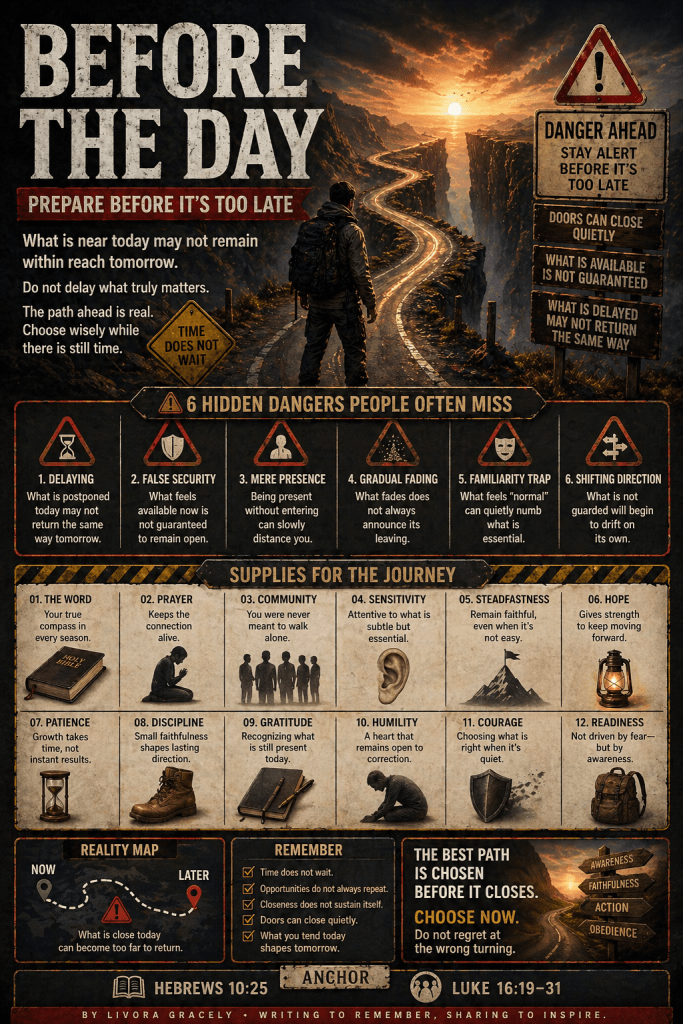
    What is available does not remain indefinitely available.

    What remains accessible is not always recognized while it remains.

    Nothing in the moment forces urgency.
    Nothing demands recognition.

    And still, something has already begun to close—not in what is seen, but in what can still be entered.

    What is postponed does not always return in the same way when it is sought again.

    What was once within reach does not always remain within reach,
    even when it is remembered clearly.

    There are distances that do not appear while they are forming.
    And once they are fully set, they are not crossed by returning to where one once stood.

    What continues to appear open does not always remain so in what it holds.

    What draws near does not wait to be noticed.


    Coda

    The gatherings continue.

    Some remain as they were.
    Some are entered differently.
    Some are left behind without much notice.

    Nothing outward marks the difference immediately.

    And yet—

    what is shared does not remain unchanged when it is no longer entered,
    what is carried does not remain the same when it is not joined,
    what is near does not remain distant, even when it appears so.

    And what was once part of the rhythm—

    does not always return when it is set aside,
    even when it is remembered.

    And what once felt close
    does not always remain so,
    even when nothing visible has moved.


    Heb 10:25 ● Lk 16:19–31