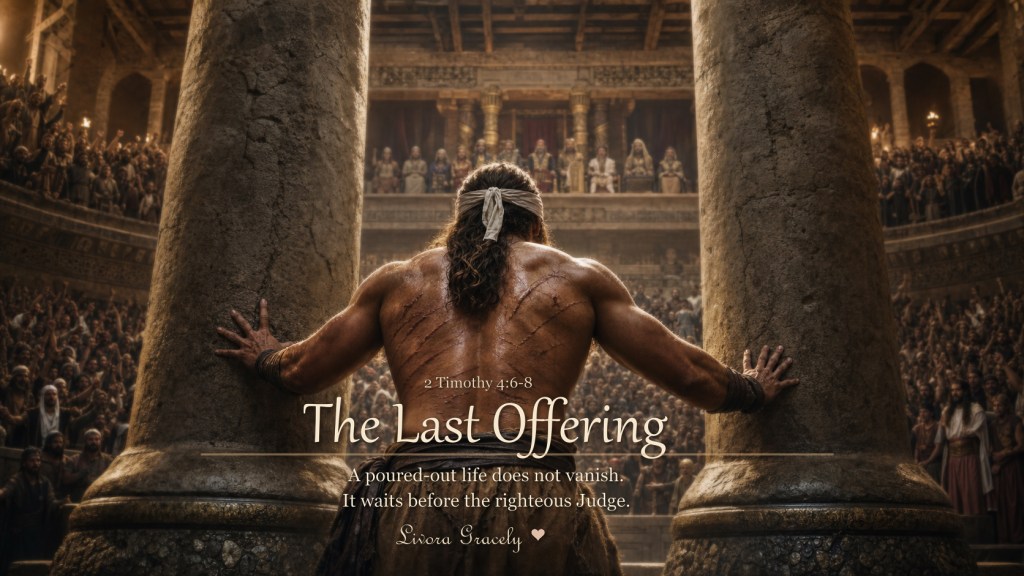
2 Timothy 4:6-8
Broken Pillars
The hall was full.
Princes sat where everyone could see them. The people crowded above. Laughter moved through the house like smoke. The enemy had turned victory into entertainment, and in the middle of the room stood a blind man with hair growing again upon his head.
Samson could no longer see the faces that mocked him.
A child held his hand.
That may be the most painful part of the scene. The man who once tore gates from a city now needed a boy to guide him between two pillars. His strength had frightened nations, but now his body had become a spectacle. His eyes were gone. His freedom was gone. His enemies had gathered around the ruins of his life.
Yet one prayer still rose from him.
One last request for strength.
Scripture does not erase Samson from the story of faith. Hebrews remembers his name among those who acted through faith. That matters. His ending should not be handled as though tragedy cancelled grace.
Still, the picture remains heavy.
Samson’s end was an act of faith in a broken life. Paul’s end carries another witness: faith kept through a completed race.
He is also near death. He is also surrounded by the power of men. His body, too, is being offered up. But he does not speak like a man trying to recover one last act of strength.
He speaks like a man whose race has reached its appointed line.
Spilled Wine
Paul did not describe his death as an accident.
He did not speak as though Rome had finally taken what belonged to him. He did not make Nero the owner of his ending. His blood may soon be shed by human hands, but Paul saw something deeper than execution. He saw offering.
“I am already being poured out.”
That picture changes the room.
A life poured out for Christ is not the same as a life wasted by men. The world may see the servant becoming weak, old, chained, and disposable. It may count his remaining days and conclude that his usefulness is almost over. But heaven does not measure offering by how much remains in the vessel. Heaven sees where the life has been given.
Paul had not waited until death to become an offering. His life had already been spent in the service of Christ. His journeys, wounds, prayers, tears, imprisonments, letters, corrections, and sufferings had all belonged to the same altar. Now the final drops were not being stolen from him. They were joining the offering that had been his life.
This must not become a transaction.
Paul was not buying a crown with blood. He was not calculating pain into reward. The grace that called him had also carried him, strengthened him, corrected him, and kept him. If his life was an offering, it was because Christ had first claimed it by mercy.
Jesus knew the cup before Him.
In Gethsemane, He did not pretend the cup was light. He prayed in agony. Yet He did not walk away from the Father’s will. The true Offering went first. Every faithful pouring after Him is only an echo of the Son who gave Himself completely.
Loosened Doors
Peter once slept between soldiers.
Herod had already killed James, and Peter seemed to be next. Chains held him. Guards surrounded him. The church prayed, but the prison doors remained closed until the night before he was to be brought out.
Then an angel entered.
The chains fell. The doors opened. Peter walked out into the street and thought he was seeing a vision.
Sometimes God opens the prison before the sword falls.
That witness matters, because it keeps the heart from thinking death has the final authority. Herod could plan. Soldiers could guard. Iron could lock. But if the servant’s work was not finished, even chains had to loosen in the night.
Yet Paul’s words show the other side of the same Lord.
Paul does not seem to expect an angel at the door. He does not write as a man waiting for one more escape. He says the time of his departure has come. Peter was released because his race was not finished. Paul is ready because his race is reaching its end.
Peter walked through an opened prison door; Paul was nearing another door, one no angel needed to prevent.
Paul had already learned to speak of the body as a tent, something temporary enough to be taken down without taking hope with it. The body may be “sown in dishonor,” yet it is “raised in glory.”
That is not denial.
It is direction.
The tent may be loosened. The body may be humbled. The departure may come near. But the servant of Christ does not belong finally to the prison, the sword, or the grave.
Paul’s peace does not come from control over the outcome.
It comes from belonging to the One who controls the time.
Finished Dust
Paul gathers his life into three quiet lines.
He has fought the good fight. He has finished the race. He has kept the faith.
There is no boasting in it. There is weight, but not pride. He is not standing over younger servants as a hero demanding admiration. He is looking back over the course entrusted to him and seeing grace that did not let him go.
The fight was good, but it was still a fight.
The race was appointed, but it still required endurance.
The faith was kept, but only because many other things had not been allowed to become lord.
This is the deeper beauty of Paul’s ending. Not a servant inventing meaning at the edge of death, but a servant recognizing that the Lord had carried him through the whole road.
And Timothy must hear this.
Paul is not only remembering. He is handing something forward. The work of the evangelist, the endurance of hardship, the ministry entrusted by God, the Scriptures able to make the servant complete for every good work: these do not disappear because Paul’s departure is near.
The older servant is almost finished.
The younger servant must remain faithful.
Stephen also knew something of this. He stood before violent men and bore witness to the Righteous One. The stones came. His body fell. Yet his last words did not belong to revenge. He saw Jesus standing, entrusted his spirit to Him, and prayed that their sin would not be held against them.
That is a finished faith.
Not loud.
Not safe.
But kept.
Waiting Crown
Now a crown is waiting.
But Paul does not speak of it like a wage owed to a worker who has successfully bargained with God. The crown of righteousness is given by the Lord, the righteous Judge. That changes everything.
Human courts had judged Paul poorly. Human power had chained him. Human opinion had often misunderstood him. Some abandoned him. Some resisted him. Some listened only long enough to decide he was dangerous. If men were the final judges, Paul’s life could look like defeat.
But they are not the final judges.
Christ is.
The righteous Judge sees truly. He sees the servant in prison and the faith that still burns. He sees the bruised body and the race that has been completed. He sees the offering that men call loss. He sees the hidden obedience no crowd applauded, the tears no church recorded, the wounds no enemy understood.
The crown is not only for Paul.
That is the mercy in the final turn. Paul does not close the door behind himself. He opens the hope to all who have loved Christ’s appearing. Not only apostles. Not only martyrs. Not only those whose names are remembered by history. All who wait for Him, long for Him, and keep faith because His coming is more real than the world’s verdict.
What we love at the end shapes how we live before the end.
If we love ease most, every hardship will feel like betrayal. If we love recognition most, every hidden obedience will feel wasted. If we love survival most, every threat will rule us.
But if we love His appearing, even a poured-out life has direction.
One house fell.
One tent loosened.
And the life kept for Christ did not end where men stopped seeing it.
Witness Notes
Judges 16:23-31 – Samson stands blind between the pillars, mocked by his enemies, and asks God for one final strength.
Hebrews 11:32 – Samson is remembered among those who acted through faith, keeping his tragic ending from being treated as faithless.
2 Timothy 4:6-8 – Paul sees his approaching death as a life being poured out, a race completed, faith kept, and a crown waiting from the righteous Judge.
Matthew 26:36-46 – Jesus faces the cup in Gethsemane and submits to the Father’s will before the cross.
Acts 12:1-11 – Peter sleeps in prison before possible execution, but God opens the prison doors because his race is not yet finished.
2 Corinthians 5:1-4 – Paul speaks of the body as a tent, temporary enough to be taken down without taking hope with it.
1 Corinthians 15:43 – Paul describes the resurrection body as sown in dishonor and raised in glory.
2 Timothy 4:5 – Paul’s nearing departure becomes a handoff to Timothy to endure hardship and fulfill his ministry.
2 Timothy 3:16-17 – Scripture equips the servant of God for every good work.
Acts 7:54-60 – Stephen bears witness to Christ before death, entrusts his spirit to Jesus, and forgives those who stone him.


Leave a comment