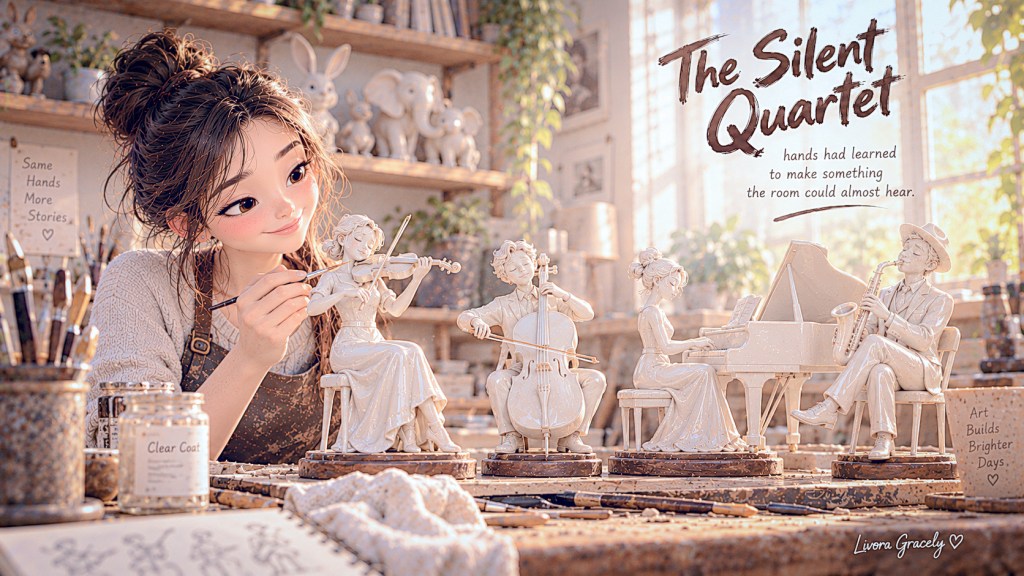
Her hands had learned to make something the room could almost hear.
The violinist had been playing the same note for three days.
Nobody complained.
The cellist had been holding one long note for even longer.
The pianist had ten perfectly silent fingers.
And the saxophonist had somehow managed to look exhausted after performing absolutely nothing.
At twenty-one, the young artist found this deeply satisfying.
She leaned over the worktable and touched a fine brush to the violinist’s shoulder.
The clay was no longer brown.
She had chosen a smooth white body for this project, shaped carefully, dried slowly, and fired until the four musicians could finally survive hands less gentle than hers.
Now came the finishing.
A jar of clear coating stood open beside her.
The studio smelled different these days.
Damp earth was still there somewhere, familiar and faint, but now it mingled with the cleaner scent of finishing materials. Brushes stood upright in jars. Fine tools were arranged by size. A soft cloth waited beside the figures.
Even the table seemed to have learned some discipline.
Some.
She brushed a thin layer across the violinist’s sleeve.
The surface changed immediately.
Not color.
Light.
The afternoon window appeared as a tiny gleam along the shoulder. Another reflection traveled down the violin. The white clay seemed suddenly deeper, smoother, almost porcelain-like.
She rotated the figure.
The violinist’s eyes were closed.
That detail had taken an entire evening.
Years ago, she would have worried whether closed eyes looked realistic.
Now she had been asking a different question.
What was the violinist hearing?
That question had changed everything.
The cellist leaned slightly into the instrument, bow suspended across the strings. The pianist sat forward, shoulders relaxed, fingers arriving at different heights above the keys.
And the saxophonist—
she smiled.
He had become her favorite.
One ankle crossed casually over the other. His shoulders sat lower than the rest. His head tilted just enough to suggest that whatever the quartet was playing, he intended to bend the rules before the final bar.
Four figures.
Four instruments.
Four different ways of inhabiting the same invisible music.
She applied another stroke of clear coating.
Swish.
Turn.
Swish.
Wait.
Light crossed the wet surface.
Behind her, the shelves held a much older audience.
The first lumpy creature.
The rabbit with its impossible teeth.
The elephants.
She rarely noticed them while working now.
But sometimes, when evening light reached the shelf, seven years could fit into a single glance.
Brown clay.
Crooked ears.
A father’s hands.
A calf looking upward.
And now this.
She looked at her own fingers.
They were steadier.
Certainly.
But steadiness wasn’t the largest change.
At fourteen, her hands had been busy trying to control clay.
At seventeen, they had begun understanding form.
At twenty-one, something stranger was happening.
Her hands were trying to express things that had no shape at all.
Sound.
Mood.
Rhythm.
Personality.
How does clay play music?
It doesn’t.
That was precisely the problem.
A violin could be sculpted accurately and still remain silent in every sense.
So could a face.
So could a hand.
Technical correctness could produce four musicians who looked as though they were posing for photographs with borrowed instruments.
She wanted something else.
She wanted the viewer to arrive after the first note had already begun.
So the cellist’s bow was caught halfway through its journey.
The pianist’s fingers did not sit neatly on the keys.
The violinist leaned.
The saxophonist breathed.
Nothing actually moved.
Yet everything had been shaped around movement.
Perhaps this was what her father had been teaching years ago when he spent eleven minutes on one eye.
She had thought he was shaping an eyelid.
He had been shaping a wink.
The difference had taken her years to understand.
Craft learns the object.
Art begins listening for what the object is supposed to carry.
A photographer eventually stops seeing only exposure.
A writer stops seeing only sentences.
A cook stops following only measurements.
A musician stops merely producing correct notes.
Skill becomes interesting when technique grows quiet enough for something else to speak through it.
The young artist placed her brush down.
Four polished figures caught the window light.
The studio remained silent.
No violin.
No cello.
No piano.
No saxophone.
She stepped backward.
For a strange second, she could almost hear them.
Then she noticed the saxophonist.
His chair was slightly crooked.
She stared at it.
Seven years earlier, she would have fixed it immediately.
She reached toward him.
Stopped.
Looked again.
Then smiled.
The chair stayed crooked.
Apparently, even after seven years of practice, one member of the quartet still needed to misbehave.
And somewhere on the shelf behind them, a rabbit with two enormous teeth would have understood perfectly.


Leave a comment