Genesis 12:5
Abram took Sarai, Lot, their possessions, and the people from Haran; together they came to Canaan.
Unpacking after the Journey
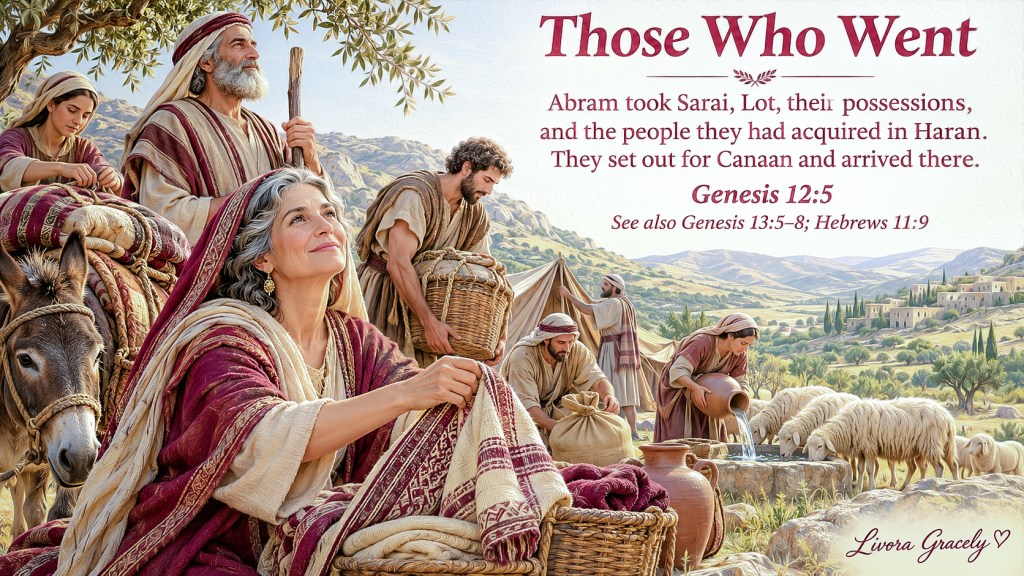
Sarai holds a length of woven cloth across her lap. Beside her, a basket is filled with folded blankets, and a loaded donkey stands nearby.
Behind them, a man carries another basket while others raise a tent. At the edge of the picture, water pours from a jar into a trough, and sheep gather to drink.
The poster imagines the household attending to its needs after a journey. Genesis does not describe these particular tasks or say when the travelers first put up a tent. It tells who went with Abram from Haran and says that they came to Canaan.
Sarai and Lot
Abram left Haran as the LORD had told him. The next verse brings the other travelers into view.
Sarai, his wife, went with him. So did Lot, his brother’s son. Lot had already traveled with the family from Ur to Haran with Terah, his grandfather. Now he continued with Abram and Sarai toward Canaan.
Their names connect this journey to the household introduced in the previous chapter. Sarai and Lot had their own places in that family before the road from Haran began.
In the poster, Sarai sits among the bundles while Abram stands nearby. Their expressions and activities are imagined, but their presence in the traveling household comes from the account.
The People from Haran
Genesis also names the possessions the household had gathered and the people they had acquired in Haran. Abram’s journey involved more people than the three named in the verse.
The passage does not give each person’s name or explain how each came into the household. Some translations use the word “servants”; the verse does not tell us the individual circumstances of their lives or say that every person traveled by choice.
In the picture, several people are tending animals and handling supplies. Their work helps the viewer imagine a larger company on the move. The details of those particular tasks remain part of the illustration.
They Came to Canaan
The destination named in Genesis is Canaan. The account says that Abram and those with him set out for the land and arrived there.
Much later, Hebrews looks back at Abraham’s life in the promised land and describes him living there as a foreigner, dwelling in tents. Its words belong to a reflection on faith and the story that continued after the arrival; they do not describe the day pictured on the poster.
For now, the travelers have reached the land toward which they set out. The next verse will follow Abram farther through it.
The Story of Lot Continues
In a later chapter, Abram and Lot both have flocks and herds. The land cannot support them while they remain together, and a quarrel arises between their herders.
Abram speaks to Lot and asks that there be no conflict between them. Genesis does not specify whether the herders disputed over water, pasture, or another need. The story has moved beyond the arrival in chapter 12, but Lot remains part of the journey.
On the poster, the water jar is still tilted toward the trough. Around Sarai, the imagined household tends to its belongings and animals. Behind the single name of Abram stands a company of people who came with him.
Livora Gracely ♥
Sources
- Genesis 11:27, 31 — Lot’s relationship to Abram and the family’s earlier journey to Haran.
- Genesis 12:4–5 — Abram, Sarai, Lot, their possessions, and the people from Haran set out and come to Canaan.
- Genesis 13:5–8 — Abram and Lot’s possessions and the dispute between their herders.
- Hebrews 11:9 — Abraham is remembered as living in the promised land as a foreigner.


Leave a Reply