Genesis 12:6
Abram traveled through the land to Shechem, where the Canaanites were already living.
Under the Great Tree
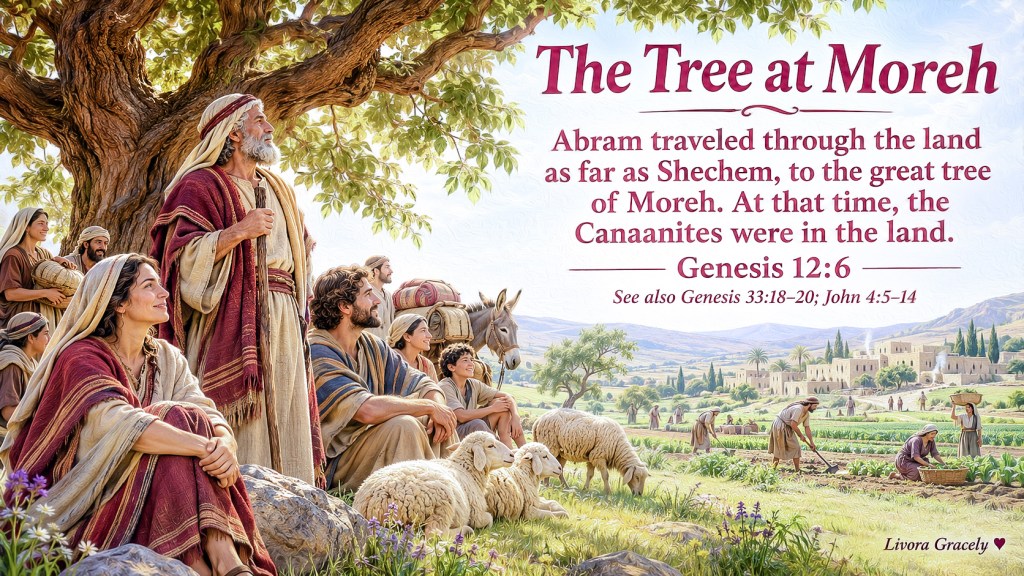
Abram stands beneath the broad branches of a tree. Nearby, Sarai sits in its shade, while members of the household rest beside their belongings and sheep graze in the grass.
Across the fields, people work near a settlement. One bends toward the soil; another carries a basket. The land beyond the tree is already home to others.
The poster imagines a pause in Abram’s journey. Genesis does not describe the family resting beneath the branches or the work taking place in the fields. It tells that Abram traveled through the land as far as Shechem, to the tree of Moreh, and that the Canaanites were then in the land.
A Place Already Inhabited
Abram had left Haran with Sarai, Lot, their possessions, and the people of their household. Genesis says they set out for Canaan and arrived there. The account then follows Abram through the land to the place near Shechem.
A single sentence adds an important detail: the Canaanites were in the land at that time. Abram’s journey brought him into a place where other people already lived.
The figures in the distant fields give that detail a place in the picture. Their work and homes are imagined, but their presence draws attention to the people mentioned in the verse. The passage does not name the people Abram saw near the tree or describe an encounter with them there.
The Land and the Promise
In the next verse, the LORD appeared to Abram and said that He would give this land to his offspring. Abram built an altar there to the LORD, who had appeared to him.
The promise follows the note that the Canaanites were in the land. Both details remain in the account: the land had people living in it, and the LORD spoke of Abram’s descendants receiving it.
Shechem in Another Generation
The name Shechem appears again in the story of Abram’s family. Much later, Jacob—Abraham’s grandson—came safely to the area of Shechem after traveling from Paddan Aram.
Jacob camped before the city and bought the piece of land where he had pitched his tent. There he set up an altar.
The two scenes belong to different generations. Abram’s journey to the tree of Moreh and Jacob’s arrival near the city are not the same event. The shared place name allows the story to be followed across the years between grandfather and grandson.
A Stranger in the Land
Much later, Hebrews looks back at Abraham’s life in the promised land. It describes him living there by faith as a foreigner, dwelling in tents.
Hebrews reflects on the longer story of Abraham and his descendants; it does not describe the particular pause imagined in the poster. Its words bring attention to a family living in a land where their journey had only begun.
Beneath the Branches
In the picture, the household rests in the tree’s shade while the fields extend toward the settlement. The scene is imagined; Genesis records Abram’s journey and the Canaanites’ presence.
For now, Abram has come to the tree of Moreh, in a land already inhabited by others. The LORD’s promise to his offspring follows in the next verse.
Livora Gracely ♥
Sources
- Genesis 12:4–7 — Abram’s arrival in Canaan, his journey to Shechem, the Canaanites’ presence, and the LORD’s subsequent promise.
- Genesis 33:18–20 — Jacob arrives near Shechem, buys land, and sets up an altar.
- Hebrews 11:9 — Abraham is remembered as living by faith as a foreigner in the promised land.


Leave a Reply