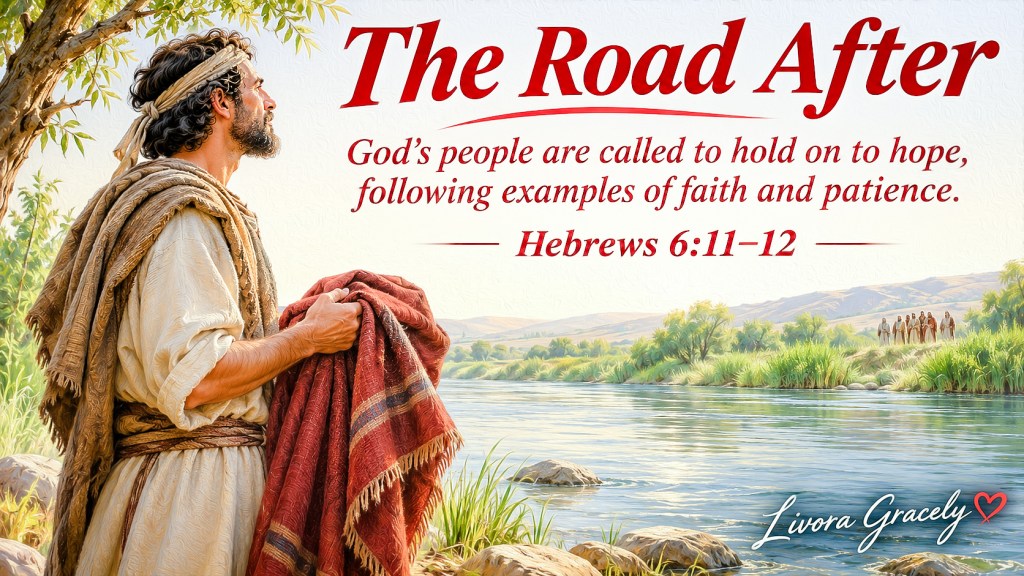
Hebrews 6:11–12
God’s people are called to hold on to hope, following examples of faith and patience.
Elijah told Elisha to stay where he was. The Lord had sent Elijah on to Bethel.¹
But Elisha answered that he would not leave him. So they went down together. At Bethel, the prophets spoke to Elisha about the day ahead: the Lord was going to take his master away. Elisha knew.¹
Twice more Elijah told him to stay. Twice more Elisha remained with him. They walked on to Jericho and then to the Jordan, where Elijah struck the water with his cloak. The river divided, and the two crossed over on dry ground.¹
Before they parted, Elijah asked what he could do for Elisha. The answer was a request for a double portion of Elijah’s spirit.¹
I Will Not Leave You
Elijah told Elisha that he had asked a difficult thing. If Elisha saw him when he was taken away, the request would be granted.¹
As they walked and talked, a chariot and horses of fire separated them, and Elijah went up to heaven in a whirlwind. Elisha saw it happen. When he could no longer see his master, he tore his clothes.¹
Then he picked up Elijah’s cloak, which had fallen, and returned to the bank of the Jordan. He struck the water and asked, “Where now is the LORD, the God of Elijah?” The water divided, and Elisha crossed over.¹
The prophets watching from Jericho saw him and said that the spirit of Elijah was resting on Elisha.¹ The road they had shared had come to an end, but Elisha’s service was continuing.
His story is not an explanation of every detail in Hebrews. It gives us a picture of a person who stayed with his teacher and then had to take the next steps without him. Elisha did not simply keep the cloak as a memory; he carried it back to the river. The prophets had watched the two men go together. Now they saw Elisha return and recognized the spirit of Elijah resting on him. The story moves from a shared journey to a new beginning, while pointing to the Lord who had been at work.
The Same Diligence
The writer to the Hebrews also wanted his friends to continue. They had shown love for God’s name by serving His people, and they were still doing so. God, he assured them, would not forget their work and love.²
Then he expressed a desire for each of them: that they show the same diligence to the end, so that their hope might be fully assured.³
He did not ask them to dismiss what had already been done. The care they had shown mattered. Now he encouraged them to carry that same earnestness into the journey ahead.
Such diligence is not measured simply by the number of tasks completed. A person living with illness, grief, or exhaustion may need to slow down and receive help. Rest and asking for support are not the same as refusing to listen to God.
Hebrews speaks to a community. Those who serve also need encouragement; those who receive care remain part of the journey. The letter later urges its hearers to consider how to encourage one another toward love and good deeds.⁴
Faith and Patience
The writer urges his friends not to become sluggish, but to imitate those who inherit God’s promises through faith and patience.³ Earlier, he had said that they had become slow to listen.⁵ Now the invitation is to keep listening and to learn from lives shaped by trust in God.
Elisha followed Elijah, but the people named in Hebrews 6:12 are described particularly by their faith and patience in relation to God’s promises. The two passages have different emphases. Elisha’s journey can help us imagine staying with a teacher; Hebrews asks its hearers to attend to the faithfulness of those who have gone before them.
The letter soon turns to Abraham. God promised to bless him and give him many descendants. After waiting patiently, Hebrews says, Abraham received what was promised.⁶ Isaac was born to Abraham and Sarah as God had said.⁷ Yet the promise reached beyond what Abraham could see fulfilled in his own lifetime.
Faith and patience do not make every desired outcome arrive on a schedule. Abraham’s story belongs to the particular promises God made to him. His example invites the community to trust the God who speaks and remains faithful. Waiting may include questions that cannot be settled in a single conversation. Faith and patience make room for a journey shared with others, as the community listens and encourages one another along the way.
The Road Continues
Elisha stood again beside the Jordan, holding the cloak that had fallen from Elijah.¹ The man he had followed was no longer walking beside him. The God to whom Elijah had belonged was still the One Elisha called upon.
Those addressed in Hebrews were invited to continue too: to remember the love already shown, to hold on to hope, and to learn from those whose faith and patience had endured.³
The letter’s deepest assurance does not rest on the strength of a human example. It points beyond Abraham to God’s unchanging promise and to Jesus, who has entered on behalf of His people as their forerunner and high priest.⁶
Elisha crossed the Jordan. The road before him was not the same as the one he had walked with Elijah. Yet he did not face it without the God of Elijah.
And as the journey continues, the hope set before God’s people remains firm in the One who has gone ahead.
Livora Gracely ♥
Scripture References
- 2 Kings 2:1–15.
- Hebrews 6:9–10.
- Hebrews 6:11–12 — main passage.
- Hebrews 10:23–25.
- Hebrews 5:11–14.
- Hebrews 6:13–20.
- Genesis 21:1–7.


Leave a Reply