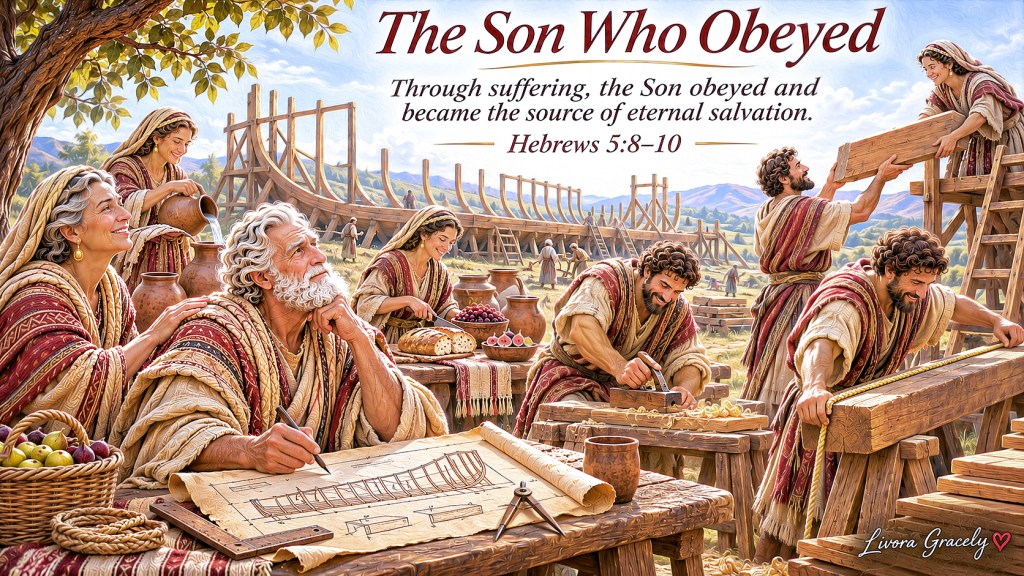
Hebrews 5:8–10
Through suffering, the Son obeyed and became the source of eternal salvation.
The flood had not yet come when Noah began to build.¹
God had warned him about what was to come and told him to prepare an ark. Noah could not see the flood as he worked, but he acted on what he had heard. Hebrews remembers his response as an act of faith.¹
The story does not tell us every question Noah carried or every word spoken by those around him. It does tell us that he followed God’s instruction. The ark became a place of safety for his household.
Later, Hebrews speaks of another path of obedience—not one that ended in an ark, but one that led through suffering. It speaks of Jesus, the Son of God.
Although He was the Son, He learned obedience through what He suffered. And, once made perfect, He became the source of eternal salvation for all who obey Him.²
Though He Was the Son
In the previous verses, Hebrews called Jesus the Son appointed by God as a priest forever. It told us that, during His life on earth, He offered prayers and petitions with cries and tears.³
Now the letter says, although He was the Son.
His place as the Son did not mean that He was kept from the difficult road before Him. He entered human life and faced its suffering.
On the night before His death, Jesus took a towel, poured water into a basin, and began to wash His disciples’ feet. Peter questioned what He was doing and at first refused. Jesus then explained that He had given them an example of service.⁴
The One who knew that the Father had placed all things in His hands knelt before His disciples. The foot washing was an act of love and service; it also gives us a glimpse of the humility with which Jesus lived among them.
Paul writes that Christ took the nature of a servant, humbled Himself, and became obedient to death—even death on a cross.⁵
He Learned Obedience
The words of Hebrews may surprise us. If Jesus was the Son, why did He need to learn obedience?
The letter has already told us that He was tempted as we are, yet did not sin.⁶ To say that He learned obedience does not mean that He first lived in disobedience and then learned to be good.
It means that His obedience was lived through the suffering He encountered. He did not watch the cost of obedience from a distance. He walked the road before Him.
Jesus told His disciples that the Son of Man would suffer, be rejected, be killed, and rise again. Peter took Him aside and began to rebuke Him. Jesus answered Peter’s objection and continued to speak of the way ahead.⁷
The disciples did not yet understand the path He had described. But Jesus did not turn from it.
The Son who prayed to the Father also entrusted Himself to the Father’s will. His obedience was not an easy word spoken far from pain. It was lived in the midst of suffering.
Made Perfect
Hebrews continues: once made perfect, Jesus became the source of eternal salvation for all who obey Him.²
The words do not mean that Jesus was once sinful and then became sinless. Hebrews has already said that He was without sin.⁶ Through the suffering and obedience He lived, His appointed work was brought to its purpose.
He became the source of eternal salvation. The letter then returns to what God had declared: Jesus was designated high priest in the order of Melchizedek.²
His suffering was not the end of the story. He died and was raised, and Hebrews goes on to say that He lives to intercede for those who come to God through Him.⁸
Peter, who once questioned Jesus as He knelt to wash his feet, later wrote about Christ’s suffering. He said that Jesus did not retaliate when insults were hurled at Him, and that He bore our sins in His body on the cross.⁹
Peter does not say there that he is remembering the foot washing. But his words direct us again to the same Lord: the One who served, suffered, and entrusted Himself to God.
All Who Obey Him
Hebrews calls Jesus the source of salvation for all who obey Him.² Both parts of that sentence matter.
Jesus is the source. We do not complete His work by gathering enough good deeds. We come to Him for the mercy and help we need.
And the letter does not treat obedience as unimportant. Those who come to Christ are called to hear Him, trust Him, and continue to follow Him.
That journey is not always welcomed by others. Peter wrote to believers whose former companions were surprised that they no longer joined them in their old way of life.¹⁰ Faithfulness could bring misunderstanding and opposition.
This does not mean every disagreement is persecution, or that suffering should be sought. Peter also distinguished suffering for doing wrong from suffering as a Christian.¹⁰ We do not need to explain another person’s pain as a lesson God has sent them. We can offer care and help while remembering that Jesus understands weakness.
Paul urged believers to be renewed in their minds and to offer their lives to God.¹¹ Following Christ is not a single step after which we must find our own way. Day by day, His people are invited to remain attentive to Him and to encourage one another.¹²
The One We Follow
Noah responded to God’s warning and built the ark. His story reminds us of faith that acts on what God has said.¹
Jesus’ story takes us further. He is not only an example of obedience. He is the Son appointed by God, the high priest who suffered and became the source of eternal salvation.
When the way ahead is difficult, we do not have to pretend that obedience is effortless. We can come to the One who knows suffering from within a human life.
He lives to intercede for those who draw near.⁸
So let us listen to Him, follow Him, and continue to come to God through Him.
Scripture References


Leave a Reply