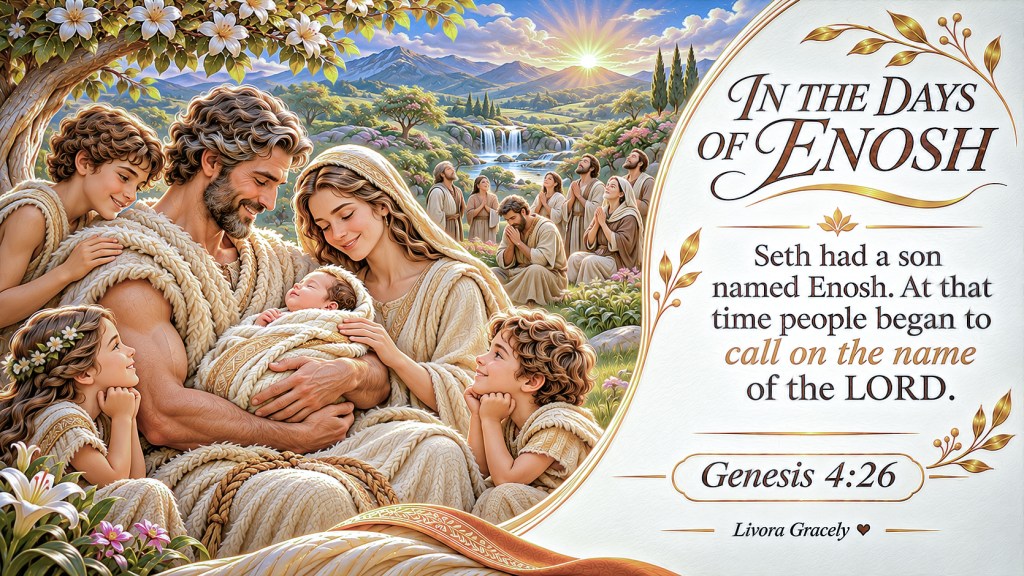
Seth had a son named Enosh. At that time people began to call on the name of the LORD.
A Son for Seth
A father gives his son a name. In the same verse, another name is called upon.
Genesis has returned to Adam and Eve after following several generations of Cain’s family. Eve gives birth to Seth and speaks of the child God has granted her after Abel’s death. The next line brings us to a new generation: Seth has a son, and he names him Enosh.
The verse is brief. We are not told what Enosh looked like or what words Seth spoke when he chose the name. The poster imagines a family gathered around a baby; its faces and setting help us picture a moment that the text itself does not describe in detail.
Yet the account gives us something more than a birth and a name. It turns from one family to the actions of people at that time.
The Name Enosh
Seth’s name entered the story through Eve’s words. Now Seth names his own son. One generation follows another, and Genesis carries the reader forward through their names.
There is something familiar in hearing a name passed around a family: a parent speaks it, a relative remembers it, and a new person finds a place in a longer story. That is an image from our own experience. Genesis does not tell us how Seth introduced Enosh to others, but it preserves the name for its readers.
The names will continue in the next chapter. Genesis 5 traces a line from Adam through Seth and Enosh, taking the story towards later generations. For this moment, however, the final sentence of chapter 4 asks us to listen beyond the family record.
Calling on the Lord
At that time, Genesis says, people began to call on the name of the Lord. The NIV notes “to proclaim” as another possible rendering of the expression.
The verse does not say that Enosh alone was the first to call on God. Nor does it record the words people used or describe the place where they gathered. The figures praying in the poster are an illustration of the passage, rather than a scene detailed in it.
Much later, Psalm 105 calls people to praise the Lord, proclaim His name, and make His deeds known among the nations. In Acts, Peter quotes the prophet Joel while speaking at Pentecost, including the promise that those who call on the name of the Lord will be saved. Each passage has its own setting, yet the attention to the Lord’s name continues through the biblical story.
A Story That Continues
Genesis 4 has held birth and loss, human work and violence, a warning and a journey away. Its final lines return to a family and then give us this brief notice about people calling on the Lord.
We need not assume that every person in Seth’s family lived one way or every descendant of Cain another. The verse gives us a moment to notice: amid the generations, the Lord’s name is being called upon.
A child was named Enosh. In those days, people began to call on the name of the Lord.
Livora Gracely ♥
Sources


Leave a Reply