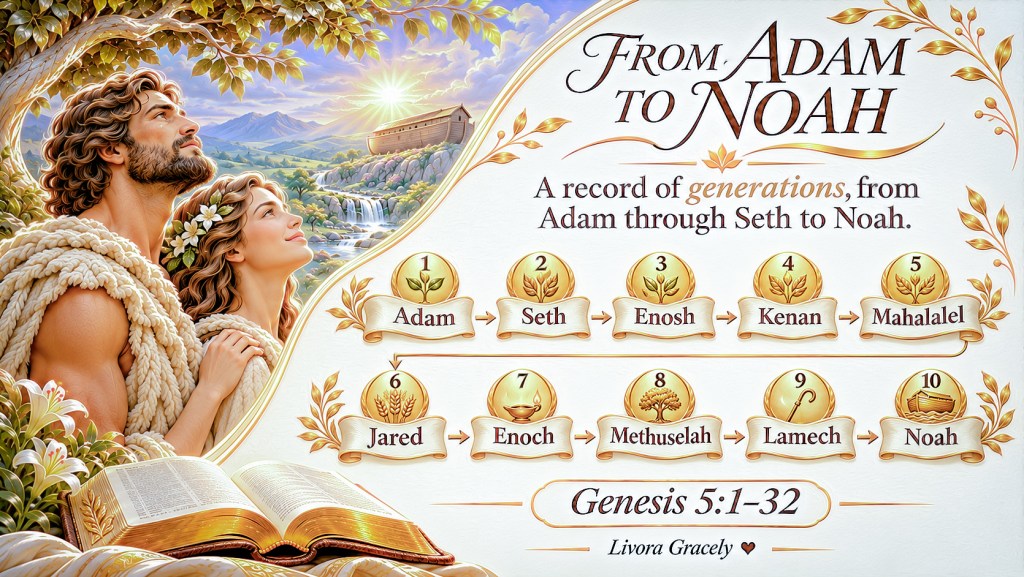
A record of generations, from Adam through Seth to Noah.
A Family Album with a Long Story
Imagine opening a family album and finding ten names arranged in a line.
Adam. Seth. Enosh. Kenan. Mahalalel. Jared. Enoch. Methuselah. Lamech. Noah.
There are no photographs, of course. Genesis gives us something else: names, ages, children, and a pattern that carries us from one generation to the next.
At first glance, the chapter may seem like a list waiting patiently to be read. But stay with it for a moment. Beneath the names is a story about life moving forward—and about the lives that come to an end along the way.
The poster follows that line from Adam to Noah. Its small picture of an ark looks ahead to a story still to come. Here, in Genesis 5, we are beginning with the family record.
The Rhythm of Generations
The chapter opens by looking back to creation. God made humanity in His likeness, created them male and female, and blessed them. Then the account follows Adam and his descendants through Seth.
One name leads to another. Fathers have sons, and the chapter repeatedly tells us that they also have other sons and daughters. The family is larger than the particular line the list follows.
The pattern becomes familiar: a man lives, has children, and lives more years. Then comes the same brief ending.
And he died.
It appears again and again, even after lives measured in hundreds of years. Genesis records those long ages, but the repeated words remind us that these lives, too, come to an end.
Yet the list does not stop there. Another name follows. Another generation begins.
One Name Breaks the Pattern
Then we come to Enoch.
He belongs to this family line: Jared is his father, and Methuselah is his son. But the account gives him a description that catches our attention. Enoch walked with God.
Genesis says it twice. And when it reaches the end of Enoch’s life in the account, the familiar words change: he was no more, because God took him away.
The chapter does not explain every detail. It leaves us with the striking difference—and with the image of a life described by its relationship with God.
Later, the writer of Hebrews remembers Enoch in a passage about faith. For now, Genesis lets that unexpected line stand in the middle of the family record, inviting us to pause before continuing down the list.
A Name That Carries Hope
Near the end of the chapter, another father speaks.
Lamech names his son Noah and expresses hope that the child will bring comfort amid their work and the painful toil of their hands. His words reach back to the ground the Lord had cursed in Genesis 3.
By the close of the chapter, Noah has become the father of Shem, Ham, and Japheth. Readers familiar with his story may already be thinking of the ark, but that part of the journey is still ahead.
Much later, Luke’s genealogy will also trace a line through Noah and these earlier generations, reaching back to Adam. The names continue to be remembered as the biblical story unfolds.
Genesis 5 gives us births and deaths, sons and daughters, a man who walked with God, and a father who dared to hope.
It is a long family record. And it is still moving forward.
Livora Gracely ♥
Sources


Leave a Reply