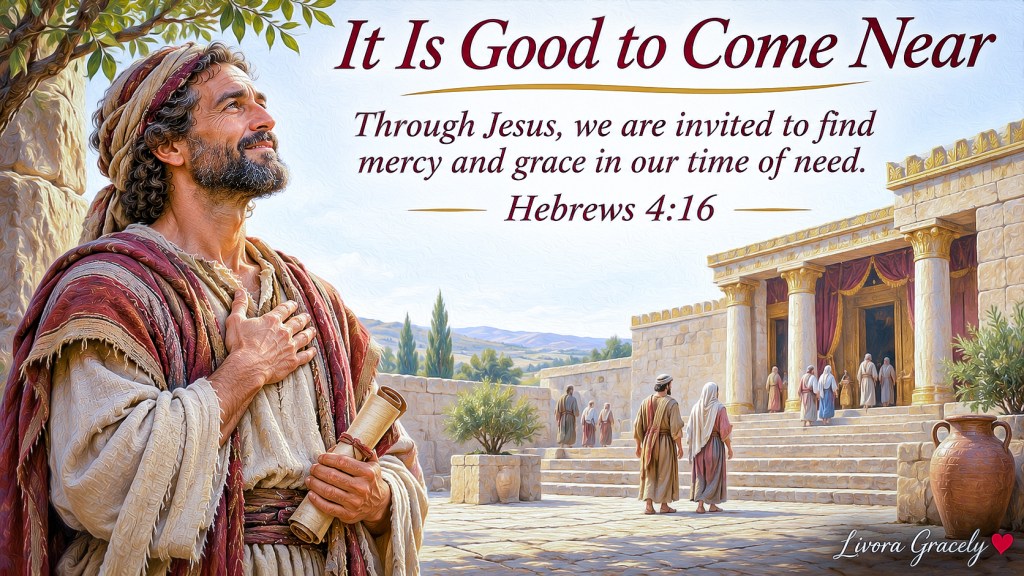
Hebrews 4:16
Through Jesus, we are invited to find mercy and grace in our time of need.
“My feet had almost slipped.”
The psalmist looked at the lives of the wicked and saw their prosperity. They seemed free from the troubles that burdened him. The more he watched, the more he wondered whether keeping his own heart pure had been for nothing.¹
He tried to understand, but the question troubled him. Then he entered the sanctuary of God, and his perspective began to change.
He saw that the prosperity he envied was not as secure as it appeared. And he came to recognise something else: through all his confusion, God had held him by his right hand.¹
The psalm ends with a confession: it is good to be near God.
Hebrews offers an invitation to people who also know what it is to need help:
Let us approach God’s throne of grace with confidence, so that we may receive mercy and find grace to help us in our time of need.²
An Invitation with a Foundation
The invitation begins with the words “let us then.” The letter has already given its hearers a reason to come.
We have a great high priest: Jesus, the Son of God. He has passed through the heavens, yet He understands our weaknesses. He was tempted as we are, but He did not sin.³
Because of Him, we are invited to draw near.
Confidence does not mean arriving with perfect words or a heart untouched by fear. Nor does it mean that we have earned a place before God. It means trusting the One who invites us and the high priest through whom we come.
The psalmist did not hide the questions that had troubled him. He admitted his envy and confusion before acknowledging how God had held him.¹
We too may bring what is true: gratitude and grief, trust and uncertainty, a prayer we have carried for years or words we can barely find.
And Hebrews says, “let us.” The invitation belongs to a community. Sometimes another person’s prayer can help us find our own. Sometimes we can sit beside someone who has grown weary and remind them that they need not carry their burden alone.
A Throne of Grace
A throne speaks of authority. Hebrews calls the place to which we are invited the throne of grace.²
The God to whom we come is the God before whom nothing is hidden.⁴ Yet through Jesus, we are invited to approach Him for mercy and grace.
Mercy meets us in our need. We may come with weaknesses we cannot conceal, with sorrow, or with failures we cannot undo. The invitation is not to pretend we have no need of compassion; it is to receive it.
Grace is God’s gift, not a reward we purchase by our own strength. Hebrews speaks of finding grace to help us in our time of need.²
The verse does not require us to separate mercy and grace into two neatly labelled gifts. Together, they tell us something about the God who welcomes those who come through His Son.
The psalmist discovered that even when his understanding was clouded, God had not released his hand.¹ We may also come before God without having resolved every question. We come to receive, not to prove that we have no need.
Remaining Near
Jesus gave His disciples another picture: a vine and its branches.
A branch receives its life from the vine. Jesus told His disciples to remain in Him, for apart from Him they could do nothing.⁵
This is a different image from the throne in Hebrews, but it helps us consider the life that follows our response to God’s invitation. We do not come near once and then set out to live by our own strength. We are invited to remain in Christ.
A full schedule of good activities is not the same as the life Jesus describes. In John’s Gospel, remaining in Him is connected with bearing fruit, keeping His commands, and loving one another.⁵ The branch stays connected to the vine, and fruit grows from that life.
Remaining may include quiet prayer and listening to Scripture. It may also lead us to forgive, to serve, or to care for someone who is struggling. What we do matters, but our strength and life are found in Christ.
The psalmist said that God guided him and that being near God was good.¹ His circumstances had raised painful questions; nearness to God gave him a place to bring them.
Help in Our Time of Need
What if we come near and the difficulty remains?
Paul knew such a question. He pleaded with the Lord to remove a painful burden he called a thorn in his flesh. The answer he received was that God’s grace was sufficient for him and that divine power is made perfect in weakness.⁶
Paul’s story does not explain every unanswered prayer. It does show us someone who asked for a burden to be removed and received an assurance of grace while he remained weak.
Hebrews does not tell us exactly what form God’s help will take in every circumstance. It does not promise that illness, grief, or danger will always disappear immediately. It invites us to come to God for mercy and grace in the midst of our need.
Another psalm calls God our refuge and strength, an ever-present help in trouble.⁷ The earth in that psalm is shaken; the waters roar. The danger in the picture is real. So is the refuge.
Help may come through strength to face another day, wisdom for a decision, or the care of another person. We can pray and also receive the support of those equipped to help us.
The psalmist who almost slipped ended by saying that God was his refuge.¹ His first questions were honest. His final confession was personal: it was good for him to be near God.
Hebrews gives us that same direction, with our eyes fixed on Jesus, the great high priest who understands our weakness.
So let us come—with the faith we have, with the questions we carry, and with the needs we cannot meet alone.
The throne to which we are invited is a throne of grace.
Scripture References


Leave a Reply