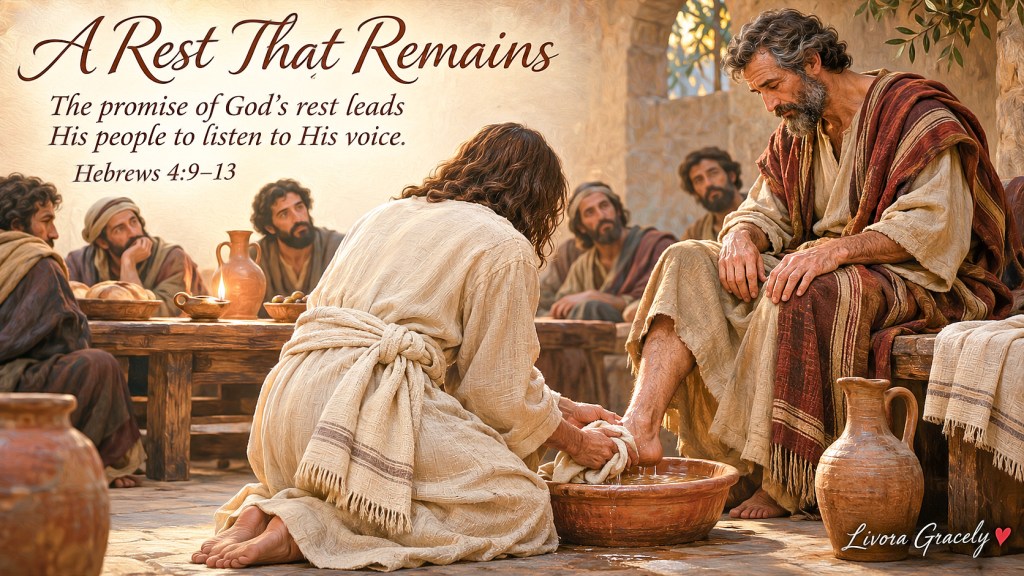
Hebrews 4:9–13
The promise of God’s rest leads His people to listen to His voice.
Jesus poured water into a basin and began to wash His disciples’ feet.
When He came to Peter, the disciple protested. His Lord was kneeling before him, ready to do the work of a servant. Peter insisted that Jesus would never wash his feet.
Jesus answered, “Unless I wash you, you have no part with me.”
Peter replied that Jesus should wash his hands and his head as well.¹ He did not want to be without a part with the One who had come to him.
That evening, Jesus spoke of belonging with Him. Hebrews speaks of a rest that remains for God’s people. The passages have different settings, yet both turn attention toward what God gives and the response of those who hear Him.
A Rest That Remains
The people had crossed the Jordan under Joshua. The Lord gave them the land and rest on every side, just as He had promised.²
Yet long after that crossing, another word was heard. Psalm 95 called God’s people to listen to His voice “today” and warned them not to harden their hearts. Hebrews sees in that later call a promise that reaches beyond the rest given in Joshua’s day.³
The letter draws its conclusion: “There remains, then, a Sabbath-rest for the people of God.”³
The rest Israel received under Joshua was real. God’s faithfulness in that generation is part of the story Hebrews remembers. But the later invitation shows that the promise of entering God’s rest has not been exhausted.
Throughout the passage, the word remains has carried the argument forward. The promise still stands; some are still to enter; a Sabbath-rest remains for God’s people. The warning from the wilderness has not erased the promise. It makes the call to receive it all the more urgent.
As God Rested
Hebrews reaches back further than the wilderness, to the completion of creation. On the seventh day God rested from His work, and He blessed that day.⁴ The rest offered to His people is called His rest.
The letter says that the one who enters God’s rest also rests from their works, just as God did from His.³ God’s rest followed the completion of His work. The promise held before His people is to share in the rest that belongs to Him.
Hebrews has already spoken of those who believe entering that rest, and it continues to hold its fulfilment before the community.³ Faith responds to God’s promise in the present, while the journey toward its fullness remains before them.
This hope is larger than a day without work or a life without trouble. Those who trust God may still know grief, weariness, and uncertainty. The promise rests on the faithfulness of the One who speaks, even while His people continue their journey.
Let Us Make Every Effort
After speaking of rest, Hebrews gives an unexpected instruction: “Let us, therefore, make every effort to enter that rest.”³
The sentence explains why: so that no one will fall by following the earlier example of disobedience. The people in the wilderness had heard God’s promise, yet refused to trust Him. Hebrews asks its hearers to take their own response seriously.
The effort is not a payment that purchases God’s gift. It is a call to listen, to believe, and to continue in faith rather than turn away from the living God.
The letter speaks to a community: let us make every effort. Earlier, it urged brothers and sisters to encourage one another daily, while it is still called “today.”⁵ Someone who is weary can be reminded of God’s promise. Someone beginning to drift can be sought and heard. The same word calls the whole community to remain attentive.
Jesus also called the weary and burdened to come to Him and promised them rest.⁶ His invitation does not erase every difficulty, but it directs the burdened toward the One who is gentle and humble in heart.
The Living Word
Why does the response matter so deeply? Hebrews continues: God’s word is living and active, sharper than a double-edged sword. It penetrates deeply and judges the thoughts and intentions of the heart.³
The word that carries God’s promise and warning is not an old sound that has lost its force. The Scriptures through which the writer has heard God speak still address the community. His word reaches beyond what can be seen from the outside.
The next verse turns attention to God Himself. Nothing in creation is hidden from His sight; everything is laid bare before the One to whom all must give account.³ Familiarity with the story cannot conceal a heart that refuses to listen.
Yet the letter does not leave its hearers standing at a distance. Its next words point to Jesus, the great high priest, who understands human weakness. Through Him, they are invited to approach the throne of grace for mercy and help.⁷
In the room with the basin, Peter had resisted what Jesus came to do. Then he heard what it meant to have a part with Him.
Jesus took up the towel and continued washing the disciples’ feet.¹
Scripture References
- John 13:1–15; quotation from verse 8, NIV.
- Joshua 21:43–45.
- Hebrews 4:1–13; main passage, verses 9–13; quotations from verses 9 and 11, NIV.
- Genesis 2:2–3.
- Hebrews 3:12–13.
- Matthew 11:28–30.
- Hebrews 4:14–16.


Leave a Reply