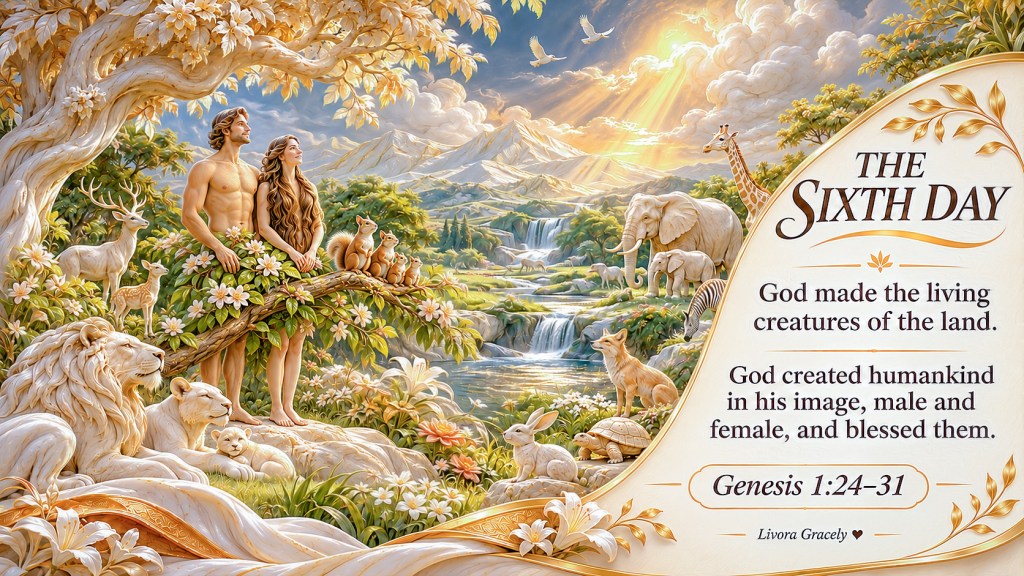
God made the living creatures of the land.
God created humankind in his image, male and female, and blessed them.
Life upon the Land
On the third day, dry land appeared, and the earth brought forth plants. Now, on the sixth, the story turns our attention to the land again. This time, it is not the fruit on a tree that invites us to look closer, but the creatures moving upon the ground.
God speaks, calling the land to bring forth living creatures according to their kinds: livestock, creatures that move along the ground, and wild animals. God makes them, and He sees that it is good.
The passage names broad groups rather than listing every animal. We can imagine our own encounters with creatures great and small: a dog waiting beside a gate, a beetle making its way across a path. Those are glimpses from our world, not scenes described in Genesis. The story itself invites us to notice the variety of life upon the land.
Then the account turns to another act of creation.
In the Image of God
God creates humankind in His image. The passage repeats the thought, then tells us that God creates them male and female.
In just a few lines, Genesis gives human beings a place within the story of creation and describes them in relation to God. Genesis 1 focuses on their creation in God’s image; the account of the garden later tells us that the man and his wife were naked and felt no shame. Its attention rests here: humanity is made in the image of God.
The words invite a question for us as readers. When we meet another person—someone familiar, or someone whose life is very different from ours—what might it mean to remember that the passage speaks of human beings this way?
The story continues with a blessing and a charge.
Blessed and Entrusted
God blesses the human beings and tells them to be fruitful, increase in number, fill the earth, and subdue it. He gives them rule over the fish of the sea, the birds of the sky, and the living creatures that move on the ground.
These words place human life among the other creatures already introduced. The waters and sky of the fifth day, and the creatures of the sixth, belong to the same unfolding account.
What should such authority look like? Readers have reflected on that question in different ways. One way to consider it is to connect the task with the goodness of the world God has made and the dignity of those made in His image.
God also gives seed-bearing plants and fruit-bearing trees as food for humankind, and green plants as food for the land animals, birds, and creatures that move along the ground. The vegetation of the third day is part of this scene too.
Everything Was Very Good
Throughout the chapter, God has seen that what He made was good. At the close of the sixth day, the account widens its view: God sees all that He has made, and it is very good.
The land and its creatures, the waters and their life, the lights, the plants, and humanity all belong within that larger view. Evening comes, and morning follows—the sixth day.
After looking closely at each part, the story invites us to stand back and see the whole.
Livora Gracely ♥
Sources


Leave a Reply