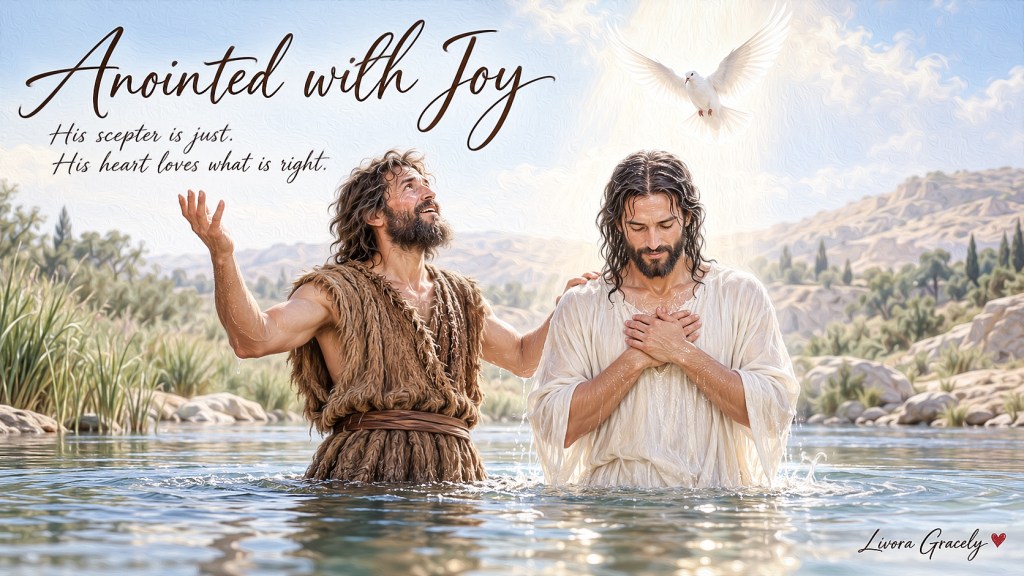
His scepter is just. His heart loves what is right.
Jesus came to the Jordan to be baptized, and John tried to prevent it.
The man who had been receiving others into the river now told Jesus that he needed to be baptized by Him. Jesus asked him to proceed, explaining that this was fitting to fulfill all righteousness. John consented.¹
Before the water, before the Spirit descended like a dove, there was this willingness to do what the Father required.
Hebrews has already described the Son’s enduring throne and His scepter of justice. Now the same declaration continues:
“You have loved righteousness and hated wickedness;
therefore God, your God, has set you above your companions
by anointing you with the oil of joy.”²
The scepter tells us how He rules. This next sentence brings us closer to the heart of the King.
Loving Righteousness
The Son loves what is right.
Righteousness here concerns a life and rule aligned with God’s will. It includes justice, honesty, and faithfulness. The King whose government is upright delights in the good His authority upholds.
This grows from everything Hebrews has said about Him. God has spoken through the Son, who reveals His glory and being, sustains all things, and has provided purification for sins. The angels worship Him and serve God’s purposes; the Son reigns.³ His love of righteousness gives that reign its moral character.
An enduring throne would offer little comfort if its ruler used power carelessly. Hebrews joins permanence with goodness. The authority that lasts belongs to the One who loves what is right.
At the Jordan, that love takes the form of obedience. John raises an objection; Jesus remains willing to receive the baptism. Matthew’s account lets us see His commitment to the Father’s will before His public ministry unfolds.
The righteousness of His kingdom belongs to the life of its King.
Rejecting Wickedness
The sentence places love beside hatred. The Son’s devotion to righteousness includes a firm rejection of evil.
Wickedness is more than an unfortunate mistake in judgment. The word carries the sense of lawlessness: conduct opposed to God’s will. The Son refuses to make room for it within His own life or to treat it as an acceptable use of power.
Hebrews later describes Him as having faced temptation without sin.⁴ His obedience was lived under pressure. Hunger, suffering, and testing did not draw Him into the wrongdoing He rejected.
That matters for the throne described in the previous verse. His justice rests upon a character that remains faithful when doing right is costly. The King does not ask others to trust a standard He abandons for His own advantage.
His rejection of evil also belongs beside His work of cleansing sinners. Hebrews has already placed purification at the centre of His mission. He confronts sin and provides the cleansing people need; His holiness gives weight to the mercy through which He saves them.
Oil of Joy
The words therefore God, your God connect His righteous life with the honour He receives.
The declaration comes from Psalm 45, a royal wedding song. Its language of anointing carries the gladness of royal honour and celebration.⁵ The King who loves righteousness receives the oil of joy.
Oil was used to appoint kings in Israel. Samuel anointed David with actual oil, and the Spirit of the Lord came powerfully upon him.⁶ Jesus’ ministry is described through a related claim: God anointed Him with the Holy Spirit and power.⁷ At His baptism, the Spirit descended upon Him and the Father declared His pleasure in His Son.
These passages help us understand anointing, while each keeps its own emphasis. Hebrews does not name the Jordan as the occasion of this oil of joy. Read alongside the Son’s heavenly seat and enduring throne, the phrase points to the royal honour bestowed upon Him. The verse gives that honour its meaning without supplying a date or describing oil being physically poured.
The Father honours the obedient Son. His divine identity has already been affirmed; His faithful life and saving work now stand within this declaration of gladness.
The throne is enduring, its rule is righteous, and the honour surrounding its King is joyful.
Above His Companions
The final comparison places Him above His companions.
The word describes those who share or participate in something. Here their precise identity is less certain than the Son’s superior standing. The surrounding chapter compares Him with angels; later, Hebrews speaks of people who share in Christ and whom He calls His brothers and sisters.⁸ Both connections have shaped readings of this phrase.
The verse does not require us to settle that question before hearing its central declaration. The Son receives a place that surpasses those around Him. Association with Him does not make anyone His equal.
Yet His greatness has already brought Him close to those He saves. The exalted King is the One who provided purification for their sins. His honour belongs to the same Person whose obedience was lived among them.
At the Jordan, John finally consented, and Jesus received the baptism. As He came up from the water, the heavens opened, the Spirit descended, and the Father’s voice identified His beloved Son.
The ministry that followed would carry Him among people burdened by suffering and evil. Peter remembered Him going from place to place, doing good and healing those oppressed by the devil. Wherever He went, people received His help.
Scripture References
- Matthew 3:13–17.
- Hebrews 1:9, NIV.
- Hebrews 1:1–8.
- Hebrews 4:15.
- Psalm 45, especially verses 6–8.
- 1 Samuel 16:13.
- Acts 10:37–38.
- Hebrews 2:10–11; Hebrews 3:14.


Leave a Reply