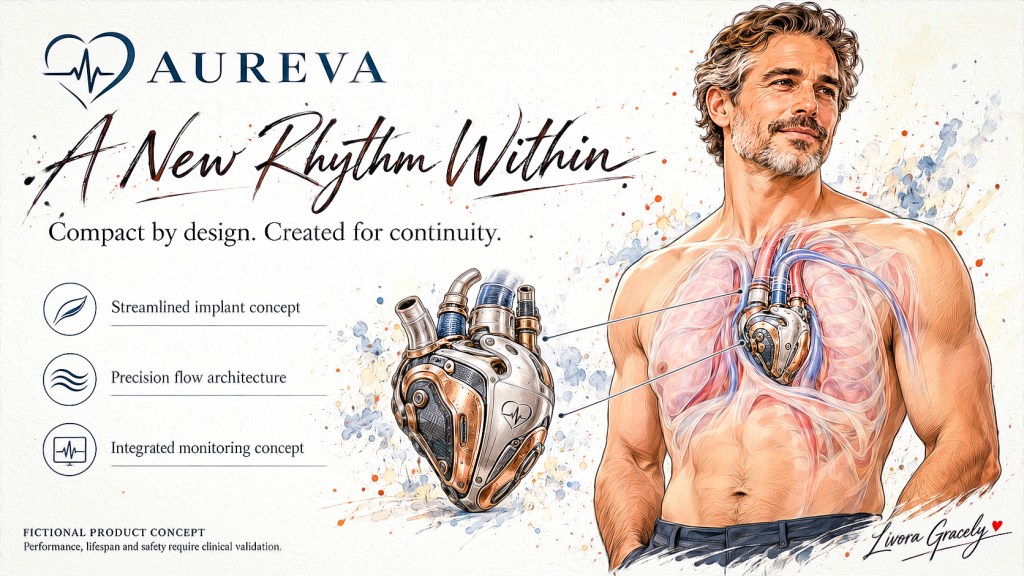
Compact by design. Created for continuity.
An Ordinary Appointment
He had brought a concert programme to his heart appointment.
It was folded around the card listing his next visit. When the nurse opened the folder, a small photograph of his granddaughter slipped onto the desk. Beneath it, someone had written her name and the piece she would play.
“Thursday,” he said. “She keeps reminding me.”
The nurse returned the programme and asked about his week. He told her about the walks, the afternoon when he had tired sooner than expected, and the questions he had written down at home. They went through them before discussing the evening at the school.
He wanted to attend. He also wanted enough time to get there without hurrying. By the end of the visit, the programme lay open beside his care notes, its printed starting time underlined in pencil.
Beneath the Shirt
In the future imagined here, the Aureva artificial heart worked beneath his ribs, moving blood through a body that still needed sleep, nourishment, and continuing care. Its compact pump and sensors belonged to a system designed to respond to changing demands and provide information for his clinical team.
The nurse reviewed the monitoring record with him. A drawing on her screen showed the device’s pathways, far simpler than the engineering drawings he had once been shown. He recognised the shape, though he could explain very little of what lay inside it.
There were things he understood better: keeping appointments, asking about a change, making room in the day for the routine his team had agreed with him. He checked the details rather than relying on memory.
Before leaving, he buttoned his shirt and slipped the programme into the breast pocket. His granddaughter’s photograph remained visible above the fold.
Beyond the Workshop
The device in the drawing had a number. So did the one implanted in him. That number connected it to records of its components, assembly, and testing, long before his name had been added to the clinical file.
In the workshops of this imagined world, precision equipment could make matching parts repeatedly. Technicians inspected them, recorded the results, and set aside components that failed the checks. Finished devices travelled with documentation that receiving teams could trace.
The work continued after delivery. At his appointment, the nurse had noticed an old service contact in his folder and replaced it with the current details. He asked her to write the number clearly; the smaller print on the previous card had been difficult to read.
Now the new card lay beside the concert programme. At home, he put the care folder in its usual drawer and left the programme on the table, where he would see it before Thursday.
A Longer Afternoon
At the school, his daughter helped him find their seats before the hall filled. He rested while she went to look for the child backstage. Around him, programmes rustled and a teacher tested the microphone twice.
His granddaughter appeared briefly at the side curtain. She searched the rows until she found him, then pointed at the pocket where he had tucked her programme. He held it up. Satisfied, she disappeared again.
When her turn came, she adjusted the piano stool and laid her hands on the keys. Halfway through, a phrase faltered. She looked towards the audience, found his face, and began the phrase again.
He stayed seated for the applause, clapping until she bowed. Afterwards, she came down the aisle with her music held against her chest and asked whether he had heard the mistake.
“I heard you finish,” he said, making room beside him while she opened the score to show him where it had happened.
Aureva is a fictional artificial-heart concept. Its design and capabilities in this story are imagined. Real artificial-heart systems have specific clinical uses, risks, care requirements, and limitations; the poster does not represent a validated product or promise permanent, failure-free support.


Leave a Reply