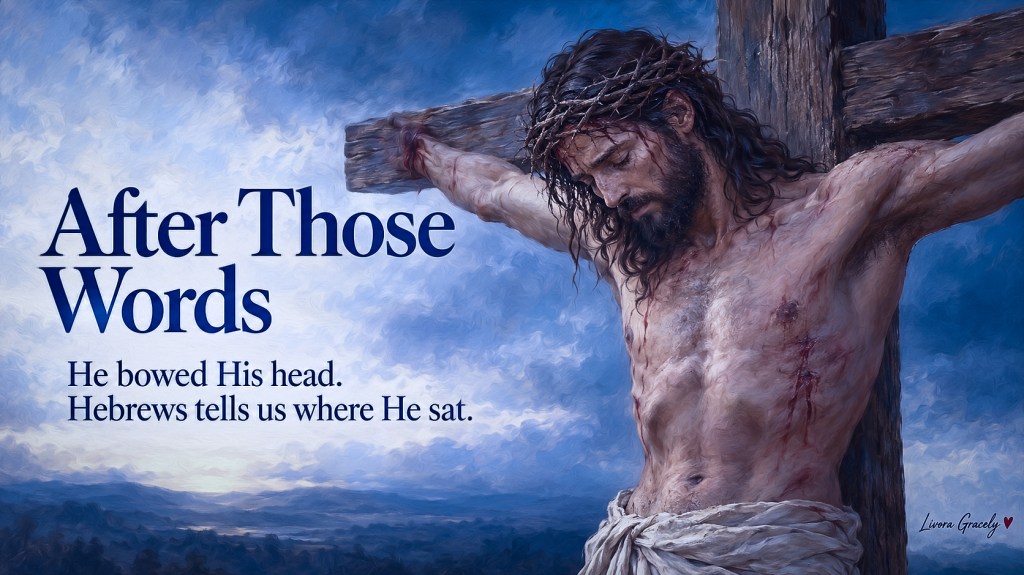
He bowed His head. Hebrews tells us where He sat.
The sharp smell of sour wine rose from a jar beside the cross. A sponge was soaked, placed on a stalk of hyssop, and lifted to Jesus’ lips. He had asked for a drink.
After receiving it, He spoke:
“It is finished.”
Then He bowed His head and gave up His spirit (John 19:28–30).
The words came from someone who had known thirst and suffering in His own body. Hebrews brings us to the same Son, already described as the radiance of God’s glory and the One who sustains all things. Now its sentence turns toward what He has done about sin:
“After he had provided purification for sins, he sat down at the right hand of the Majesty in heaven.” — Hebrews 1:3, NIV
Purification Provided
Purification is a word for cleansing. Here, the need for it concerns sins.
The sentence takes human wrongdoing seriously. Something must be dealt with in the relationship between people and the holy God whom the Son reveals. Knowing more about God cannot by itself remove the guilt of turning away from Him. Hebrews names a need that reaches deeper than understanding.
It also names the One who has acted. The Son provided purification. The One through whom God speaks has entered the work of cleansing those who need to approach Him.
Later, Hebrews explains how: Christ offered Himself to God. His blood cleanses the conscience so that people may serve the living God (Hebrews 9:14). The offering involves His own life, and its purpose reaches into the person who receives its cleansing.
At the cross, the drink touched the lips of the One giving that life. His thirst was real. So was the self-giving that Hebrews would describe.
The letter places purification before us as something He has accomplished. Its opening gives the reader this foundation before unfolding the priesthood, sacrifices, and covenant through which the depth of His work will become clearer.
He Sat Down
The small word after gives the sentence its order. Purification has been provided; then the Son sits down.
Hebrews later makes the significance of this posture clear. The priests stand at their duties, offering the same sacrifices repeatedly. Christ offers one sacrifice for sins and sits at God’s right hand (Hebrews 10:11–14). The repeated work of the former arrangement stands beside the completeness of His offering.
His sitting expresses something about what has been done. The sacrifice has reached its purpose. There is no further offering of Himself required to complete it.
The words spoken at the cross return here with greater weight. Jesus gave His life declaring the completion of His work. Hebrews describes the sufficiency of His sacrifice and the posture that follows it.
This does not mean that His people have already reached the end of their growth. The same passage speaks of those who are being made holy. Their lives continue to be changed upon the foundation of His completed offering.
Nor does sitting mean His concern for them has ended. Hebrews will show Him serving as their living High Priest. The offering is complete, and the One who offered it remains.
The Right Hand
The Son’s seat is at the right hand of the Majesty.
Majesty names God with reverence. The phrase keeps the Father and the Son before us: the Son sits at God’s right hand, in the place of honour and royal authority.
Psalm 110:1 stands behind these words. There, the Lord appoints a place at His right hand while enemies are brought beneath the feet of the one seated beside Him. Hebrews draws upon that royal promise to describe the Son’s exaltation.
The language gives us the meaning of His position. He shares in God’s rule. The One whose sacrifice cleanses His people is also the One who reigns.
This gathers the earlier descriptions into a fuller picture. God has spoken through the Son, made the universe through Him, and appointed Him heir of all things. The Son sustains creation and has provided purification for sins. His place at the right hand belongs within that immense account of who He is and what He has done.
The head that bowed at the cross belongs to this Son. His suffering remains part of His story as Hebrews speaks of His honour. The letter’s great High Priest is the very One who gave Himself.
In Heaven
The sentence ends by telling us where He sits: in heaven.
These words carry the account into God’s presence. The Son’s work on earth has its outcome there, where Hebrews locates His royal seat and His continuing priestly service.
Later, the letter says that Christ entered heaven itself to appear for us before God (Hebrews 9:24). The One who provided purification is present on behalf of those who depend upon Him. His ministry reaches the place their own efforts could never secure for them.
Hebrews 8:1–2 brings the two truths together. Our High Priest sits at the right hand of the heavenly throne, and He serves in the true sanctuary established by the Lord. His completed offering and His continuing service belong together.
The voice heard beside the jar of sour wine belongs to the One now present before God. His words at the cross remain attached to a living Person, whose sacrifice is complete and whose ministry continues.
The whole movement of the verse can now be seen: the Son reveals God, sustains creation, provides purification, and sits in heavenly honour. The One who comes so close to human suffering has this place in the presence of the Father.
At the cross, the sponge was lifted to His lips. He received the drink, spoke, and bowed His head.
The One who bowed His head is seated at the right hand of God.


Leave a comment