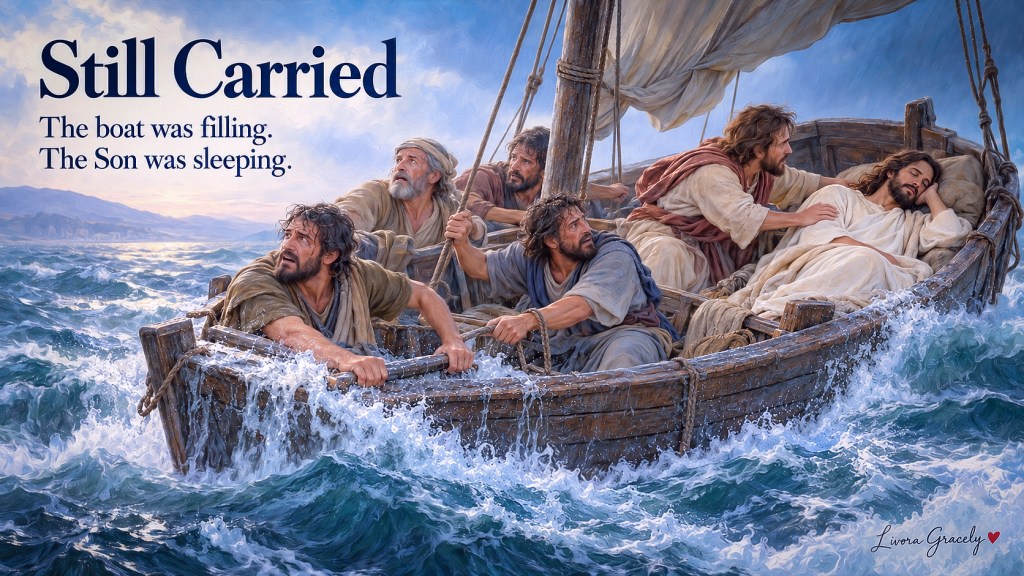
The boat was filling. The Son was sleeping.
Water broke over the side before the boat had recovered from the last wave. The hull lurched beneath the disciples, and cold spray struck their faces. At the stern, Jesus slept on a cushion.
They woke Him with a question that had become more urgent than the crossing:
“Teacher, don’t you care if we drown?”
Mark places their fear beside His sleep. Hebrews brings us closer to the identity of the One they woke. Having called the Son the radiance of God’s glory and the exact representation of His being, it continues:
“Sustaining all things by his powerful word.” — Hebrews 1:3, NIV
The Same Son
The sentence has not changed its subject. The One who makes the Father known is also the One who sustains creation. His relationship with the world reaches beyond what He teaches its inhabitants about God. The world itself depends upon Him.
This gives weight to everything Hebrews has already said. God speaks by His Son, through whom He made the universe. The Son reveals God faithfully, and His activity extends throughout the creation that came into being through Him. Revelation and sustaining belong to the same Person.
The disciples approached Jesus as their Teacher. Hebrews gives that title a larger setting. The authority of His teaching belongs to One whose relationship with creation is deeper than theirs. He speaks within a world that owes its existence and continuance to Him.
There is something difficult to hold together here: the Son’s real participation in human life and the vastness of the claim Hebrews makes about Him. His sleep belongs to the Gospel account. His sustaining belongs to the letter’s description of His identity and work. Neither needs to be removed to make the other easier.
Still Sustaining
Creation has a beginning. Sustaining concerns its continuance.
Hebrews 1:2 has taken us back to the making of the universe. Now the letter speaks of the Son’s continuing activity. The world does not pass beyond His concern once it has been made. Its existence remains dependent upon Him.
An ordinary maker can finish an object and leave it behind. A table may outlast its carpenter; a vessel may travel where its builder never goes. Hebrews describes a relationship with creation that remains active throughout its existence. The Son continues to uphold what came into being through Him.
That continuing work is easy to overlook precisely because existence usually feels ordinary. Another morning arrives. A seed opens in the soil. Someone draws breath while deciding what to say. Hebrews asks its readers to understand the familiar world as creation still dependent upon its Maker.
The letter does not explain the physical mechanism of this sustaining. It tells us to whom creation owes its continuance. Its confidence rests in the Son’s activity, rather than in the appearance that the world can carry on by itself.
The disciples had to wake Jesus to speak with Him. Hebrews gives us no reason to think their cry began His care for creation.
All Things
The reach of the phrase is enormous: all things.
It includes more than the lives of those who recognise the Son. Creation’s dependence is already real before anyone understands or acknowledges it. The claim extends beyond a congregation, a nation, or a single boat crossing a lake.
Paul expresses a closely related truth when he writes that all things hold together in Christ (Colossians 1:17). Both passages direct attention to the same Person and to a dependence that reaches throughout the created world.
This places bodily life within the discussion. Water, earth, breath, and the material conditions of daily existence belong to creation. Hebrews gives no reason to treat them as an unrelated background while the Son attends only to religious matters.
Yet sustaining creation cannot simply mean keeping every part of it comfortable. The boat in Mark’s account was in genuine danger. The Son’s presence did not prevent the disciples from encountering a storm, and the existence of a storm did not place the lake beyond His authority.
Hebrews’ claim is larger than a promise of favourable weather. It concerns the dependence of the whole created order upon the Son, including a world in which suffering and danger remain real.
His Powerful Word
Hebrews names the means of His sustaining: His powerful word.
The power belongs to the Son whose word it is. This is no technique handed to human beings for controlling the world through carefully chosen sentences. The letter is describing His authority over creation.
At the lake, that authority became visible in a particular event. Jesus rebuked the wind and addressed the waves. The storm subsided at His command.
Hebrews takes our attention beyond that extraordinary moment. The Son’s relation to the world includes its ongoing preservation. The calm of one lake displays His authority; the letter affirms the greater reach of His sustaining work.
Read beside His appointment as heir of all things, this continuing work also places creation within God’s purpose. Its future belongs with its beginning and continuance in the Son’s hands. We are not given a timetable for every difficulty. We are given the identity of the One upon whom creation depends.
On the lake, the wind had fallen silent. The disciples were still afraid. They turned to one another with a different question:
“Who is this?”
They were no longer asking whether He cared enough to wake.
They were asking who had been sleeping in their boat.


Leave a comment