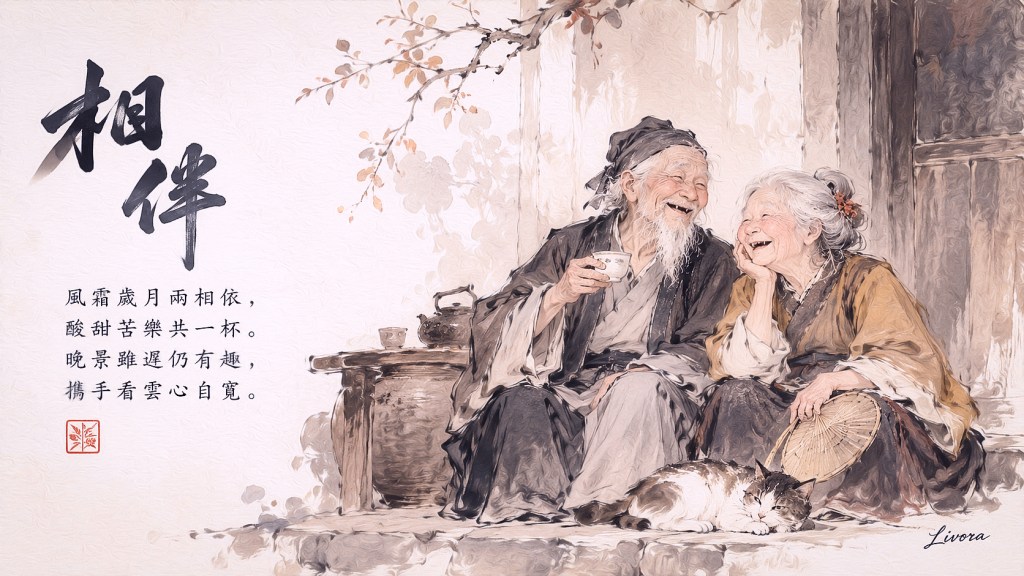
風霜歲月兩相依,酸甜苦樂共一杯。
晚景雖遲仍有趣,攜手看雲心自寬。
Through wind and weather, the years have found us side by side;
the sour, sweet, bitter, and joyful have shared a single cup.
Evening comes late, but still brings its pleasures;
hand in hand, we watch the clouds and let the heart grow wide.
The old woman’s cup was missing.
She checked beside the teapot, beneath the folded cloth, and finally behind the small clay jar that had not moved since spring.
Nothing.
Her husband watched this investigation from his chair by the doorway.
“You had two cups,” she said.
“I have one.”
“You had two.”
“Then I have improved.”
She looked at the cup in his hand.
He took a slow sip.
After fifty-eight years of marriage, neither of them considered this suspicious behavior unusual.
The Second Cup
Morning rain had left the stone steps cool and dark. Water still clung to the roof tiles, falling occasionally from the eaves, while the courtyard smelled of wet earth and old timber warmed by the first returning sunlight.
Their cat had selected the driest patch beside the doorway and was washing one paw with the concentration of a scholar correcting a manuscript.
The old woman ignored both scholars.
She went back inside.
A kettle murmured over the charcoal stove. Steam carried the faint roasted smell of tea leaves through the room, mingling with smoke from the fire and the medicinal scent of the herbs her husband insisted he did not need.
She opened a cupboard.
No cup.
“You broke it,” she called.
“I did not.”
“You hid it.”
“I am eighty-three.”
“That has never prevented you from hiding things.”
Her husband considered this unfair but historically difficult to challenge.
She returned to the doorway and sat beside him.
He held out his cup.
She looked at it, then at him.
“Drink.”
“You drank from it.”
“Yes.”
She took the cup anyway.
The tea had cooled enough to be pleasant. It was slightly bitter at first, then left a soft sweetness at the back of her tongue.
She drank once and returned it.
He drank from the same place.
Neither mentioned the missing cup again.
After the Rain
By noon, sunlight had reached the courtyard wall.
Her husband decided that the branch above the doorway needed trimming. His wife decided that an eighty-three-year-old man standing on a stool with a knife was an unnecessary contribution to village life.
“You are holding the stool,” he pointed out.
“I am preventing a funeral.”
“That is supportive.”
A twig fell into her hair.
She looked up.
He became extremely interested in the branch.
The cat left.
This was probably wise.
When the work was finished, he climbed down carefully and rubbed one knee. She saw the movement but said nothing. Instead, she took the knife from his hand and gave him the folded fan she had been carrying.
He opened it.
“You think I am tired?”
“I think you are hot.”
“I am not hot.”
A bead of sweat travelled down the side of his face.
She waited.
He began fanning himself.
The afternoon passed without either party formally surrendering.
One Bowl
Toward evening, she brought out a small bowl of preserved plums.
Her husband chose one, bit into it, and immediately made a face.
“Sour.”
“You chose it.”
“They all looked trustworthy.”
She selected another and tasted it.
Her eyes narrowed.
He started laughing before she could swallow.
For several seconds she tried not to join him. This effort failed badly.
The cat, who had returned in the hope that old people eventually dropped food, opened one eye.
The old man pushed the bowl away.
His wife pulled it back.
“You bought them.”
“You asked for them.”
“You said they were sweet.”
“The seller said they were sweet.”
“So we have both been deceived.”
He reached for another plum.
She slapped his fingers lightly with her fan.
“You just complained.”
“I am gathering evidence.”
This time she laughed hard enough to lean against his shoulder.
The cat closed its eye again.
No food appeared likely to survive.
Evening Clouds
The day cooled slowly.
Someone farther down the lane began cooking with garlic and scallions, and their fragrance drifted across the courtyard with the smoke. From beyond the houses came the muted clatter of bowls, a child calling for someone to wait, and the squeak of a wooden cart making its way home.
The old couple remained on the step.
Above the roofs, clouds had turned pale gold.
The woman rested one hand beside her on the stone. Her husband’s fingers found it without looking.
His hand was thinner than it had once been. The knuckles were larger now, the skin marked by years of sun and work. Her own hand had changed with it.
Neither examined the evidence.
A breeze moved through the branches overhead.
After a while, she looked at the cup still sitting beside him.
“I know what happened to mine.”
He turned.
“You dropped it yesterday.”
He stared toward the clouds.
“You remember?”
“I heard it break.”
“Why did you spend all morning looking for it?”
She thought about this.
Then she picked up their remaining cup and took the last mouthful of cold tea.
“I wanted to see how long you could keep quiet.”
He looked offended.
She handed him the empty cup.
For several seconds he said nothing.
Then he began to laugh.
She followed.
The cat lifted its head, reconsidered the household it had chosen, and went back to sleep.
Tomorrow, apparently, they would need another cup.
Or perhaps they wouldn’t.


Leave a comment