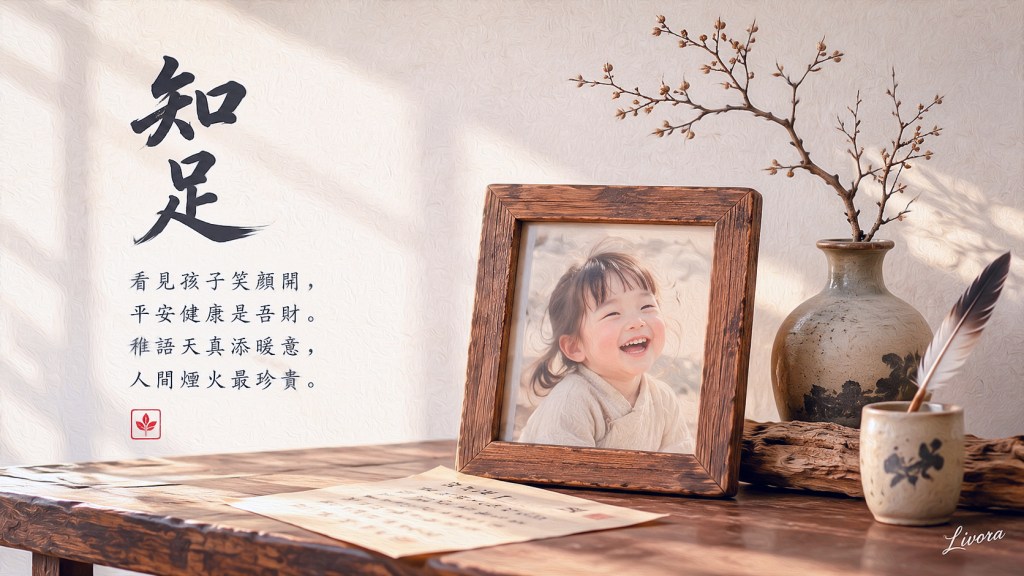
看見孩子笑顏開,平安健康是吾財。
稚語天真添暖意,人間煙火最珍貴。
To see a child’s smiling face; peace and health are riches enough.
Her innocent words bring warmth; ordinary days become the dearest treasure.
The old man had been trying to finish the same line for nearly forty minutes.
This was partly the fault of the ink.
It was also partly the fault of his granddaughter.
Her photograph stood at the far corner of his desk, framed in dark wood and leaning slightly to the left. Every time he lowered his brush toward the paper, the afternoon light reached the glass and caught her laughing at something beyond the edge of the picture.
He straightened the frame.
Then he returned to his work.
The frame leaned left again.
The old man narrowed his eyes.
A less patient man might have blamed the table.
He blamed the frame.
One More Line
The room was warm with late afternoon sun. A narrow branch in the clay vase cast thin shadows across the wall, and somewhere outside, a bicycle bell sounded twice before fading down the lane.
The old man dipped his brush into the ink.
Its faint mineral smell mixed with the dry scent of old wood and paper. Beneath his wrist lay a sheet on which several careful lines had already dried to a soft black.
Only the last one remained.
He lowered the brush.
The telephone rang.
He kept the brush suspended for a moment, perhaps hoping the telephone would reconsider.
It did not.
By the fourth ring, he placed the brush down and walked across the room.
His daughter was calling.
“We’re home.”
He looked automatically toward the photograph.
“And?”
“She’s fine.”
The two words changed nothing visible in the room. The branch remained still. The ink remained wet at the tip of the brush. Sunlight continued crawling across the wooden desk.
The old man sat down.
His daughter continued talking. The doctor had said there was nothing to worry about now. The fever had gone. Their daughter had eaten lunch, complained about the vegetables, and asked whether being healthy meant she could have two desserts.
“Absolutely not,” the old man said.
There was a pause.
His daughter laughed. “She’s beside me.”
“Then put me on speaker.”
Important Business
A small voice arrived through the telephone.
“Grandpa?”
“Yes.”
“I’m healthy.”
“So I hear.”
There was a rustling sound, followed by what appeared to be a serious negotiation occurring somewhere away from the receiver.
Then she returned.
“Mama says healthy people eat carrots.”
“Doctors cannot know everything.”
“Grandpa!”
He smiled and leaned back in his chair.
His granddaughter gave him a detailed account of the day. The clinic had a fish tank. One fish had followed her finger. The doctor’s hands were cold. The adhesive bandage had a rabbit on it, although she would have preferred a tiger. She had also discovered that the elevator buttons lit up when pressed.
This last fact seemed especially important.
The old man listened to all of it.
When she finally ran out of news, he could hear her breathing near the telephone.
“Are you writing?” she asked.
He glanced at the unfinished sheet.
“I was.”
“What are you writing?”
“Something important.”
“More important than the fish?”
He looked at her photograph again.
“No.”
“Good.”
Someone called her from the other end of the room. She shouted that she was coming, apparently without moving any closer to whoever had called.
Then she returned to the telephone for one final announcement.
“Grandpa, the rabbit is still on my arm.”
“I’m relieved.”
The call ended.
The Crooked Frame
For a while, the old man did not pick up his brush.
The room had become quieter, though not completely quiet. A sparrow scratched somewhere along the roof tiles. The wooden desk gave a small creak as the afternoon cooled, and a breeze entering through the half-open window stirred the corner of the unfinished paper.
He reached for the photograph instead.
It had been taken several months earlier. His granddaughter was sitting outdoors, hair untidy from the wind, eyes nearly closed from laughing. One sleeve had slipped halfway over her hand.
There was nothing formal about it.
That was why he liked it.
He wiped a faint mark from the glass with his thumb and set the frame down again.
It leaned left.
This time he examined the bottom properly.
One corner of the old wooden frame had worn away.
“Ah.”
The frame, after several hours of accusation, was innocent.
He opened a drawer and searched through old receipts, string, envelopes, and two keys whose purpose had apparently been forgotten by everyone involved. At the bottom he found a small folded piece of paper.
He tucked it beneath the worn corner.
The photograph stood straight.
The old man sat back to inspect his repair.
A minute later, he removed the paper.
The frame leaned left again.
He smiled.
For some reason, it looked better that way.
Before Evening
The sun had reached the other side of the room when he finally returned to his writing.
His tea was cold now. He drank it anyway.
The brush touched the paper and moved slowly through the final line. There was no telephone this time, no bicycle bell outside, and no granddaughter reporting urgent developments in elevator technology.
When he finished, he washed the brush and placed it beside the inkstone.
The room was beginning to darken.
Before leaving, he picked up the photograph once more and carried it to the window, where the last light was stronger.
His granddaughter’s smile brightened behind the glass.
The old man looked at it for a few seconds, then returned the frame to its corner of the desk.
He switched off the lamp.
From the hallway, the telephone rang again.
He turned around immediately.
The unfinished papers could wait.
The fish, apparently, had done something.


Leave a comment