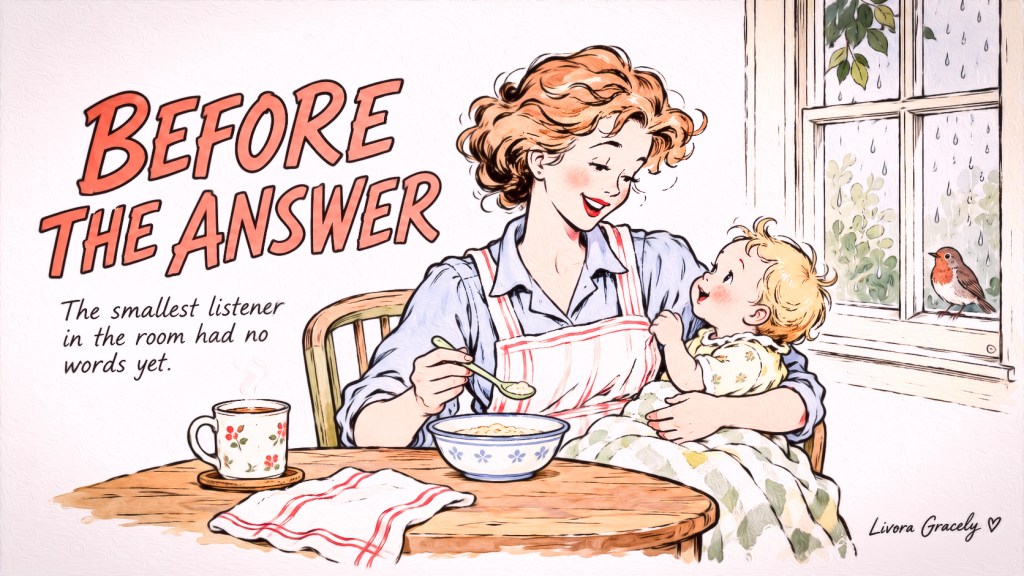
The smallest listener in the room had no words yet.
Tap.
A small plastic spoon touched the side of the porridge bowl. The baby stopped waving his fist.
“That’s breakfast,” his mother told him.
He sat on her lap beside the kitchen table, one hand caught in the soft fold of his blanket. He watched the spoon travel from the bowl toward him. When it arrived, he opened his mouth. That part of the conversation needed no explanation.
The rain had stopped, leaving the outside of the window streaked with water. His mother touched the cool glass and pointed to a bird on the sill. The kitchen smelled of warm porridge and milk.
“Bird,” she said.
The bird flew away.
She told him its name anyway.
All morning she had been speaking to someone who could not repeat a word. When he made a small sound, she paused, answered it, and continued with what she had been saying.
The letter to the Hebrews begins by remembering another voice that spoke before its hearers had found their answer:
“In the past God spoke to our ancestors through the prophets at many times and in various ways.”
— Hebrews 1:1
Long Before
The first sentence of Hebrews reaches into the past, but it does not treat that past as a room whose door has been closed. It calls the people who heard God’s words “our ancestors.” Their stories and the words given to them had been carried from one generation to another.
Abraham heard a promise long before he could see where it would lead. Israel received instruction on a journey whose end was still far away. Kings heard warnings when they would have preferred praise. Later generations kept reading the words spoken to those who had lived before them.
God’s speech stretched across all those years.
Even before the prophets stood before Israel’s kings and crowds, the biblical story showed God addressing human beings. In the garden, a short command marked a boundary with enormous consequences. Before the flood, Noah built an ark while the ground around it was still dry. Plank by plank, the work took shape before the rain came.
The mother reached for her cup of tea. The baby reached too.
She moved the hot cup farther across the table and drew him closer with her free arm. He objected briefly, then noticed the empty windowsill.
“Where did it go?” she asked.
He stared at the place where the bird had been. She waited with him.
Many Ways
Hebrews says God spoke “at many times and in various ways.” The messages came into different circumstances, and they did not all arrive in the same form.
Nathan came to David with a story about a stolen lamb. David listened closely enough to condemn the wrong before he recognised his own place in the story. Jeremiah bought a field while Jerusalem faced disaster. The purchase gave people something ordinary and solid to look at while he spoke of a future beyond the ruin.
Elsewhere in the biblical record, words were written on stone tablets and a warning appeared on a palace wall. On another road, Balaam was stopped by a donkey that noticed danger before he did.
Some words had to be read. Some had to be heard. Some were accompanied by an action that people would remember long after the speaker had gone.
At the table, the baby had found the patch of sunlight that crossed the floor. His mother pointed toward the window again, but his eyes stayed on the light. She followed his gaze and named that instead.
A moment later, the plastic spoon tapped the bowl.
His head turned at once.
She gave the spoon a look. It had made its point with very little effort.
Human Voices
Hebrews is precise about the way God spoke to the ancestors: “through the prophets.”
The prophets had to carry words into real places. Nathan stood before a king. Jeremiah lived among people who could see the field he had bought and question why he bought it. Their hearers were free to turn away, argue, or postpone a response.
Nor did carrying God’s word spare a prophet from ordinary human strain. Moses hesitated. Elijah grew weary. Jeremiah’s words brought him trouble. Jonah went toward his appointed city reluctantly.
Their voices differed. So did the rooms in which they spoke. Hebrews gathers their testimony into its opening sentence because, through them, God had addressed His people.
Nathan could tell his story, but David had to acknowledge what it uncovered. Jeremiah could buy his field, but the people watching him had to decide whether they could trust the promise attached to it. The words had reached them; what followed would be lived beyond the moment of hearing.
The baby caught his mother’s sleeve while she was speaking. His fingers held the fabric tightly enough that she had to pause before moving him to her other arm.
She waited. His grip loosened. He kept watching her face.
The Next Line
The porridge had cooled by the time the bird returned.
It landed on the outside sill, shook a little rainwater from its feathers, and gave a short call. The baby turned toward it. His mother looked too, still holding the spoon above the bowl.
Hebrews leaves its readers at a point like this, with many words already behind them and another sentence about to be heard. God had spoken to the ancestors, repeatedly and in varied ways, through the prophets. The letter begins there before saying how He has spoken in these last days.
The bird called once more, then lifted away from the sill.
“Bird,” the mother said.
The baby looked at the empty place by the window. Then he turned toward her voice and made a sound she could not quite understand.
She lowered the spoon, answered him, and told him about the bird again.


Leave a comment