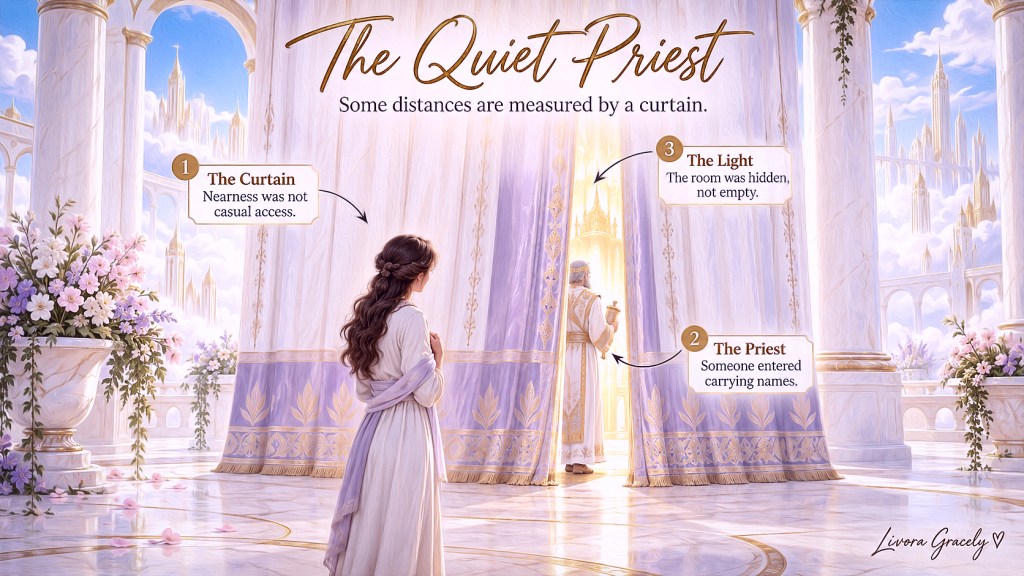
Some distances are measured by a curtain.
Imagine a worshipper standing near the entrance of the sanctuary while the morning work is already under way.
There is the smell of smoke in the air, wool brushing against wool, the dull shine of metal, and the careful movement of people who know which vessels belong where. Someone has brought an offering. Someone else is checking a garment. A priest has washed his hands and is preparing to enter the place assigned to him.
The room is busy enough to suggest that heaven must be very close.
Then the curtain moves.
Only slightly. A fold lifts, a strip of light appears, and the hand of the priest disappears behind it. The worshipper remains where he is, close enough to hear the work but not close enough to see everything it means.
The curtain has not been placed there to make God seem absent. It has been placed there because nearness is not the same as casual access.
The Holy Distance
Hebrews enters the world of priests, offerings, sacred vessels, washings, blood, and the tabernacle with great seriousness. It does not treat Israel’s worship as a collection of strange decorations left behind by a less enlightened age. The arrangements matter because they teach a difficult truth through physical space: God is near, and God is holy.
The two statements belong together.
The tabernacle was not a sign that God had abandoned His people to an empty wilderness. It was a sign of His presence among them. The cloud, the tent, the altar, the priestly garments, and the repeated acts of worship all gathered around the same astonishing fact: the God who made the heavens had chosen to dwell in the midst of a people.
But the presence of God was not treated as a public convenience. Nobody simply wandered into the innermost room because the day felt spiritually promising. The priest entered according to an order larger than personal confidence, carrying an offering and representing people who could not cross that distance by their own strength.
This is where modern readers can mishear the older arrangement. We may think the curtain only says, “Stay away.” Hebrews sees something more precise. The curtain says that the distance between God and humanity is real, but it also says that the distance can be approached through appointed means.
There is an altar because guilt is not imaginary. There is a priest because human beings do not merely need better information about God. There is a sanctuary because holiness is not an idea to be admired from across a room. It is a reality before which a person must learn how to stand.
The system is not failing because people cannot enter however they please. It is revealing why they need help to enter at all.
The worshipper outside may understand only part of this. He hears the steps. He feels the heat of the fire on his face. He watches the curtain settle back into place. The work has happened inside, but he has not performed it himself.
That is the quiet ache at the centre of priesthood. Someone must go where others cannot yet go, and that someone must not go merely as a private individual. He goes carrying names.
Another Priest
Hebrews then brings forward a figure who appears briefly in the older Scriptures and refuses to remain small: Melchizedek.
He meets Abraham after the battle, brings out bread and wine, blesses him, and receives a tenth. The scene is short. Melchizedek does not receive the kind of biography we might expect from someone who will later become important. There is no long family record placed beside his name, no explanation of where his priesthood began, and no closing sentence announcing how it ended.
He arrives, blesses, and disappears from the page.
Hebrews notices the silence.
The writer does not claim that Melchizedek was secretly wandering through history as an immortal priest. The argument is literary and theological: in the scriptural record, his priesthood is presented without the genealogy that normally defines the Levitical line. That makes him a fitting pattern for a different kind of priesthood, one not established by ancestry alone.
Psalm 110 had already spoken of a king who would be a priest forever according to the order of Melchizedek. Hebrews reads that promise in relation to Jesus.
The point is not that Jesus has found a more impressive title. It is that His priesthood does not depend on the same structure as the priests who serve under the law. He is not simply another descendant taking his turn in a sacred sequence. He belongs to a priesthood that the older pattern had suggested but could not fully contain.
This is one of the ways Hebrews reads Israel’s Scriptures. It does not throw away the earlier image when a larger image appears. It looks again and discovers that the old lines had been carrying more than they could say in one moment.
The altar, the garment, the blessing, the blood, and the curtain were not meaningless because they were temporary. A lamp can be useful even when dawn is approaching. A map can be true even when the traveller finally reaches the country it described.
Melchizedek becomes a quiet interruption in the family register. He reminds the reader that God’s purpose is not trapped inside the most obvious line of succession.
And then Hebrews turns toward Jesus, not as a priest who has wandered in from nowhere, but as the One whose priesthood answers a need the earlier arrangements had kept displaying.
Not Temporary
The priests of the former covenant served faithfully within a ministry that had one unavoidable weakness: each priest eventually had to stop.
He might be wise, careful, devout, and deeply aware of the people he represented. He might know the prayers by heart and perform every duty with reverence. Yet his body remained mortal. His service would be followed by another man’s service, and that man would one day be followed by someone else.
The work continued because the priests did not.
Hebrews places this beside Jesus and changes the shape of the argument. He does not hold the priesthood temporarily, as though He has been given a shift in the heavenly schedule. He continues forever. Because He lives, His priesthood does not pass to a successor.
The difference is more than administrative.
A temporary representative can help for a season. A living priest who continues forever can become the lasting ground of hope. The person who comes to God through Him does not need to wonder whether the one who represents him will be replaced tomorrow by someone who knows less, cares less, or has already begun preparing to leave.
Hebrews is not presenting Jesus as a religious employee with an unusually long contract. It is presenting Him as the Son who has passed through suffering, death, and exaltation, and who now remains before God on behalf of His people.
The letter says that He is able to save completely those who draw near to God through Him because He always lives to intercede for them.
Intercession is a quiet word. It does not sound like conquest. It does not arrive with a trumpet or require a crowd to admire it. It describes someone standing for others, carrying their need into a place where they cannot secure a hearing for themselves.
That is why the phrase “always lives” matters. The work of Christ is not a moment that has been preserved in memory while He has moved on to something more interesting. His life remains the life of the risen One who represents, welcomes, and helps.
The worshipper outside the curtain may have thought the priest’s disappearance meant that the important person had left the room. Hebrews suggests the opposite. The priest enters in order to keep the people from being forgotten.
The Quiet Work
The climax of this movement is not a louder ritual. It is a deeper one.
Hebrews does not say that Israel’s priests were foolish for serving at the altar, or that the tabernacle was an embarrassing mistake waiting to be corrected. It says that the priests and sacrifices belonged to a copy and shadow of heavenly realities. Their work was real within the covenant given to them, but it pointed beyond itself.
The shadow is not the enemy of the body. It tells us that a body is nearby.
In Jesus, the pattern reaches its centre. He is both the Son who stands above the heavenly servants and the Priest who comes near to the people He represents. He is not distant from weakness, because He has shared human flesh, endured testing, and suffered. He is not trapped by weakness, because He has passed through death and lives forever.
This is the strange quietness of His priesthood. The great work is not always visible from the outer room.
There may be no dramatic announcement when a frightened person begins to pray again. No audience hears the moment someone stops hiding a failure from God. A hand loosens its grip on the doorframe. A person who has stayed outside for years takes one step nearer, not because the holiness has become smaller, but because the Priest has become trustworthy.
The movement is modest. The distance is not.
Hebrews will soon speak more directly about the way into God’s presence, about a new and living way, about confidence to draw near, and about the blood of Christ cleansing the conscience. But before the way is described as open, the Priest must be known.
The room matters. The curtain matters. The altar matters. Yet none of them is the final centre of the hope. The centre is the One who enters on behalf of others and does not disappear from the work when the ceremony is over.
Imagine the sanctuary again near the end of the morning. The smoke has thinned. The vessels have been put away. The folds of the curtain hang quietly, concealing the room beyond them. Outside, the worshipper is still holding the edge of his garment, though he no longer knows why.
He has not crossed the curtain by his own courage.
But someone has gone in carrying his name.
And the Priest, unlike the curtain, is still there.


Leave a comment