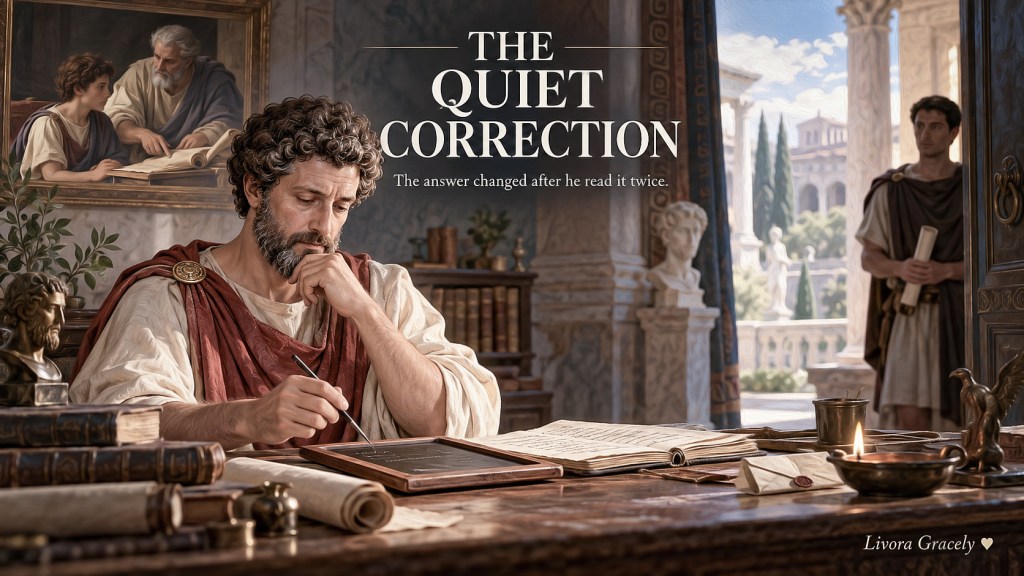
The emperor had a book with his own name nowhere on it.
No title.
No dedication.
No list of victories.
Only pages covered in a small, careful hand.
Marcus Aurelius kept it close while Rome kept asking for decisions.
A messenger waited outside the room.
A guard stood by the door.
Somewhere beyond the walls, someone was looking for the emperor.
Marcus turned another page.
Then he stopped.
A sentence had been written too quickly.
He drew a line through it.
The page became untidy.
He left it that way.
The Other Teachers
Marcus had not learned everything from one teacher.
His early lessons came from many rooms.
There was Alexander, who taught grammar.
There was Fronto, who taught rhetoric and trained him to care about words.
There was Apollonius, the Stoic philosopher.
There was Sextus.
There was Claudius Severus.
And there was Rusticus.
The names did not sit quietly in Marcus’s memory.
They returned whenever he was tempted to become impressed with himself.
Fronto could hear weakness in a sentence.
Rusticus could hear weakness in a character.
One corrected the word.
The other waited for the man behind it.
Marcus had once enjoyed beautiful phrases.
He could write them.
He could arrange them carefully, give them balance, make them sound as if they had been polished with oil.
Rusticus did not appear to be impressed.
A clever sentence could still hide a careless thought.
A fine speech could still come from a person who had not corrected himself.
So Marcus began keeping two things close.
A book.
And the discomfort of being shown where he was wrong.
A Waiting Messenger
A young emperor was not expected to look uncertain.
People came to him carrying petitions, reports, disputes, and requests.
They wanted decisions.
They wanted confidence.
They wanted the face of a man who already knew.
Marcus gave them the face they needed.
Then he returned to his room.
On one evening, he read a passage again.
The first reading had seemed sufficient.
He understood the general meaning.
That was usually where a busy man stopped.
A servant entered with fresh tablets.
Marcus raised a hand.
The servant waited.
Marcus read the passage again.
Then once more.
The oil lamp made the edges of the page tremble.
The words had not changed.
His understanding had.
He reached for a narrow piece of wood and placed it between the pages.
“Leave this here,” he said.
The servant looked at the open book.
“There is a meeting, Caesar.”
“I know.”
The servant waited for the emperor to close the book.
Marcus did not.
He picked up the tablet.
The meeting could begin without him for another moment.
The page could not.
That was the arrangement he had made with himself.
A crown could make other people listen.
It could not make a difficult passage become clear.
A title could bring a teacher into the room.
It could not do the reading.
The Hard Passage
Years passed.
Marcus became older.
The empire became heavier.
Letters arrived from distant places. Some carried news of war. Others carried arguments between men who believed their disagreement deserved the emperor’s entire attention.
There were days when he read late into the night.
There were other days when he read the same short passage and discovered that tiredness had been pretending to be understanding.
His book grew crowded.
Some lines were crossed out.
Some were rewritten.
Some were left unfinished.
He did not make the pages beautiful.
He made them useful.
When a person praised him, he turned to a sentence that made praise uncomfortable.
When anger rose, he remembered the kind of correction Rusticus had given him.
When a speaker talked too long, Marcus listened for the first thing that had not been examined.
When he was tempted to make a public display of discipline, he put the display away.
The lesson had become practical.
It appeared in small places.
A reply delayed.
A judgment softened.
A speech shortened.
A door opened again for someone who had offended him.
No statue recorded these moments.
No trumpet announced them.
The emperor simply returned to the page.
Before Deciding
Marcus did not write his book as a lesson for Rome.
He wrote as a man trying to remain teachable while surrounded by people who had learned to call him wise.
That was a dangerous room.
A ruler could become accustomed to agreement.
A powerful man could mistake silence for proof.
A celebrated man could begin to believe that correction belonged to other people.
Marcus kept writing.
Not because he had solved himself.
The pages would have been shorter if he had.
He wrote because the work kept returning.
The same temper.
The same impatience.
The same desire to be admired for being disciplined.
The same need to read carefully before deciding that he understood.
One morning, the book lay open beside a folded report.
The report concerned a dispute between officials.
The decision looked obvious.
Marcus read it once.
Then he reached for the book.
A sentence waited in the margin.
He had written it there weeks earlier.
The handwriting was his.
The warning was also his.
Do not answer the first version of yourself.
Marcus looked again at the report.
The room remained quiet.
The guards remained outside.
Rome continued waiting.
He took up the stylus.
The first answer was crossed out.
A second one followed.
This time, he left space beneath it.
For a correction.
For another fact.
For the possibility that the person making the decision still had something to learn.
The emperor closed the book only after the page had become difficult enough to trust.
And when the next message arrived, he opened it with the same hand that had just corrected him.
Marcus had teachers before he had an empire.
He kept them after the empire began listening.
The crown changed the number of people who waited for his answer.
It did not change the work required before giving one.
The book remained beside him.
The margins filled slowly.
And the emperor kept returning to them.
Not because he had nothing more to learn.
Because he knew exactly how much a person could lose by believing he was finished.


Leave a comment