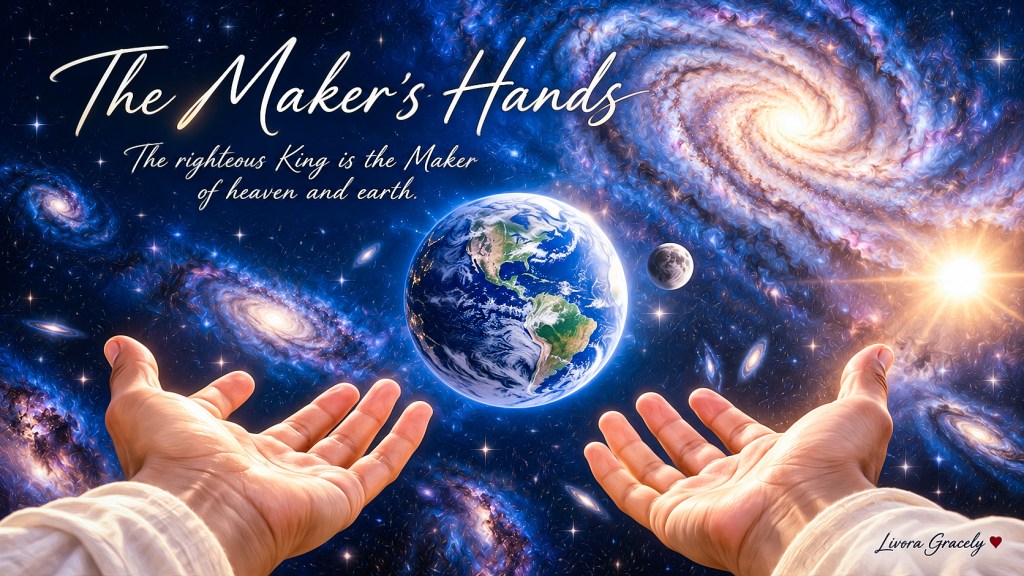
The righteous King is the Maker of heaven and earth.
Tears had mingled with the psalmist’s drink.
He lay awake, comparing himself to a lonely bird on a roof. His days seemed to fade like an evening shadow, and his strength was failing. Yet his prayer reached beyond his own shortened life. He called upon the Lord whose years continued through every generation.¹
Within that prayer came the words Hebrews now applies to the Son:
“In the beginning, Lord, you laid the foundations of the earth,
and the heavens are the work of your hands.”²
The previous verses have shown His enduring throne, His just scepter, and His love of righteousness. Now the letter carries that same King back to the beginning of the world. The One who reigns over it is its Maker.
Before All Things
The words in the beginning concern the beginning of creation.
Genesis opens with God creating the heavens and the earth. John returns to that beginning and tells us that the Word was already there, with God and Himself divine. Everything that came into being was made through Him.³ The world’s beginning finds the Son already present and active.
Hebrews has prepared us for this declaration. Its opening says that God made the universe through His Son. Now, continuing the words spoken about Him, it addresses Him as Lord and names the earth and heavens as His work.
The quotation comes from Psalm 102, where the afflicted writer appeals to the Lord as Creator. Hebrews brings that divine address into its account of the Son. His creative work belongs alongside the glory and being of God already revealed through Him.
This gives depth to Jesus’ own declaration that He existed before Abraham.⁴ His life among us reaches back beyond Israel’s history, beyond the first human life, to the beginning of the created world.
The Son who received baptism in the Jordan had entered a world He had already made.
Earth’s Foundations
The next words picture the work of a builder: He laid the earth’s foundations.
A foundation belongs to the beginning of a building, when its shape and support are established. Here that image gives weight to the Son’s work. The earth owes its existence to Him; the world beneath human feet is His creation.
God uses similar language when speaking to Job. He asks where Job was when the earth’s foundation was laid, then speaks of its measurements and cornerstone. The picture includes the morning stars singing and heavenly beings shouting for joy.⁵
Job hears about a work beyond his experience or ability. He lives within a world whose beginning he could neither witness nor direct. Hebrews identifies the Son with the Lord who performed that creative work.
The building language helps us understand His authority without explaining the planet’s physical construction. Its claim concerns the Maker and His achievement. Earth is something He brought into being.
That makes the earlier declaration of His kingship larger still. His throne has authority over the very creation that owes its beginning to Him.
Earth and Heaven
The verse lifts our attention from the earth’s foundations to the heavens above it.
Together, earth and heavens describe the breadth of the created world. The Son’s work reaches beyond the ground on which people build their houses and live their brief lives. The heavens also belong to what He has made.
Paul gives this breadth further expression. He writes that all things were created in the Son, including things in heaven and on earth, visible and invisible. All were created through Him and for Him, and He is before them all.⁶
This keeps the comparison with angels in view. However great the heavenly servants may be, they belong within the created order. The Son stands on the Creator’s side of the distinction. Their strength and splendour do not place them beside Him as another maker of the universe.
His reign therefore encompasses more than one people or one earthly kingdom. The King who loves righteousness possesses authority over the whole world that came into being through Him.
The psalmist’s prayer arose within that world, from a life that felt painfully small. His appeal was directed to its Lord.
His Own Work
The heavens are called the work of His hands.
The phrase makes the creation His own work, expressing His action and power through the familiar image of a maker’s hands. Another psalm describes the heavens being made through the Lord’s word: He spoke, and what He commanded came to be.⁷ Both passages place creation under His will.
John then tells us that the Word became flesh and lived among us. The One through whom the world was made entered human life. His real human hands belonged to that life among us; the earlier language of creation speaks of the divine work He had already accomplished.
Hebrews holds these truths together. The Son made the world, sustained it, provided purification for sins, and took His seat beside the Majesty. The saving work belongs to the same Person as the creative work. His righteous reign carries the authority of the Maker who came among His creatures.
That identity also belongs within the hope of a new heaven and a new earth. In John’s vision, the Lamb gives light to the city, and the throne of God and of the Lamb is there.⁸ The Son remains central to the life God promises beyond the old order.
The prayer that began with tears in a drink reached toward the Lord who laid the earth’s foundations. At the far end of Scripture, John saw another body of water, clear as crystal. The river of life flowed from the throne of God and of the Lamb, down the middle of the city’s great street.
Scripture References
- Psalm 102, especially verses 7, 9–12, and 23–25.
- Hebrews 1:1–10; quotation from verse 10, NIV.
- Genesis 1:1–3; John 1:1–3, 14.
- John 8:58.
- Job 38:4–7.
- Colossians 1:15–17.
- Psalm 33:6–9.
- Revelation 21:1, 22–23; Revelation 22:1–3.


Leave a Reply