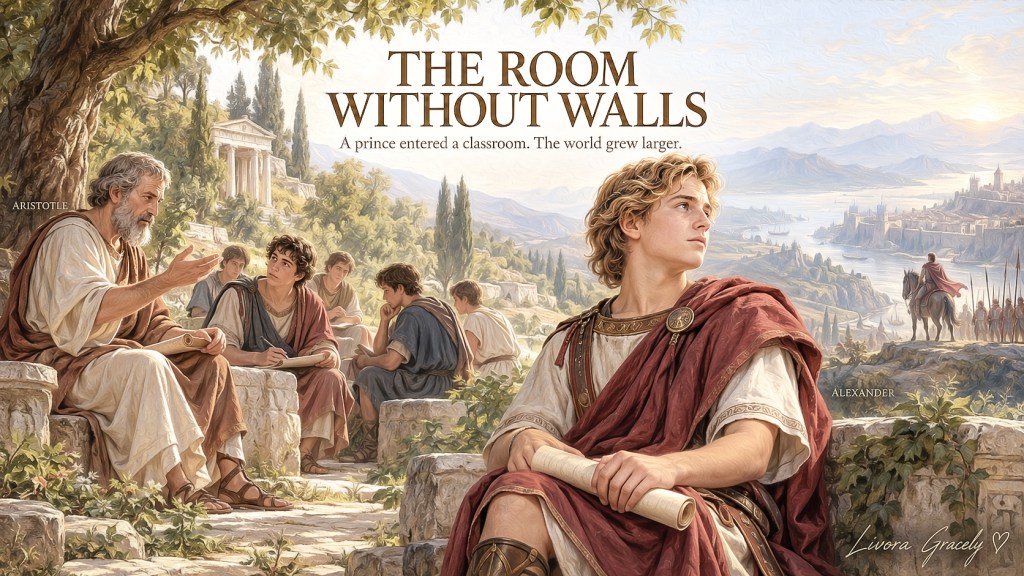
The boy already had a father, a kingdom waiting somewhere ahead, and several teachers.
Philip of Macedon sent for one more.
He did not bring Aristotle to the palace and ask him to continue Alexander’s lessons there. He sent the boy away from the palace instead, to Mieza, where the school stood near a temple of the Nymphs.
There were no painted walls.
No royal throne.
No large hall filled with people waiting to hear Alexander speak.
There were trees, shaded paths, and stone seats.
Alexander was thirteen.
Aristotle was already one of the most famous thinkers in the Greek world.
The arrangement was unusual. A prince had been given a philosopher, and the philosopher had been given a place where the prince could sit down.
The School at Mieza
The other pupils came from noble Macedonian families. They were not gathered merely to learn how to read or behave at court. Under Aristotle, they studied literature, ethics, politics, and the questions that made ordinary answers look rather less complete.
Alexander had already been trained for action.
He rode horses. He learned weapons. He hunted. He had been raised among soldiers and officials who understood that one day he would be expected to command.
Mieza gave him a different kind of work.
A sword could be lifted quickly.
A question usually took longer.
Aristotle did not need to remind Alexander that he was a prince. Everyone knew. The title had probably arrived before the boy did, just as files and reputations sometimes arrive before people.
The lesson was not to make Alexander smaller.
It was to give him something larger to stand inside.
A kingdom had borders.
Politics had consequences.
A poem could carry an entire people into another century.
A question about justice could last longer than a battle.
The stone seats remained under the trees while the subjects grew wider around them.
Sometimes the students walked.
Sometimes they sat.
Sometimes the teacher spoke and the future king listened.
The arrangement may have looked peaceful from a distance. It was still a classroom, and classrooms have their own small humiliations.
A pupil can be excellent at remembering a passage and still fail to understand it.
He can speak confidently about ruling others and discover that the word rule requires more explanation than expected.
He can know the name of a city, a hero, or a god and still have no answer when somebody asks what makes a city well governed, a hero admirable, or a god worthy of imitation.
Aristotle had many questions available.
He had spent years collecting them.
The Lessons
Alexander did not remain at Mieza forever.
By the time he was sixteen, his father appointed him regent while Philip was away. The student was already being called into the work of power.
The stone seats had not turned him into somebody else.
They had simply placed other things beside the sword.
Words.
History.
Judgment.
The habits of examining what appeared obvious.
Later, Alexander became king. Then he began crossing territories that had once existed for him only as names on maps.
He moved through cities, deserts, mountains, and courts. He met people whose languages, customs, gods, and political arrangements did not fit neatly into the lessons of a single childhood.
His world became larger in every direction.
It also became harder to understand.
A soldier can look at a city and ask how to enter it.
A ruler has to ask what happens after the gates open.
A conqueror can place a region under his authority.
That does not mean he has learned how the people inside it live.
There is always another country.
Another language.
Another custom that refuses to behave like the last one.
Another question waiting just beyond the edge of the map.
Alexander eventually ruled over an enormous world.
Aristotle had first taken him to a room without walls.
The Stone Seats
Years later, the palace, the armies, and the campaigns belonged to history.
Mieza remained a place of trees, paths, and stone.
Visitors were still shown the seats where Aristotle had taught.
The stones did not look powerful. They had held no army and issued no orders. They had simply remained in the shade while a boy listened to a man who knew more than he did.
Alexander had left the grove.
He had become a king.
He had crossed the limits of the map.
The seats stayed where they were.
A room without walls had held a prince long enough for him to discover that the world was larger than inheritance, larger than command, and larger than anything a single lifetime could finish learning.
The lesson had no final bell.
And the room was still there.


Leave a comment