Before the final reading
This twenty-first article closes our journey through Philemon. It returns to the whole letter, from the names at the door to the grace at the final line, and asks what kind of growth the letter quietly requires from everyone inside it.
Philemon is not merely the man expected to settle Paul’s request concerning Onesimus. Paul addresses Apphia, Archippus, and the church meeting in Philemon’s house. As host and fellow worker, Philemon’s response would carry unusual weight. If he refused Onesimus, the congregation gathered beneath his roof might find its own response arranged around that refusal. If he received Onesimus as a brother, his welcome could become the welcome of the room.
The letter never tells us which way the room moved.
That silence will remain. Hebrews will not supply the missing biography of Onesimus, and this series will not ask it to. But Hebrews will take us through the next doorway: toward believers who must resist hardened hearts, encourage one another, move toward maturity, endure, and keep growing into what they confess.
Philemon closes with one man holding a letter and one brother waiting for room. Hebrews will widen the question: what kind of people can keep making room because they have not stopped growing?
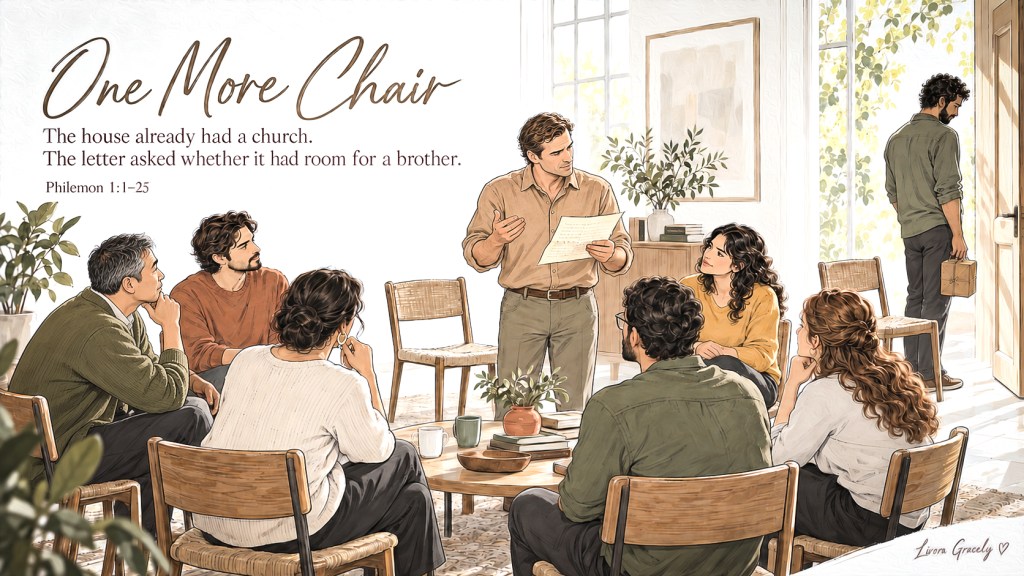
The house already had a church.
The letter asked whether it had room for a brother.
Philemon 1:1–25
Front Door
The letter arrived at a house that already knew how to open its door.
Paul addressed Philemon, Apphia, Archippus, and the church meeting in their home. There must have been places to sit, voices crossing the room, bread being passed, and enough welcome for a congregation to gather beneath one roof. Philemon was not being introduced to hospitality. It had already become part of his name.
Paul began with grace and peace.
He would end with grace too. Between those two words, however, someone had to enter the house.
Onesimus was returning with a history the letter does not fully narrate. Paul does not begin by listing it. He first addresses the room into which that history will arrive. The appeal is personal, but it is not private. Apphia, Archippus, and the church are named before Onesimus is.
The house has witnesses.
That makes Paul’s greeting more than courtesy. Peace is about to be asked to govern an actual relationship. Grace is about to require furniture.
The house already had chairs.
One of them was about to become complicated.
Comfortable Reputation
Paul thanks God for Philemon.
He has heard of Philemon’s love and faith. The hearts of the saints have been refreshed through him. This is not strategic flattery laid down before a difficult request. Paul names something true: Philemon has become a source of joy and encouragement to other believers.
The compliments are accurate.
This is going to make them less convenient.
A good reputation can become a comfortable chair. After enough people have praised it, a person may sit down inside the name and assume the learning portion of the evening is over. But Paul’s gratitude does not frame Philemon’s character and hang it safely on the wall. He brings that character to the next test.
The man known for refreshing hearts will soon be asked what happens when one particular heart arrives carrying an inconvenient past.
Paul writes elsewhere, “Do not be conceited.” He places the warning beside harmony, humility, and willingness to associate with people of low position. In Romans 12:16, these are not separate virtues. Harmony becomes impossible when one person’s social height is treated as proof of superior sight.
Philemon’s standing in the church does not make him the villain of the letter. It also does not make him the one person in the room who has nothing left to learn.
His reputation is real.
Paul simply refuses to let it become final.
Folded Authority
Paul could command.
He says so himself: he is bold enough in Christ to order Philemon to do what is required. The authority is present, properly identified, and then left unused.
It remains folded inside the letter.
Instead, Paul appeals on the basis of love. He calls himself an old man and a prisoner of Christ Jesus. The apostle does not disappear, but he chooses not to make his title the loudest person in the room.
This is Romans 12:16 before the verse is quoted. Paul does not regard his own wisdom, age, calling, or relationship with Philemon as permission to stand above everyone else. He lowers his voice without lowering the truth.
Then he introduces Onesimus.
Not as a case.
Not as property under discussion.
As “my child,” whose father Paul became while in chains.
The prisoner has somehow acquired family. Rome supplied the chains. It appears not to have checked Paul’s guest list.
Paul even calls Onesimus his own heart. Authority has now done something unusual: rather than protecting its distance, it has placed itself beside the person with the least power in the arrangement.
Paul knows what he believes Philemon should do. Yet he still leaves room for Philemon to do it willingly. A command might produce compliance. Paul is asking whether love can produce recognition.
The difference will matter when someone chooses where Onesimus may sit.
Useful Trouble
Paul allows himself one piece of wordplay.
Onesimus, whose name is associated with usefulness, had formerly been useless to Philemon. Now, Paul says, he has become useful both to Philemon and to Paul.
The sentence smiles briefly.
The situation does not.
Onesimus is being sent back. Paul would have liked to keep him nearby, but he will not quietly arrange Philemon’s response in Philemon’s absence. He returns the man, the question, and the freedom to answer.
Then Paul offers a possibility: perhaps the separation happened for a while so that Philemon might have Onesimus back forever—no longer merely as a slave, but more than a slave, as a beloved brother.
“Perhaps” matters. Paul does not claim secret knowledge of God’s purpose. He looks at a painful situation and notices that grace may be doing more with it than anyone first expected.
This is where Romans 12:2 enters the house. “Be transformed by the renewing of your mind.” Renewal does not merely give Onesimus a better description. It asks Philemon to see the same man within a new relationship.
The doorway has not changed.
The category has.
Paul describes inward renewal elsewhere as happening “day by day.” It is not a ceremony awarded to beginners while mature believers watch. Onesimus needs a renewed life. Philemon needs renewed sight. Paul’s own authority is renewed in the way he uses it.
No one graduates from this work.
A name may be true and still be incomplete. A person may be changed through an encounter he did not plan. A difficult situation may arrive looking like an interruption and quietly rearrange the room.
The furniture, so far, has offered no objection.
Charged Account
Paul now makes the request impossible to keep abstract.
“If you consider me a partner, welcome him as you would welcome me.”
If Onesimus has wronged Philemon or owes him anything, Paul says, the amount may be charged to Paul’s account. Then he takes the pen and writes the promise in his own hand.
The debt is not declared imaginary. Grace does not require poor bookkeeping. It asks who is willing to carry the cost so that a relationship need not remain imprisoned by it.
Paul places himself inside the account.
Then, with a small turn of the pen, he reminds Philemon that Philemon owes Paul his very self.
The arithmetic has become crowded.
There is a possible debt from Onesimus to Philemon, a larger debt from Philemon to Paul, and an offer from Paul to pay. Everyone appears in someone else’s column. The ledger was doing reasonably well until brotherhood arrived.
Paul writes elsewhere, “By the grace of God I am what I am.” That confession does not mean, “I need never change.” It means that identity begins in grace rather than self-invention. To the Colossians he adds another instruction: let Christ’s peace rule among the members of one body—and be thankful.
Gratitude keeps identity from becoming pride. Renewal keeps gratitude from becoming passivity.
Paul can be an apostle and still appeal. Philemon can be a respected host and still be corrected. Onesimus can acknowledge a troubled past without agreeing that the past is his permanent name.
Each may say, in a different way, “By grace, I am what I am.”
None may use it to say, “Therefore I shall remain exactly as I am.”
Paul is confident that Philemon will obey and do even more than requested. He does not describe the “more.” Perhaps some answers become smaller when written too early.
The account remains open.
So does the door.
Spare Room
Then Paul asks Philemon to prepare a guest room.
The request is wonderfully ordinary. After love, partnership, slavery, debt, reconciliation, and brotherhood, Paul would also appreciate somewhere to sleep.
Philemon is to prepare it because Paul hopes to be restored to them in answer to their prayers. The letter suddenly gives the future a bed, a doorway, and the possibility of an apostle arriving to see what happened after his appeal was read.
Paul may be a prisoner, but his travel plans have not received the news.
The guest room also places a quiet question beside Philemon. Preparing for Paul would be natural. Paul is honoured, beloved, and expected. Receiving Onesimus is harder precisely because the same welcome must cross a social boundary.
It is possible to prepare a beautiful room for an apostle while leaving no ordinary chair for a brother.
Paul then names Epaphras, Mark, Aristarchus, Demas, and Luke. The appeal that began among names closes among names. Some carry histories of restoration. Some will remain. One will later leave. None has become unnecessary to the sentence simply because his story is unfinished.
Finally, Paul writes, “The grace of the Lord Jesus Christ be with your spirit.”
That final blessing gathers the whole letter.
Do not assume you are wise enough to place another person permanently beneath you. Let the mind be renewed, because yesterday’s categories are often surprisingly punctual. Receive your life as grace, and let gratitude make room for peace within one body.
Philemon must remain teachable despite his good name. He must allow an unplanned person and an awkward situation to reshape what welcome means. Then he must choose an action that Paul cannot perform for him.
The strength for that choice does not come from reputation alone.
Grace has been present since the first line.
The letter ends there. We are not told whether Philemon rose from his chair, crossed the room, or called Onesimus brother. We are only shown what had been placed before him.
A church already met in the house.
Paul asked for a guest room.
The letter said nothing about moving the chairs.
One of them had become difficult to leave empty.


Leave a comment