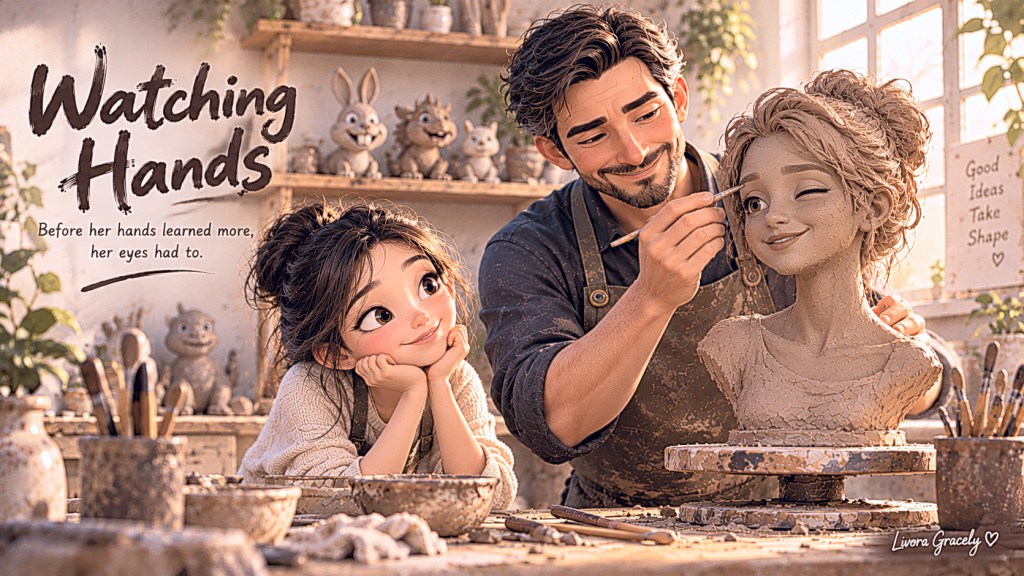
Before her hands learned more, her eyes had to.
Her father had been working on the same eye for eleven minutes.
She knew because she had counted.
Not intentionally at first.
But after the fourth minute, it became suspicious.
The girl rested her chin in both hands and watched.
The studio was unusually quiet. Afternoon light poured through the tall window, laying warm rectangles across the wall and the cluttered worktable. Somewhere near the sink, water dripped at patient intervals.
Tik.
Her father moved the wooden tool half a centimeter.
Tik.
He turned the clay bust.
Tik.
Another tiny scrape.
That was it.
She looked toward the shelf behind them.
Her own creatures were sitting there.
The rabbit with the two enormous teeth occupied the middle like someone who had accidentally become mayor. Beside it sat the first lumpy creature, still wearing the expression of something surprised to exist.
She loved them both.
But now she looked back at the bust.
This was different.
A face was emerging from the wet clay.
Not all at once.
The nose had appeared slowly beneath her father’s thumbs. The corners of the mouth had been lifted so slightly that she had not noticed the smile until it was already there.
And now the eye.
One remained open.
The other was beginning to wink.
She leaned closer.
Her father scraped beneath the eyelid.
Then stopped.
He did something she had not expected.
Nothing.
For several seconds, he simply looked.
The girl looked too.
She had always thought skill lived mostly in the fingers.
Quick fingers.
Steady fingers.
Fingers that somehow knew exactly where to press.
But her father’s hands spent a surprising amount of time doing absolutely nothing.
They waited.
His eyes moved across the face.
Forehead.
Cheek.
Mouth.
Back to the eye.
Only then did the tool touch the clay again.
A tiny movement.
Suddenly the wink worked.
The girl sat upright.
“How did you do that?”
Her father smiled.
“Do what?”
She pointed accusingly at the sculpture.
“That.”
He looked at the face as though it had done something without consulting him.
“The eye?”
“It wasn’t alive before.”
He laughed.
“It’s still clay.”
She knew that.
Obviously.
But she also knew what she had seen.
Ten minutes earlier there had been a lump with a nose.
Now somebody seemed to be looking back at her.
Winking, no less.
She returned her chin to her hands.
This time she stopped watching the sculpture.
She watched him.
His thumb did not press immediately.
His tool did not rush toward every uneven surface.
He turned the bust toward the window. Light slid across the damp cheek and caught in the shallow grooves around the mouth.
He waited.
Looked.
Touched.
Stopped.
Looked again.
And suddenly she understood something her own clay animals had been trying to teach her.
Her father did not make fewer corrections because he made fewer mistakes.
He made fewer unnecessary corrections because he could see more before touching anything.
That was different.
The realization was slightly inconvenient.
She had hoped becoming good meant acquiring better tools.
Perhaps a special knife.
A professional brush.
Possibly one of those expensive wooden things in his drawer that she was not supposed to borrow.
Instead, apparently, she would have to learn patience.
Terrible news.
She glanced toward her rabbit.
Its giant teeth offered no sympathy.
Her father continued working.
The smell of wet earth hung in the warm room. Fine curls of clay collected beneath the turntable. Outside the window, a branch moved through the sunlight, and its shadow slowly crossed the sculpture’s shoulder.
The girl said nothing more.
Neither did her father.
But something had shifted.
Until that afternoon, she had watched finished things and wondered how hands could make them.
Now she was beginning to watch the spaces between the movements.
The hesitation before a touch.
The inspection after it.
The decision to leave something alone.
There are skills we learn because someone explains them.
Others arrive quietly because we stay close enough to notice.
A child watches a parent repair something.
An apprentice watches a craftsperson choose not to cut.
A young writer notices where an older writer stops adding words.
A musician hears not only the notes, but the rests between them.
Mastery often looks impressive from across the room.
Up close, much of it looks like attention.
Her father finally put the tool down.
The clay face smiled.
One eye remained open.
The other winked mischievously at the girl.
She smiled back.
Behind her, two crooked little animals waited patiently on the shelf.
Tomorrow, perhaps, her hands would return to them differently.
But today they had learned something without touching clay at all.
They had watched.


Leave a comment