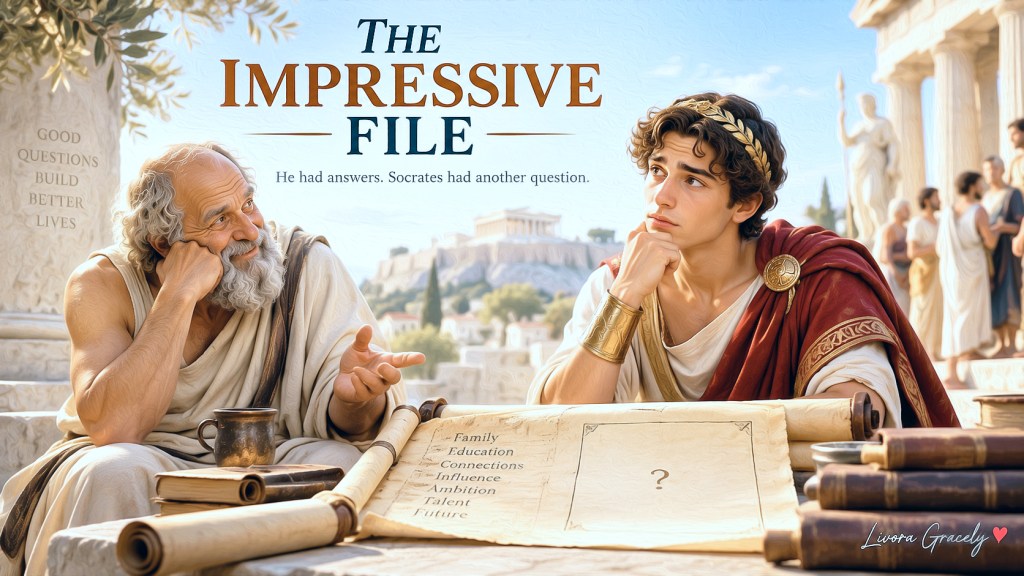
Alcibiades was almost at the steps.
Athens was waiting.
Men were gathering near the assembly. There would be arguments, speeches, important faces, and the usual number of people who had arrived already certain that everyone else was wrong.
Alcibiades was ready for them.
He was young, handsome, well connected, well educated, and ambitious enough to consider Athens a reasonable place to begin.
His family name opened doors.
Pericles had been his guardian.
People knew who he was before he introduced himself.
The file was impressive.
Alcibiades adjusted his robe and looked toward the steps.
Then somebody pulled his sleeve.
Socrates.
Of course it was Socrates.
One Question
“Going somewhere?”
Alcibiades looked toward the assembly.
It was difficult to misunderstand.
He was going to advise the Athenians.
Socrates seemed pleased to hear this.
About what?
Alcibiades answered.
The affairs of the city.
Excellent.
Socrates had another question.
What kind of affairs?
There were people who understood ships better than Alcibiades. Builders understood buildings. Physicians understood health. Trainers understood wrestling.
Athens presumably did not need Alcibiades to explain any of those.
No.
He would speak about larger matters.
War.
Peace.
What the city should do.
Now they were getting somewhere.
Alcibiades glanced at the steps again.
They were still there.
Unfortunately, so was Socrates.
When should Athens go to war?
When it was better to do so, Alcibiades replied.
Better.
Socrates liked that word.
Better in what way?
A short conversation had developed a second floor.
Alcibiades answered again.
Socrates followed.
Another answer.
Another question.
The assembly had not moved.
Alcibiades had.
Just not toward it.
The Sleeve
This was an unusual problem for Alcibiades.
Most obstacles in his life were visible.
A rival could be defeated.
A crowd could be persuaded.
A position could be won.
A question was harder.
Especially a small one.
Socrates was not telling Alcibiades that he was foolish.
That would have been easier to dismiss.
He was asking where Alcibiades had learned the things he was preparing to teach Athens.
From a teacher?
No.
Then perhaps he had discovered them himself.
That sounded possible.
Socrates wanted to know when.
Alcibiades paused.
This was becoming inconvenient.
He had known about justice for as long as he could remember. Even as a boy, he could complain when another boy cheated during a game.
Surely that counted for something.
Apparently it counted for another question.
Where had he learned it?
From people around him, Alcibiades suggested.
Socrates considered this.
People could teach a child Greek because they generally agreed about the words they were using.
Justice was more troublesome.
Athenians argued about it constantly.
Alcibiades was preparing to advise some of those same people.
The steps waited patiently.
Almost There
Nothing about Alcibiades had changed.
He was still handsome.
Still connected.
Still gifted.
Pericles had still been his guardian.
His ambitions had certainly not packed their bags and gone home.
If anything, they were probably getting impatient.
But the conversation had found something his reputation had missed.
There were things Alcibiades knew.
There were things he did not know.
And somewhere between them was a much more interesting category:
things he had never thought to question.
Socrates seemed unusually interested in that category.
Alcibiades looked toward the assembly again.
Perhaps he had expected his first difficulty in public life to come from somebody inside it.
An opponent.
An older statesman.
A hostile crowd.
Instead, he had not even reached the steps.
An elderly man had stopped him with questions.
There was something almost rude about the efficiency of it.
Socrates had not taken away Alcibiades’ education.
He had not changed his family.
He had not reduced his intelligence.
He had not asked Athens to stop noticing him.
He had merely pulled his sleeve.
And for a moment, the impressive young man had stopped moving.
Still Waiting
The ancient conversation does not leave Alcibiades humiliated and abandoned.
He stays.
That may be the most interesting part.
He could have pulled his sleeve away.
He could have laughed.
He could have reminded Socrates exactly who his family was.
He could simply have climbed the steps.
Instead, the young man who wanted Athens to listen found himself listening.
The conversation moved beyond politics.
Socrates turned the questions toward Alcibiades himself.
A person might know his possessions without knowing himself.
He might know what he could do without knowing what should be done.
He might even become very skilled at gaining influence before deciding what influence was for.
The assembly suddenly seemed like the second appointment of the day.
The first was smaller.
Two men.
A few questions.
One sleeve.
Years later, Plato would place Alcibiades in another room, at a drinking party, speaking about Socrates again.
By then he was no inexperienced young man waiting to enter public life.
His life had become considerably more complicated.
Yet Socrates still occupied an uncomfortable place in his memory.
Alcibiades admitted that this was the man who could make him feel ashamed of how he was living.
That is quite an achievement.
Athens had many ways to embarrass a politician.
Socrates managed it while sitting down.
The Steps
Eventually, Alcibiades would enter public life.
Very thoroughly.
He became a prominent general and political figure. His career would pass through influence, military command, scandal, exile, changing allegiances, return, and more trouble than could reasonably fit into one afternoon.
The young man at the steps had not been wrong about one thing.
Athens would know his name.
But for a few minutes before all of that, Socrates had his sleeve.
The family remained.
The education remained.
The connections remained.
The talent remained.
The ambition certainly remained.
The impressive file did not lose a single page.
It simply acquired a question mark.
Athens was still waiting.
The steps were still there.
Alcibiades had not become less impressive.
He simply knew one more thing before climbing them.
Socrates released his sleeve.
Somewhere else, another adviser had become so respected that nobody pulled his anymore.


Leave a comment