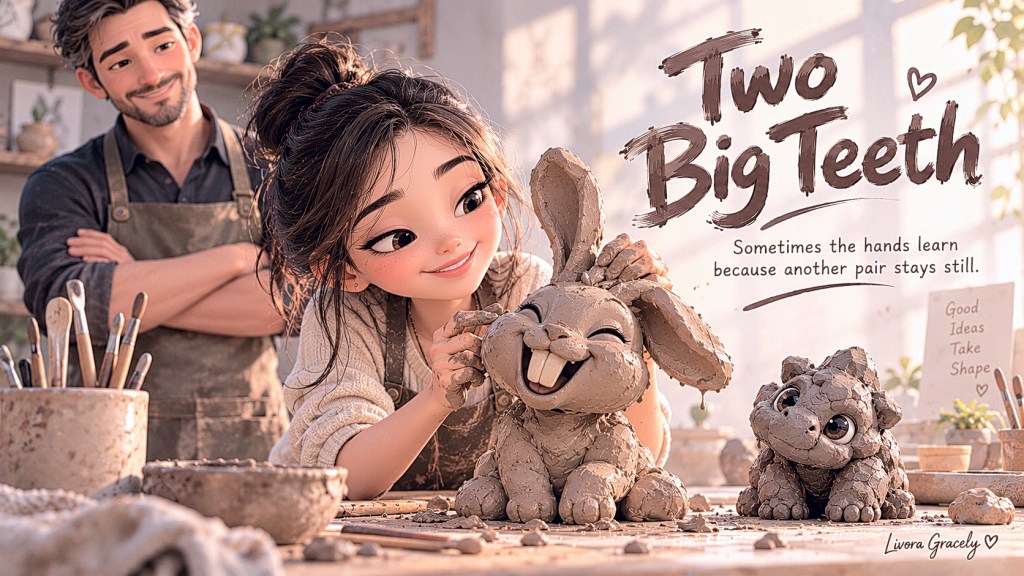
Sometimes the hands learn because another pair stays still.
The rabbit had two enormous front teeth.
Not slightly enormous.
Architecturally enormous.
The girl leaned closer.
The rabbit appeared delighted with them.
She was not.
A thin strand of hair slipped across her cheek as she pressed one thumb into the wet clay. The studio smelled faintly of damp earth. Wooden tools clicked against the table whenever her elbow nudged them, and afternoon sunlight had begun drawing long window-shaped shadows across the wall.
Beside the rabbit sat her previous creature.
Small. Lumpy. Still slightly ridiculous.
It watched with enormous dark eyes, looking rather pleased to have survived its own creation.
Her father stood behind her.
He had been there for several minutes.
He said nothing.
The girl pinched the rabbit’s left cheek.
Too narrow.
She added clay.
Too fat.
She scraped some away.
Now the cheek looked reasonable, but the ear beside it had begun leaning sideways.
She stared at it.
Her father stared at it.
The rabbit continued laughing.
She glanced over her shoulder.
Her father smiled.
That was all.
This was becoming annoying.
Surely he could see the problem.
He had watched her struggle with the first creature. He knew how clay behaved when it was too wet, how an ear needed support, how one careless thumb could turn a smile into something requiring an apology.
Yet he remained quiet.
So she turned back.
The rabbit’s crooked ear waited.
She touched its base.
Then she stopped.
Instead of pushing it upright, she studied where the weight was falling. She removed a little clay from one side, supported the other, and smoothed the join with a wet fingertip.
The ear stayed.
Something changed in her face.
Not triumph.
Recognition.
She had seen the problem herself.
The next twenty minutes became quieter.
Press.
Turn.
Look.
Scrape.
Look again.
The soft shhk-shhk of metal against clay replaced the earlier impatient tapping. Wet brown crumbs gathered beneath her fingers. Occasionally the rabbit rotated on its little board, presenting another imperfection for inspection.
Its eyes became rounder.
Its cheeks became fuller.
Its smile became absurdly wide.
But the teeth remained.
She considered reducing them.
One finger hovered over the first tooth.
Then she laughed.
“No.”
Her father raised an eyebrow.
She wiped clay from her fingers.
“The teeth stay.”
Now he laughed too.
The rabbit, having apparently won the argument without saying anything, grinned between them.
Her first creature had taught her that imperfect things could still be loved.
This one was teaching something different.
At first, she had been trying to make the clay obey the picture in her head. Every difference looked like failure. Every crooked line needed correction.
But somewhere between the leaning ear and those ridiculous teeth, she had begun doing what makers eventually learn to do.
She stopped asking only:
How do I make this right?
And started asking:
What is this becoming?
That small change matters far beyond a studio.
A child learning to draw.
Someone writing a first story.
A cook tasting a sauce.
A gardener discovering that a branch has grown in an unexpected direction.
At the beginning, improvement often looks like better control.
Later, it becomes better attention.
The hands grow more skilled because the eyes grow more patient.
And sometimes the person standing nearby understands this before the learner does.
Her father could have corrected the ear.
He could have shown her where to press.
He could probably have saved twenty minutes.
Instead, he gave her those twenty minutes.
By evening, the rabbit was still imperfect.
One ear remained slightly higher.
Its cheeks were uneven.
And those two magnificent teeth could probably open a tin can.
The girl placed it beside her first creature.
She stepped back.
Two strange little faces looked up from the table.
One had been shaped by uncertain hands.
The other by hands beginning to trust their own eyes.
Her father finally spoke.
“Finished?”
She studied the rabbit once more.
Then smiled.
“No. Better.”
And this time, he didn’t correct her.


Leave a comment