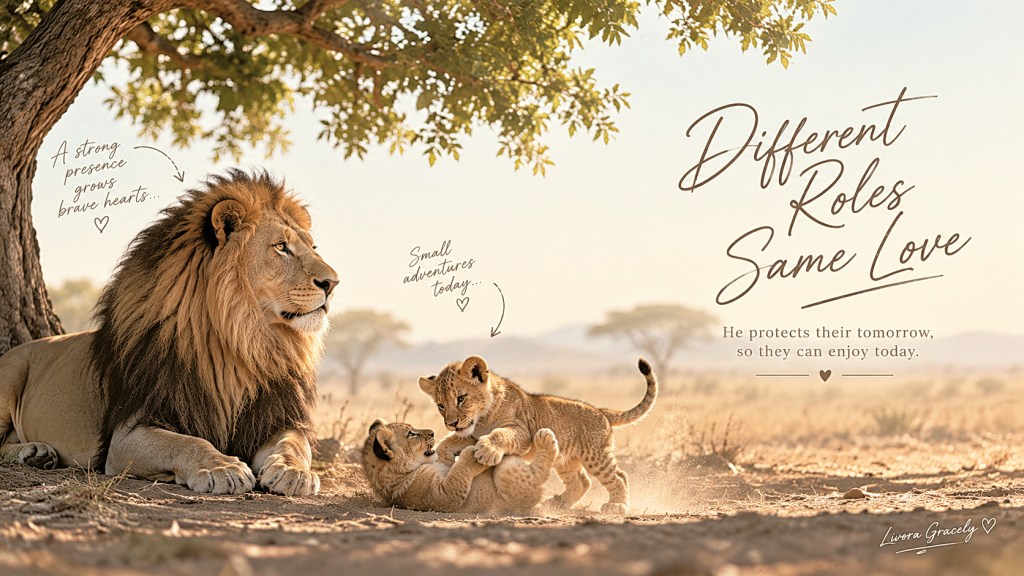
The father was watching the horizon.
His children were attacking each other.
Neither situation appeared particularly urgent.
Under the shade of the tree, the old lion sat almost motionless, his mane moving slightly whenever the dry wind crossed the plain.
A few steps away, his two cubs had discovered an important problem:
There was only one patch of dust.
Apparently both needed to occupy it at exactly the same time.
One jumped.
The other rolled.
Four paws appeared briefly in the air.
Dust rose around them.
Their father did not even turn his head.
Very Serious Business
To the cubs, this was not play.
This was training for something enormously important.
One crouched behind a clump of dry grass and launched an ambush that could probably have surprised a sleepy beetle.
The other responded with a paw to the face.
Then both rolled over again.
No prey had been caught.
No territory had been gained.
Excellent afternoon.
What looks like foolishness in young animals often carries serious work underneath it.
Bodies are learning balance.
Eyes are learning distance.
Muscles are discovering speed.
Young minds are learning when to push, when to retreat, and when the creature underneath you has had enough.
Growing up sometimes looks suspiciously like playing.
The Lion Looking Away
Their father seemed uninterested.
But uninterested and unnecessary are not the same thing.
His attention belonged to another part of the world.
Beyond the tree was open country.
Movement.
Scent.
Possibility.
While the cubs concentrated on each other, someone else could afford to look farther.
There is a kind of care that sits beside us.
There is another kind that watches what we cannot yet see.
Children rarely notice the difference.
They remember playing freely.
They may never remember why freedom was possible.
Dust Is Allowed
One cub landed on its back.
The other stood over it for approximately two glorious seconds before losing balance and joining it on the ground.
Another cloud of dust.
Their beautiful coats were becoming progressively less beautiful.
Their father remained magnificent.
This seemed deeply unfair.
But childhood has never been famous for remaining clean.
It experiments.
Trips.
Misjudges distances.
Runs too quickly.
Learns something.
For a young lion, dust is not evidence that the afternoon went badly.
Quite the opposite.
Sometimes dust means life is being practiced.
Different Roles
The three lions shared the same shade but not the same responsibility.
The cubs could play because they were cubs.
The father could watch because he was not.
One life was learning the world.
Another had learned enough of it to keep watch.
Neither role needed to imitate the other.
There would come a day when the cubs stopped tumbling beneath this tree.
Their paws would become enormous.
Their games would become skills.
Their world would stretch far beyond the patch of dust where they once wrestled.
Perhaps that is one of the quieter shapes love takes.
It does not always enter the game.
Sometimes it sits nearby, facing outward.
Someone gets to play because someone else is watching the horizon.


Leave a comment